
Back to Blogs
Drew Neisser is the founder of CMO Huddles and a globally recognized authority on B2B marketing. He’s an AdAge columnist, LinkedIn TopVoice, leading CMO coach, podcast host & friend of penguins everywhere.
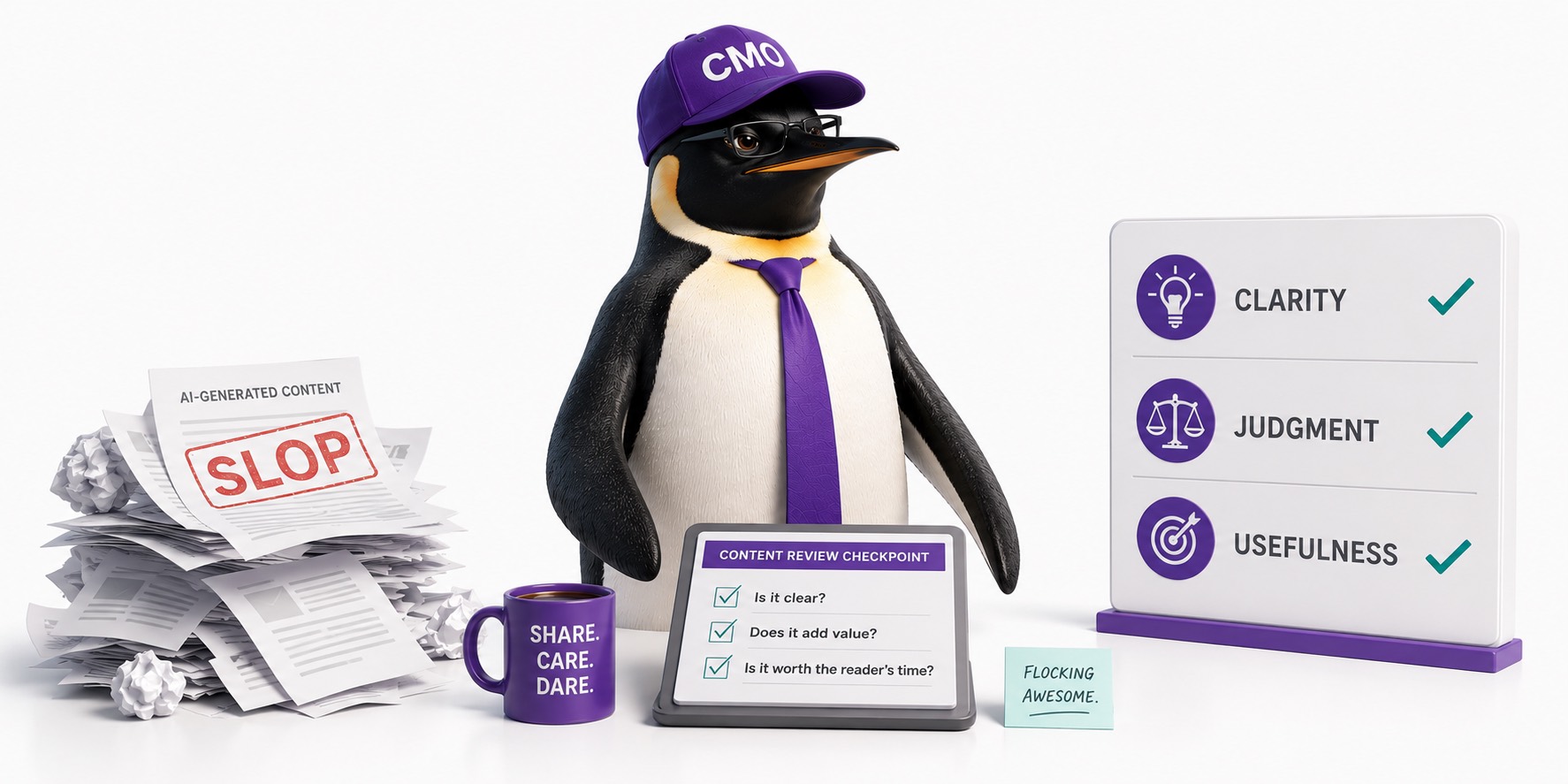
AI-assisted content is not automatically bad content. The better CMO question is whether the content shows judgment, clarity, specificity, usefulness, and accountability. In a GEO world, marketers should stop treating AI involvement as a scarlet letter and start asking whether the finished piece is worth reading, citing, and defending.
Can we stop pretending AI-assisted content is automatically slop?
That was the thought after hearing a familiar concern at a GEO conference: AI-generated content may not be future-proof. The concern is not ridiculous. There is plenty of AI-generated sludge drifting around the internet right now, and much of it reads like it was assembled by a committee of buzzwords wearing a trench coat.
But the conclusion is too blunt. Not all AI-assisted content is bad. Not all human-created content is good. The tool is not the villain. The lazy thinker is.
The more useful question is not whether AI was involved. It is whether judgment was involved. Was there a clear point of view? Was the argument edited? Were claims checked? Was the content built around a real buyer question or merely poured into a template and shipped before anyone could stop it?
This matters even more as CMOs think about generative engine optimization. If the goal is to show up in AI-generated answers, where is the evidence that high-quality AI-assisted content performs worse than human-only content?
This is not a defense of low-quality auto-generated sludge published at scale. That content should be shown the nearest exit. The point is different: thoughtful, edited, original content created with AI assistance and human accountability should be judged by the finished work.
AI search and answer engines appear to reward clarity, structure, specificity, freshness, authority, and usefulness. That is not an authorship test. It is a quality test.
AI can help turn messy conference notes into a structured outline. It can surface themes, group related ideas, summarize transcripts, identify contradictions, and suggest questions a reader might ask next. It can turn one strong idea into multiple useful formats without losing the thread.
But AI cannot replace discernment.
It cannot decide what you believe. It cannot know which argument is worth making unless you give it direction. It cannot take responsibility for the nuance, context, or promise being made to the reader.
That is still the job of the human. More specifically, it is the job of the marketer, editor, strategist, and CMO who knows what good looks like.
The CMO's job is not to ban AI-assisted content. The CMO's job is to raise the standard for judgment.
Before publishing, ask:
-Is this useful to a specific audience?
-Does it answer a real question?
-Can we defend the claim?
-Is there an original point of view?
-Has a smart human edited it?
The real divide is not human content versus AI content. It is thoughtful content versus thoughtless content.
So yes, call out slop. Reject lazy automation. Stop pretending volume is strategy. But also stop pretending AI-assisted is a scarlet letter.
If your name is on it, you own it. If your brand publishes it, your brand owns it. And if you cannot proudly defend the thinking behind it, the problem is not the tool.
It is you.
There is no clear evidence that high-quality AI-assisted content is penalized simply because AI helped create it. Quality, usefulness, structure, and authority matter more.
Ban lazy, unexamined content. Do not ban responsible AI assistance that improves structure, clarity, and speed while preserving human accountability.
Publishing content no one can defend. That risk exists whether the draft came from AI, a junior writer, or an overconfident executive with a blank page.
Use it to organize, critique, summarize, and pressure-test. Keep humans responsible for judgment, claims, voice, and final approval.
CMO Huddles helps B2B marketing leaders win by bringing together peers, fresh perspectives, and opportunities to build stronger personal brands. Want to join the huddle? Learn more about CMO Huddles and apply to join the community.