
Back to Blogs
Eric Eden is a B2B marketing leader specializing in AI and SaaS. He’s a CMO, advisor, and growth strategist who has built nine-figure pipelines and helped drive eight successful VC- and PE-backed exits.
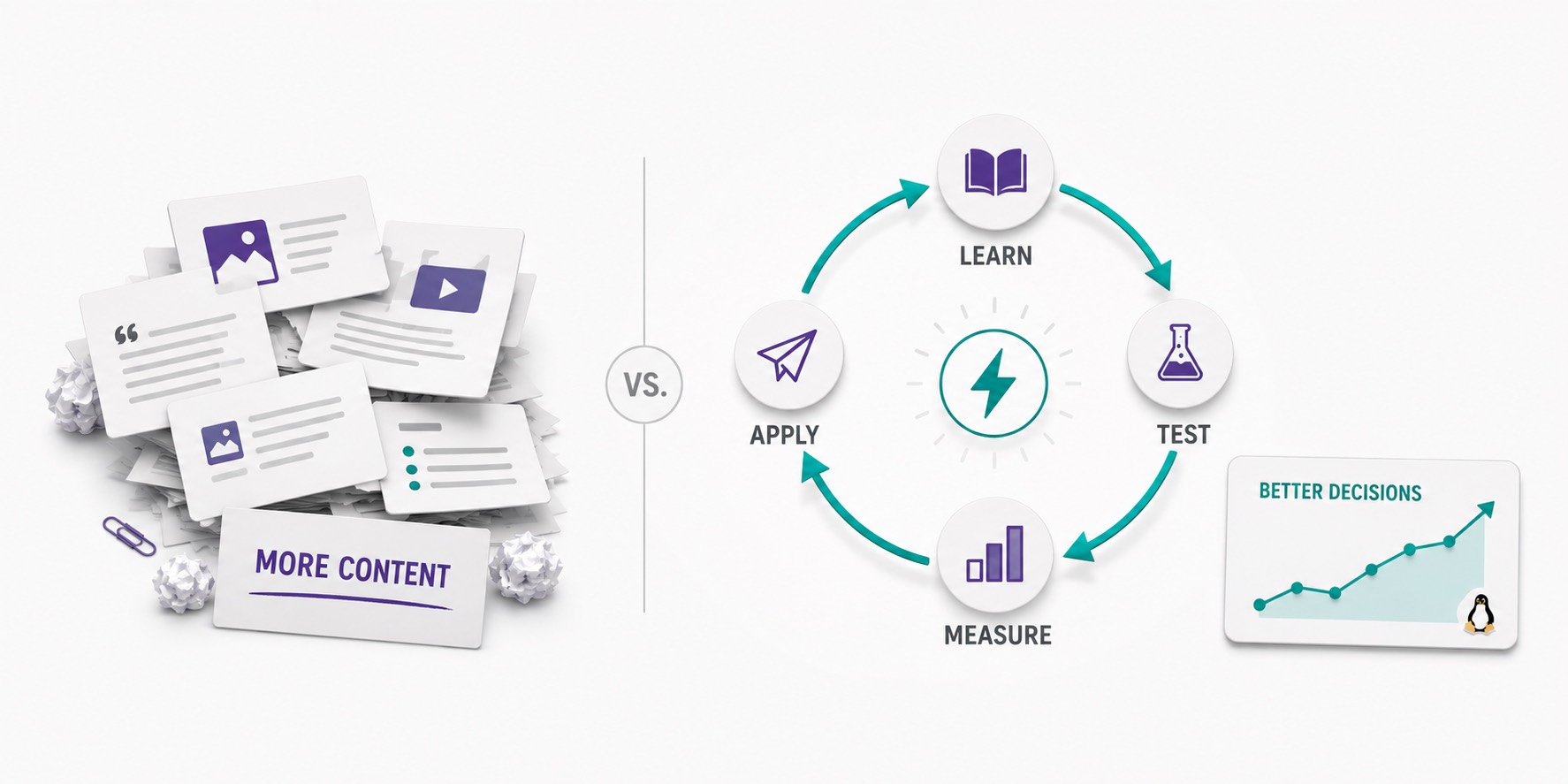
AI has made content cheaper, faster, and easier to produce, but that does not mean marketing has become easier to lead. For B2B CMOs, the real opportunity is shifting from activity volume to learning velocity: using AI to improve decisions, tighten feedback loops, and turn sharper insight into measurable growth.
B2B marketing teams are no longer asking whether AI can help them produce more. That question has been answered, loudly, repeatedly, and often with a suspicious number of LinkedIn carousels.
The better question is whether all that extra production is improving business outcomes.
When AI lowers the cost of creating content, campaigns, variants, summaries, and assets, volume stops being a meaningful advantage. If everyone can create more, then "more" becomes table stakes. Worse, more can become camouflage. A team can look busy, ship constantly, and still fail to learn anything useful about buyers, markets, or revenue.
That is the AI productivity trap for CMOs. The organization celebrates output while the board waits for growth.
One useful way to frame this shift is moving from traditional funnel thinking to a loop: outlearn, outmarket, outgrow. Whether or not a CMO adopts that exact language, the underlying point is worth taking seriously.
In a market shaped by AI, the advantage is not simply faster execution. It is faster learning.
Learning velocity means the speed at which a marketing organization can absorb signals, interpret what they mean, and adjust action accordingly. That includes customer conversations, campaign performance, sales feedback, product usage, win-loss patterns, search behavior, and competitive movement.
AI can help, but only if it is attached to the right operating model. Adding AI to broken workflows often produces the same old confusion at a higher speed. This is how teams end up with ten times more content and the same pipeline problem.
The classic funnel still has value as a reporting model. It helps teams describe movement from awareness to consideration to pipeline to revenue.
But as an operating model, the funnel can be too static. It implies a neat sequence. Modern B2B buying rarely behaves so politely.
The Loop idea shifts attention from a one-way progression to a continuous cycle: learn from the market, act on that learning, measure what changed, and feed the insight back into the next move. In the source material, this is described as outlearn, outmarket, and outgrow. The language is punchy, but the management implication is practical: growth increasingly depends on how quickly the marketing organization can turn signals into smarter action.
For CMOs, the Loop is less a slogan than a stress test. If insight from sales calls takes weeks to influence messaging, the loop is slow. If campaign data is reviewed but not used, the loop is ornamental. If AI creates more assets without improving decisions, the loop is leaking.
A feedback-loop mindset asks different questions:
This is where AI can become useful beyond content generation. It can summarize patterns, compare messages, mine transcripts, cluster objections, and help teams see weak signals faster. But the CMO still has to decide what matters. Human judgment remains the steering wheel; AI is not ready for the driver's seat, no matter how confidently it adjusts the mirrors.
The practical implication is not "use more AI." Most teams are already doing that.
The useful mandate is more specific: connect AI usage to better decisions and measurable outcomes.
Start with outcome obsession. If the team cannot name the business outcome an AI-enabled workflow is meant to improve, pause before adding another tool, prompt, or pilot. The goal might be improving conversion, accelerating sales follow-up, increasing customer expansion, reducing manual reporting, or identifying high-intent accounts faster. The point is to define success before the machine starts humming.
Next, audit the feedback loops. Where does learning get trapped? Sales calls may contain useful objections that never reach content strategy. Customer success may spot expansion patterns that never inform demand generation. Campaign data may sit in dashboards without changing the next move. AI can help synthesize these inputs, but only if the organization has agreed to act on what it learns.
Then, distinguish content volume from market impact. A larger asset library is not a strategy. More blog posts, emails, webinars, and social snippets do not automatically create more trust. CMOs should ask whether AI-assisted content is improving relevance, speed, personalization, conversion, or customer understanding. If not, it may just be making the noise machine cheaper to operate.
Finally, organize for response time. In fast-moving categories, three weeks of approval can turn a useful insight into a historical artifact. That does not mean eliminating governance. It means creating clear lanes where teams can test, learn, and adjust without waiting for every decision to climb the organizational staircase in formalwear.
AI has changed the economics of marketing production. It has not changed the CMO's obligation to create clarity, focus, trust, and growth.
The next advantage will not come from producing the most content. It will come from learning faster than competitors, translating that learning into sharper market action, and measuring whether the action actually moves the business.
Treat this as a working model, not a stone tablet. AI capabilities, buyer behavior, and platform rules are changing quickly. But for now, the direction is clear enough: CMOs should spend less time asking, "How much more can we make?" and more time asking, "How much faster can we learn?"
Equating activity with progress. More AI-generated content is only valuable if it improves buyer relevance, speed, conversion, or insight.
Track how quickly market signals become decisions. Useful indicators include time from insight to campaign change, sales-feedback adoption, message-testing cycles, and speed of reporting-to-action.
No. The funnel is still useful for reporting. The issue is using it as the only operating model when buying behavior is messier and feedback needs to move faster.
Pick one high-value workflow, such as sales-call insight mining or campaign performance analysis, and connect AI directly to a measurable business outcome.
Not necessarily. Start by fixing decision flow and feedback loops. Org structure should follow the work, not the software.
CMO Huddles helps B2B marketing leaders win by bringing together peers, fresh perspectives, and opportunities to build stronger personal brands. Want to join the huddle? Learn more about CMO Huddles and apply to join the community.