
Back to Blogs
Drew Neisser is the founder of CMO Huddles and a globally recognized authority on B2B marketing. He’s an AdAge columnist, LinkedIn TopVoice, leading CMO coach, podcast host & friend of penguins everywhere.
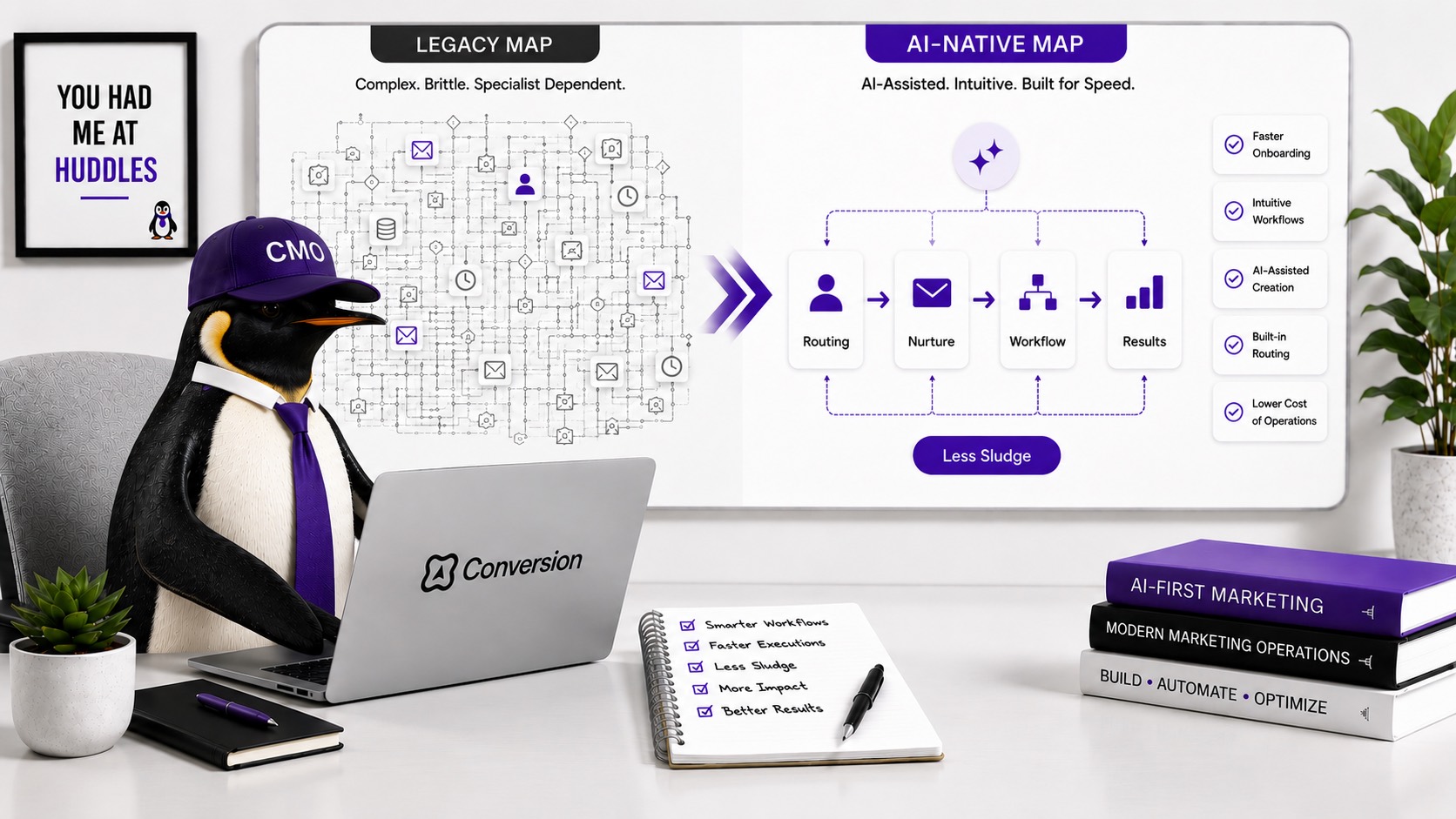
Most CMOs are pushing their teams to become AI-powered, but legacy marketing automation platforms may be slowing them down. AI-native platforms like Conversion.ai point to a different future: Faster onboarding, simpler workflows, less specialist dependency, and marketing operations that help teams solve problems instead of tiptoeing around brittle systems.
Most CMOs are racing to become AI-powered. They are testing copilots, building agents, rethinking content engines, and asking their teams to move faster with fewer resources.
But here is the uncomfortable question: What if your marketing automation platform is the thing holding you back?
For years, marketing automation has been treated like mission-critical infrastructure. Marketo. Pardot. Marketing Cloud. Eloqua. Pick your flavor. They all promised scale, segmentation, nurture, and measurement.
They also created a quiet tax on marketing teams: Certified specialists, long training cycles, painful migrations, brittle workflows, support tickets, routing workarounds, and a whole lot of “do not touch that unless the expert is available.”
That model may have worked in the pre-AI era. It will not work much longer.
CMO Huddles is excited to welcome Conversion.ai as a Founding Sponsor of the CMO Super Huddle.
Conversion.ai is building an AI-first marketing automation platform for the next era of B2B marketing. Not a legacy system with AI bolted on. Not a slightly shinier version of yesterday’s MAP. A new platform built for the way marketing teams need to work now: Faster, more intuitively, and with far less dependence on expensive platform specialists.
Because sponsorship fit matters, we did what we always do before getting excited: We asked a serious operator.
I recently spoke with Tammy Chan, a 12-year marketing operations veteran and President of the Boston Chapter of MOps, the community-led platform helping shape the standard for marketing operations.
Tammy knows the MAP landscape cold. She has lived through Marketo, Pardot, Marketing Cloud, SharpSpring, and the usual parade of “rip-and-replace” projects. She has trained Marketo teams multiple times. She knows what it costs, in both dollars and morale, when a marketing team needs a certified expert just to keep the machine running.
Her take on Conversion.ai was refreshingly blunt: The usual pain of onboarding a new marketing automation platform was largely missing.
The platform was intuitive enough that a junior team member could become a power user in about a month. No months-long certification process. No “only one person knows how this works” problem. No need to budget for a $140K-a-year expert user just to unlock basic campaign execution.
That matters because the future of marketing operations is not about making every marketer more technical. It is about making powerful systems easier for smart marketers to use.
We are already seeing this broader shift in AI-layered tools like Clay, where workflows that once required deep technical knowledge are becoming far more intuitive. Conversion.ai appears to be bringing that same AI-native rethink to marketing automation.
Let’s be clear: No software is perfect. Tammy did not suggest Conversion.ai is magically finished or frictionless in every way. Caveats matter, especially when shiny platforms start making everyone’s demo brain light up.
What she did highlight was something many CMOs should care about deeply: Enterprise-grade support mentality at startup speed.
When there were hiccups, Conversion.ai worked through them quickly. Their team showed up more like a partner than a vendor. They embedded closely, responded fast, and helped solve problems before they became internal headaches.
That combination matters: Intuitive product plus white-glove support.
For CMOs, the implications are bigger than “we can send emails faster.” The real opportunity is structural:
Tammy even described building lead routing workflows inside Conversion.ai, including round-robin assignment to SDRs. That is the kind of practical, unglamorous capability that can quietly remove a lot of operational sludge.
And sludge is the enemy of AI-powered marketing.
Here is the question every CMO should ask their marketing ops leader:
If we were designing our marketing automation stack today, would we choose the same platform we are using now?
If the honest answer is no, then it is time to investigate what AI-native alternatives can do.
This does not mean every company should rip-and-replace tomorrow. It does mean CMOs should stop assuming legacy MAPs are permanent fixtures. AI is changing the economics of expertise. It is changing what junior team members can do. It is changing how much workflow complexity should be tolerated.
And it is raising the bar for what “modern marketing automation” should mean.
The CMO Super Huddle is designed to help senior B2B marketing leaders join the top 5% of AI-empowered CMOs. Moving to AI-native platforms is just one of the many AI-forward conversations we will be having in Palo Alto.
That is why Conversion.ai belongs in the room.
Not because every CMO needs another platform pitch. They do not.
Because CMOs need to understand where AI-native infrastructure is already changing what marketing teams can do, who can do it, and how quickly they can learn.
And if Tammy Chan’s experience is any indication, Conversion.ai is a company worth investigating.
If you are a senior B2B marketing leader ready to explore this and other AI-forward shifts with your peers, apply to join us at the CMO Super Huddle.
AI-native marketing automation refers to platforms designed around AI-assisted workflows, intuitive campaign creation, and faster operational execution from the start, rather than legacy systems with AI features added later.
Legacy platforms can create hidden costs through specialist dependency, long onboarding, brittle workflows, and slow campaign execution. CMOs should evaluate whether their MAP helps or hinders an AI-powered operating model.
No. A rip-and-replace decision should depend on business requirements, integrations, team readiness, data quality, and migration risk. The first step is an honest assessment, not a panic migration.
They should evaluate ease of use, workflow flexibility, routing capabilities, onboarding speed, support quality, data model fit, integration requirements, governance, and whether junior team members can execute safely without constant specialist intervention.
AI adoption depends on speed, experimentation, and operational confidence. If the MAP is hard to use or dependent on one expert, the team cannot move quickly enough to turn AI ideas into measurable campaigns and workflows.
CMO Huddles helps B2B marketing leaders win by bringing together peers, fresh perspectives, and opportunities to build stronger personal brands. Want to join the huddle? Learn more about CMO Huddles and apply to join the community.