
Back to Blogs
Drew Neisser is the founder of CMO Huddles and a globally recognized authority on B2B marketing. He’s an AdAge columnist, LinkedIn TopVoice, leading CMO coach, podcast host & friend of penguins everywhere.
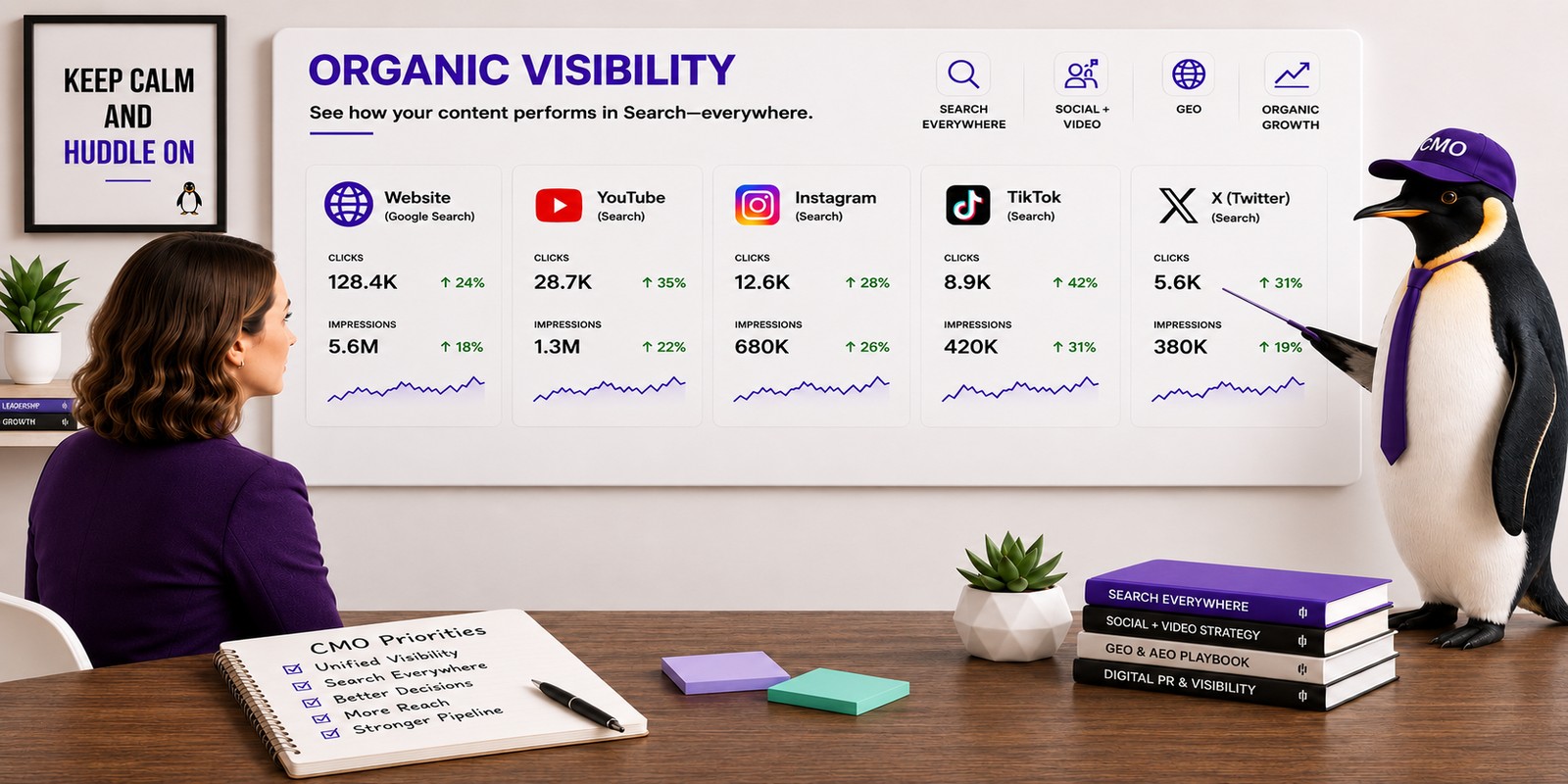
Google’s new Search Console platform properties let brands connect Instagram, TikTok, X and YouTube accounts to see how social and video content performs in Search. For B2B CMOs, this is more than a reporting update. It signals a larger shift toward cross-platform organic visibility, search everywhere optimization, and new org-design questions.
I recently spoke with Anirudh “Ani” Singla, CEO of Pepper, about Google’s July 7, 2026 Search Console announcement and what it could mean for B2B CMOs. Ani’s take was sharp: This is not just a tool update. It may be another signal that organic visibility is becoming a cross-platform discipline.
That does not mean we should overstate what Google has announced. Google has not said this new data influences rankings, AI Overviews, or AI Mode. For now, the official announcement frames platform properties as a reporting and measurement feature. Caveat penguin deployed.
On July 7, 2026, Google introduced platform properties, a new Search Console property type that lets brands connect certain social and video accounts directly to Search Console.
According to Google’s official announcement, the initial supported platforms are:
Once available, platform properties can show how content from these accounts performs in Google Search, including search terms, clicks, impressions, top-performing content, traffic trends, discovery patterns, and milestones.
The rollout is gradual, so not every account will see the feature immediately.
This matters because Search Console has historically been anchored to websites. Platform properties expand the visibility lens to content that lives on platforms a brand does not own in the traditional backend sense.
NOTE: We can't wait for Google to add LinkedIn to their supported platforms list.
B2B buyers do not discover brands in tidy channel silos. They may find a company through a YouTube tutorial, a TikTok explainer, an executive’s social post, a podcast clip, a Reddit thread, a webinar recap, a partner page, an analyst mention, or a traditional webpage.
Marketing dashboards, however, often remain stubbornly siloed. SEO looks at website performance. Social looks at engagement. PR looks at mentions. Demand gen looks at conversion. GEO and AEO are still trying to find a desk and a decent chair.
Google’s platform properties update nudges CMOs toward a more integrated view: Organic visibility is not just what ranks on your website. It is how your brand, people, videos, posts, and ideas show up when buyers search.
That is especially important as AI search changes buyer behavior. If buyers are asking more conversational questions, and Google can surface more platform-native content in response, then CMOs need to understand which content formats are answering which buyer questions.
Ani framed the shift as part of a move from SEO to Search Everywhere Optimization.
That phrase is useful because it captures what many CMOs are already feeling. Search is no longer confined to blue links on a results page. Buyers search on Google, YouTube, TikTok, Reddit, LinkedIn, Perplexity, ChatGPT, Gemini, Claude, and inside industry communities.
The practical implication is not “abandon SEO.” The implication is that SEO becomes one part of a broader organic visibility system.
For B2B CMOs, that system should answer questions like:
The opportunity is not just better reporting. It is better content strategy.
Ani’s more provocative idea is that this kind of measurement shift could eventually change marketing org design.
If organic social, SEO, GEO/AEO, video, and digital PR are all contributing to discoverability, should they continue to sit in separate functions with separate metrics? Or should CMOs consider a more unified organic growth owner?
That does not mean every company needs to reorganize tomorrow morning. Please do not forward this paragraph to HR with “Codex said so.”
But the question is worth taking seriously.
CMO Huddles has formed the FOMO Taskforce — Future of Marketing Org Design — to examine how marketing teams should evolve as AI changes work, workflows, skills, and ownership models. The taskforce will present findings at the CMO Super Huddle.
Ani’s vision is one important direction for that discussion: Consolidate responsibility for organic visibility across web, social, video, GEO/AEO, and PR so the team can manage one connected system rather than five disconnected surfaces.
Whether the title is Organic Growth Lead, Head of Search Everywhere, Director of Organic Visibility, or something less likely to make the CFO blink, the strategic idea is clear: Buyers do not experience your visibility by department. They experience it by answer quality, relevance, and trust.
As platform properties become available, connect official Instagram, TikTok, X, and YouTube accounts to Search Console. Assign a clear owner so this does not become another “we should probably do that” item floating in the marketing fog.
Look for posts or videos earning impressions and clicks from important buyer questions. If a YouTube video answers a query your website does not, that is not trivia. That is a content gap with a flashing neon sign.
Do not let platform-property data become a separate report no one reads. Bring it into existing SEO, AEO, GEO, content, and demand discussions. The goal is an integrated view of organic discovery, not one more dashboard tab quietly gathering dust.
Ask who owns visibility across the full discovery journey. If SEO owns webpages, social owns engagement, PR owns mentions, and no one owns the connective tissue, the org may be under-designed for the AI search era.
Google’s platform properties update is not proof that social posts now influence rankings, AI Overviews, or AI Mode. Google has not said that.
But it is a meaningful signal. Search Console is expanding from website measurement toward broader visibility measurement. For B2B CMOs, that is a prompt to rethink how organic discovery is planned, measured, and owned.
The website still matters. SEO still matters. But the buyer’s path to your brand increasingly runs through social posts, videos, AI-generated answers, third-party mentions, and platform-native content.
The companies that adapt fastest will not simply publish more everywhere. They will understand which surfaces answer which buyer questions, which content earns visibility, and how to organize teams around the way buyers actually discover information now.
In other words: Organic visibility is becoming a system. CMOs should start managing it like one.
If this shift from SEO to broader organic visibility is on your radar, join CMO Huddles, Pepper, and GTM Society for The CMO Table: An Executive Salon for Marketing Leaders on July 29, 2026, from 4-8pm in San Mateo. We’ll be discussing how CMOs should adapt as search, social, GEO, and org design continue to converge. Request your spot here.
Pepper is a Founding Sponsor of the CMO Super Huddle. Pepper, CMO Huddles, and GTM Society are also co-hosting The CMO Table: An Executive Salon for Marketing Leaders.
Platform properties are a new Search Console property type that lets brands connect certain social and video accounts, including Instagram, TikTok, X, and YouTube, to see how that content performs in Google Search.
Not based on Google’s announcement. Google has positioned platform properties as a reporting and measurement feature. Any claim that this directly affects rankings, AI Overviews, or AI Mode should be treated as speculation.
Because B2B buyers discover brands across more than websites. Social and video content can answer buyer questions, introduce expertise, and influence consideration before a buyer ever reaches the company site.
Search everywhere optimization is the idea that brands need to optimize visibility across all the places buyers search, including Google, YouTube, social platforms, AI answer engines, communities, and third-party sources.
Inventory official social and video accounts, connect eligible platform properties when available, identify which posts and videos earn search visibility, and fold those insights into SEO, GEO, and content planning.