
Back to Blogs
Drew Neisser is the founder of CMO Huddles and a globally recognized authority on B2B marketing. He’s an AdAge columnist, LinkedIn TopVoice, leading CMO coach, podcast host & friend of penguins everywhere.
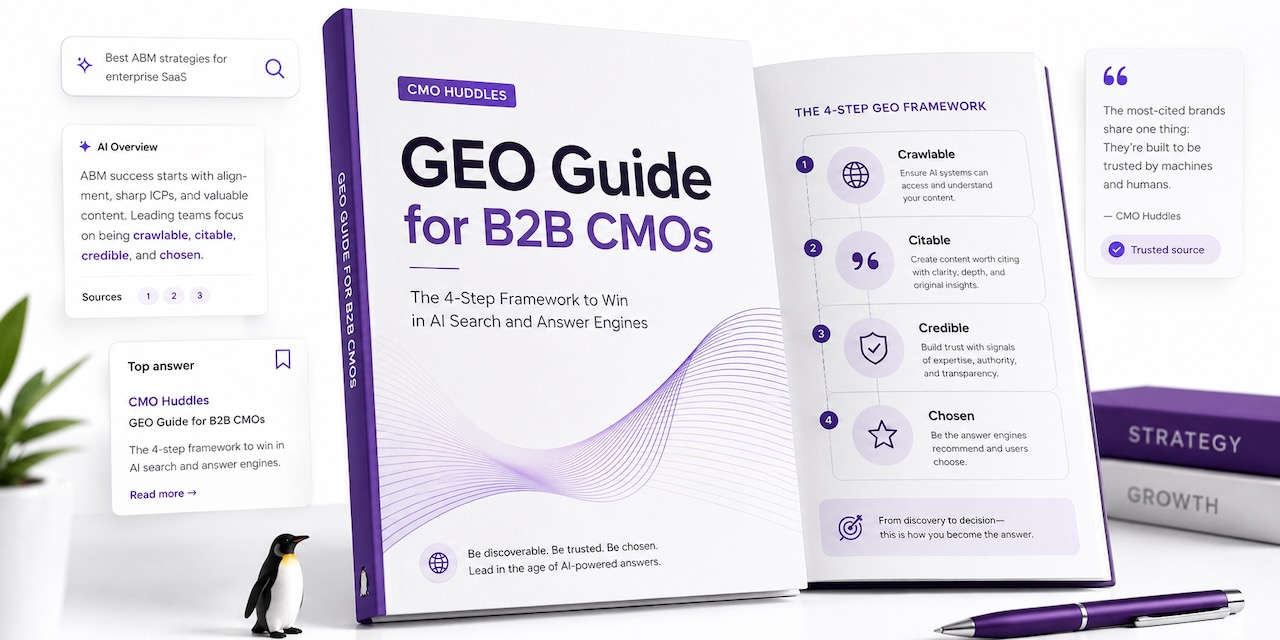
GEO is becoming a practical CMO discipline, not another acronym to admire from a safe distance. This guide explains how B2B brands can become crawlable, citable, credible, and chosen in AI-generated answers, while avoiding overpromises in a fast-changing search landscape where today's best practices may look quaint by next quarter because marketing apparently needed another weather system.
Generative AI has changed how B2B buyers discover, research, compare, and shortlist vendors.
That is the whole ballgame. Or at least a newly weird inning of it.
Buyers are still visiting websites. They are still talking to peers. They are still reading analyst reports, review sites, LinkedIn posts, Reddit threads, industry content, and customer stories. But increasingly, they are doing this through an AI intermediary. They ask ChatGPT, Claude, Gemini, Perplexity, or Google's AI Overviews to explain the market, compare vendors, identify risks, summarize options, and recommend next steps.
In many cases, the shortlist is being shaped before a buyer ever clicks a link.
That shift has created a new marketing discipline with an unfortunate surplus of names. Some call it AEO, or Answer Engine Optimization. Some call it AI Search. Some call it LLM Discovery. Some call it LLMO. Some call it AXO, or AI Experience Optimization. This guide uses GEO: Generative Engine Optimization.
Why GEO? Because B2B CMOs do not need another acronym debate. They need a practical operating guide.
For the purposes of this post, GEO is the discipline of making your brand findable, understandable, credible, citable, and selectable inside AI-generated answers. Whether your team calls that AEO, AI Search, LLM Discovery, or "the thing making organic traffic weird," the job is the same.
Get found. Get cited. Get trusted. Get chosen. And then make sure the buyer has somewhere useful to go.
One important caveat before anyone turns this into a laminated desk card: GEO is changing quickly. AI platforms, citation behavior, crawler policies, buyer habits, and measurement tools are all in motion. Treat this as a current working model, not a permanent law of marketing physics.
One of the cleanest ways to explain GEO to a CMO? GEO is product marketing for machines.
That does not mean writing for machines instead of people. It means recognizing that AI systems now sit between buyers and brands, and those systems need to understand your company before they can recommend it.
Machines do not appreciate your color palette. They do not infer your strategic nuance from a beautiful homepage. They do not feel the emotional lift of your 90-second brand video if there is no transcript. They work with facts, entities, relationships, structure, citations, repetition, recency, and consensus.
Your job is not to make your website less human. Your job is to make your expertise more machine-readable.
Traditional SEO helped buyers find your pages. GEO helps machines understand why your brand belongs in the answer.
Let's put one tired debate to rest: SEO is not dead.
It is just no longer enough.
Buyers do not live in one discovery channel. They bounce between Google, AI assistants, LinkedIn, Reddit, YouTube, review sites, analyst reports, communities, podcasts, events, and peer recommendations. AI search does not replace all of those behaviors. It connects, compresses, and reshapes them.
SEO still matters because AI systems often rely on traditional search infrastructure, crawlable content, metadata, and authoritative pages. But GEO expands the work. It asks whether your company is retrievable, quotable, trusted, current, and consistently described across the sources machines use to synthesize answers.
This is why GEO cannot live as a side project inside SEO. It touches content, product marketing, PR, analyst relations, community, social, web, demand gen, RevOps, customer marketing, brand, and reputation.
In other words, GEO is not a side quest. It is a new operating layer for B2B marketing.
This guide is built on CMO Huddles Strategy Labs, GEO conference notes, and expert input from practitioners who are seeing this shift from different angles. Credit matters here because GEO is still forming in public, and some of the best ideas are coming from people doing the work before the playbook is settled.
Taken together, these experts point to the same conclusion: GEO is not a single tactic. It is a cross-functional operating model for becoming easier for AI systems to understand, easier for buyers to trust, and easier for the market to choose.
A useful way to think about GEO maturity is through four stages:
Most B2B companies are not failing at only one stage. They are leaking value across all four.
They may have strong thought leadership trapped in PDFs. Product pages may look beautiful but load too slowly. Case studies may be buried behind forms. The website may say one thing while review sites, partners, analysts, and social profiles say something fuzzier. Or the company may show up in an AI answer but send buyers to a vague page that does not help them take the next step.
The maturity model matters because it prevents the most common GEO mistake: treating "showing up" as the finish line.
Showing up is only the beginning. The real goal is to become the source AI systems trust and buyers choose.
Before building a grand GEO strategy, make sure the machines can read the room.
Literally.
Many B2B websites were built for two audiences: humans and Google. Now there is a third audience: AI agents. These agents do not admire your hero animation. They do not patiently wait for JavaScript-heavy pages to load. They do not fill out forms. They do not download gated PDFs and say, "What a wonderful lead capture experience."
They move on.
The crawlable stage is about making your content technically accessible and structurally understandable. Start with your top 25 to 50 pages: homepage, product pages, solution pages, comparison pages, high-performing SEO pages, thought leadership, glossary pages, and the pages that map to the topics you want to own.
For each priority page, check the basics:
The CMO question is simple: Can AI systems access and understand the content that matters most to our category?
Once your content can be crawled, the next question is whether it can be cited.
This is where many B2B teams discover an uncomfortable truth: their content is written for themselves, not their buyers.
Marketing teams develop internal language. They name frameworks. They polish positioning until everyone inside the company nods along. Meanwhile, buyers ask messy, specific, practical questions:
If your website doesn't answer those questions directly, AI systems will find someone else who does.
In traditional SEO, teams optimized around keywords. In GEO, the core unit is the question. LLM prompts are longer, more specific, more conversational, and more contextual than traditional search queries.
Do not try to boil the ocean. Pick three topics your company wants to be known for. Not ten. Not twenty. Three.
For each topic, generate buyer questions across five stages: Unaware, aware, comparing, evaluating, and deciding. Then compare those questions to your current content. The gaps are your GEO roadmap.
For each priority question, build or refresh content with a clear structure:
This is where content teams need to stop producing random acts of thought leadership and start building answer architecture. Machines like structure. Buyers like usefulness. Miraculously, those two preferences can coexist.
Here is where the work gets bigger.
Your website is the home base. It should be the cleanest, clearest, most authoritative source on your company. But AI systems do not rely on your website alone. They look for corroboration.
What do analysts say? What do customers say? What do review sites say? What do media sources say? What do partners say? What do executives say on LinkedIn? What does the broader web appear to believe?
If your website says one thing, LinkedIn says another, press coverage says a third, review profiles are outdated, and Reddit thinks your category is confusing, AI systems will still synthesize a picture.
The question is whether that synthesized picture helps you.
Strong GEO requires consistency across owned, earned, shared, and community sources. Not robotic sameness. Consistency. The same category language. The same problem framing. The same use cases. The same proof points. The same differentiation. The same customer outcomes.
This makes PR a growth marketing function. Digital PR, analyst mentions, podcasts, industry publications, awards, webinars, guest articles, directories, review platforms, and credible third-party citations all reinforce authority signals that AI systems use to decide what to trust.
Different AI systems may weigh sources differently. Some may lean more heavily on Reddit, LinkedIn, review sites, directories, official documentation, editorial coverage, or community discussion. The right source strategy depends on your audience, category, and prompt set.
The practical move: Identify where your buyers are likely to ask questions, then study which sources those systems cite for the prompts that matter to your category.
A modern backlink is not just a link. It is a trusted source saying the right thing about you in language a machine can understand.
Getting cited is good. Getting chosen is better.
If an AI assistant cites your company but sends the buyer to a vague product page, a gated PDF, a generic resource center, or a demo form with no context, you may have won the citation and lost the buyer. That is a very B2B way to lose.
The AI-assisted buyer may arrive after several research sessions. They may already understand the category. They may have compared you to competitors. They may have explored objections, implementation risks, pricing considerations, and alternatives. They may be closer to a decision than your lead scoring model realizes.
Call this an AQL: AI Qualified Lead.
An AQL does not need to be shoved into an early-stage nurture stream. They need the next useful step. That might be a comparison guide, pricing explainer, ROI calculator, readiness assessment, technical evaluation checklist, relevant customer story, migration guide, use-case demo path, buyer committee guide, or "how to make the business case" page.
For each priority GEO page, ask:
The job is not to control the buyer. It is to help the buyer own the decision.
GEO is partly an addition problem. Add schema. Add FAQs. Add answer blocks. Add glossary pages. Add third-party authority.
But GEO is also a subtraction problem. Some long-standing B2B marketing habits now actively work against discoverability.
GEO can become sprawling quickly. The trick is to start small enough to move and important enough to matter.
Choose three GEO clusters your company wants to own. Assign an internal GEO lead. Select a measurement baseline. Identify your top 25 to 50 priority pages. Audit speed, schema, robots.txt, llms.txt, PDFs, transcripts, and entity clarity. Establish baseline visibility in the AI systems your buyers are most likely to use.
By day 30, you should know where machines can access your content, where they struggle, and which topics deserve priority.
Turn buyer questions into a content roadmap. Refresh priority pages with direct answer blocks, stronger H2s, FAQs, examples, internal links, and proof. Convert high-value PDFs into HTML. Build or update glossary pages. Create question clusters, not just keyword clusters.
By day 60, your priority topics should have clearer, more extractable, more useful answers.
Update external profiles, review sites, partner listings, analyst descriptions, podcast bios, executive LinkedIn language, and PR messaging for consistency. Build next-step paths for high-intent visitors. Add comparison guides, assessments, calculators, customer stories, and use-case demo paths where they naturally fit.
By day 90, GEO should no longer be an experiment hiding in SEO. It should be a cross-functional operating rhythm.
GEO cannot live in one function. The CMO's job is to make sure every function knows its role.
If only one team owns GEO, nobody really owns GEO.
GEO measurement is still evolving. Do not expect the clean dashboards Google trained marketers to expect. LLMs do not provide the same impression, click, and keyword data.
That does not mean GEO is unmeasurable. It means the signals are different.
This measurement will not be perfect. That is fine. CMOs have survived worse dashboards. The goal is to build enough signal to guide action, not to wait for perfect attribution to descend from the clouds holding a spreadsheet.
The first wave of GEO work may look technical: schema, FAQs, page speed, llms.txt, robots.txt, direct answer blocks, and entity checks.
Do those things, but don't stop there.
The real work is bigger. GEO forces marketing teams to answer hard questions: Are we clear about what we want to be known for? Do we answer the questions buyers actually ask? Is our best content accessible? Are third-party sources reinforcing our story? Does our website help buyers make decisions? Are we measuring visibility, accuracy, sentiment, and conversion?
That is why GEO belongs on the CMO agenda.
Not because it is trendy. Not because organic traffic is getting weird. Not because another vendor invented another acronym.
Because AI is becoming part of the buying committee before your sales team ever gets invited into the conversation.
The brands that win will not be the ones that publish the most content. They will be the ones that become easiest to understand, easiest to trust, and easiest to choose.
Crawlable. Citable. Credible. Chosen.
Start there.
Pick three topics your company wants to own, then audit whether your priority pages are crawlable, clear, current, and useful enough to answer real buyer questions.
No. SEO remains foundational, but GEO also depends on product marketing, PR, reviews, community signals, conversion paths, customer proof, and consistent authority across the broader web.
No. But your best educational content, proof, and category explanations should not be trapped entirely behind forms. Keep high-value assets available as crawlable HTML when discoverability matters.
Use directional signals: AI answer visibility, citation quality, message accuracy, sentiment, AI referral traffic, conversion behavior, and opportunity influence. The measurement will be imperfect, but useful enough to guide decisions.
Review priority pages at least quarterly, and faster when products, positioning, competitors, platform behavior, or buyer questions change. GEO rewards freshness, consistency, and clarity; stale content has a way of aging loudly.
CMO Huddles helps B2B marketing leaders win by bringing together peers, fresh perspectives, and opportunities to build stronger personal brands. Want to join the huddle? Learn more about CMO Huddles and apply to join the community.