
Back to Blogs
Drew Neisser is the founder of CMO Huddles and a globally recognized authority on B2B marketing. He’s an AdAge columnist, LinkedIn TopVoice, leading CMO coach, podcast host & friend of penguins everywhere.
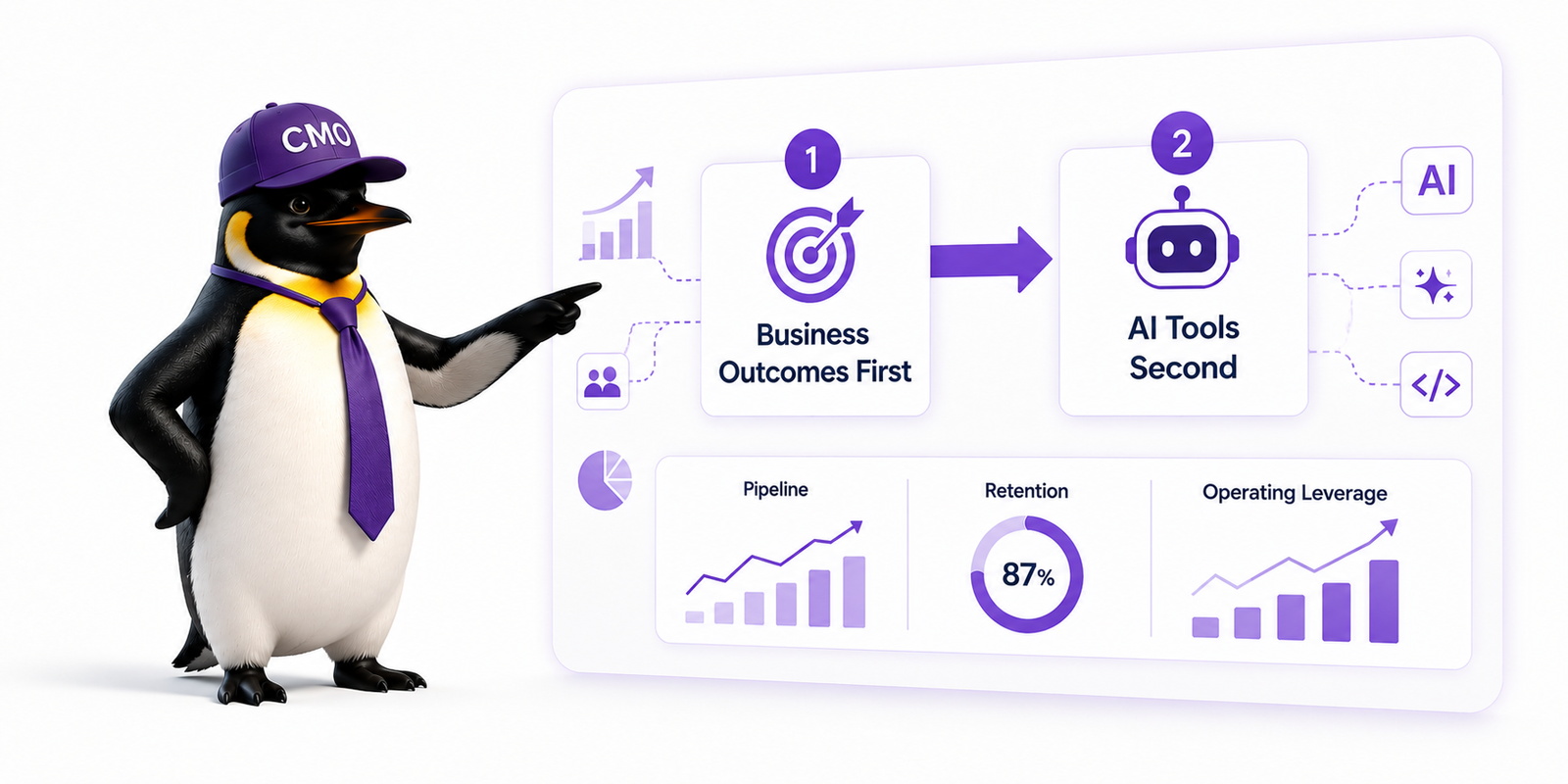
Executives keep asking for an AI strategy, but CMOs should be careful. AI is not the strategy. It is an accelerant. The better question is which business outcomes matter most and where AI can improve acquisition costs, retention, productivity, customer experience, operating leverage, or speed without turning activity into theater.
A CMO recently shared that the marketing team was using AI so aggressively they were flagged by the company's AI oversight committee. A whole policy came out of it.
That story is funny because it feels familiar. AI experimentation is spreading quickly. Oversight committees are forming. Executives keep asking the same question: what is our AI strategy?
There is just one problem. It may be the wrong question.
No one asks about a Salesforce strategy. No one asks about a Zoom strategy. And thankfully, no one asks about a spreadsheet strategy.
These are tools. The strategy comes first.
If the objective is to reduce customer acquisition costs, AI can help. If the objective is to improve retention, AI can help. If the objective is to scale revenue without adding proportional headcount, AI can definitely help.
But AI is not the objective. It is the accelerant.
That is why organizations get into trouble when they spend more time debating AI policies than business outcomes. Governance matters. Security matters. Compliance matters. But governance is not strategy.
A policy tells people what they cannot do. A strategy tells people what they should do.
Those are very different conversations.
The more mature AI conversations are not centered on prompts, agents, or model selection. They are centered on pipeline, acquisition costs, sales productivity, customer experience, and operating leverage.
In other words, business outcomes first. AI second.
That order matters because sooner or later every CFO asks the same question: so what?
Saving six hours is nice. Growing faster without increasing expense is better.
Many companies now have AI task forces. Fewer have figured out who owns adoption, how experiments become repeatable workflows, or how successful ideas spread across the organization.
That is the next frontier. Not AI strategy. AI operating models.
AI is a mirror, not a crystal ball. If processes are messy, AI exposes them. If data is fragmented, AI exposes that too. And if strategic priorities are unclear, AI exposes that faster than anything.
So here is the better CMO question: if someone banned the phrase AI strategy from the next leadership meeting, would the team still know exactly which business outcomes it is trying to achieve?
Or has the tool become the strategy?
They should have a business strategy that clearly defines where AI can create leverage. AI should not become a standalone strategy detached from outcomes.
Pipeline impact, acquisition cost, retention, productivity, customer experience, operating leverage, and speed to insight are stronger measures than tool usage.
No. Governance reduces risk, but it does not tell teams where to create value.
An AI operating model: ownership, workflows, adoption paths, measurement, and repeatable ways to scale what works.
CMO Huddles helps B2B marketing leaders win by bringing together peers, fresh perspectives, and opportunities to build stronger personal brands. Want to join the huddle? Learn more about CMO Huddles and apply to join the community.