
Back to Blogs
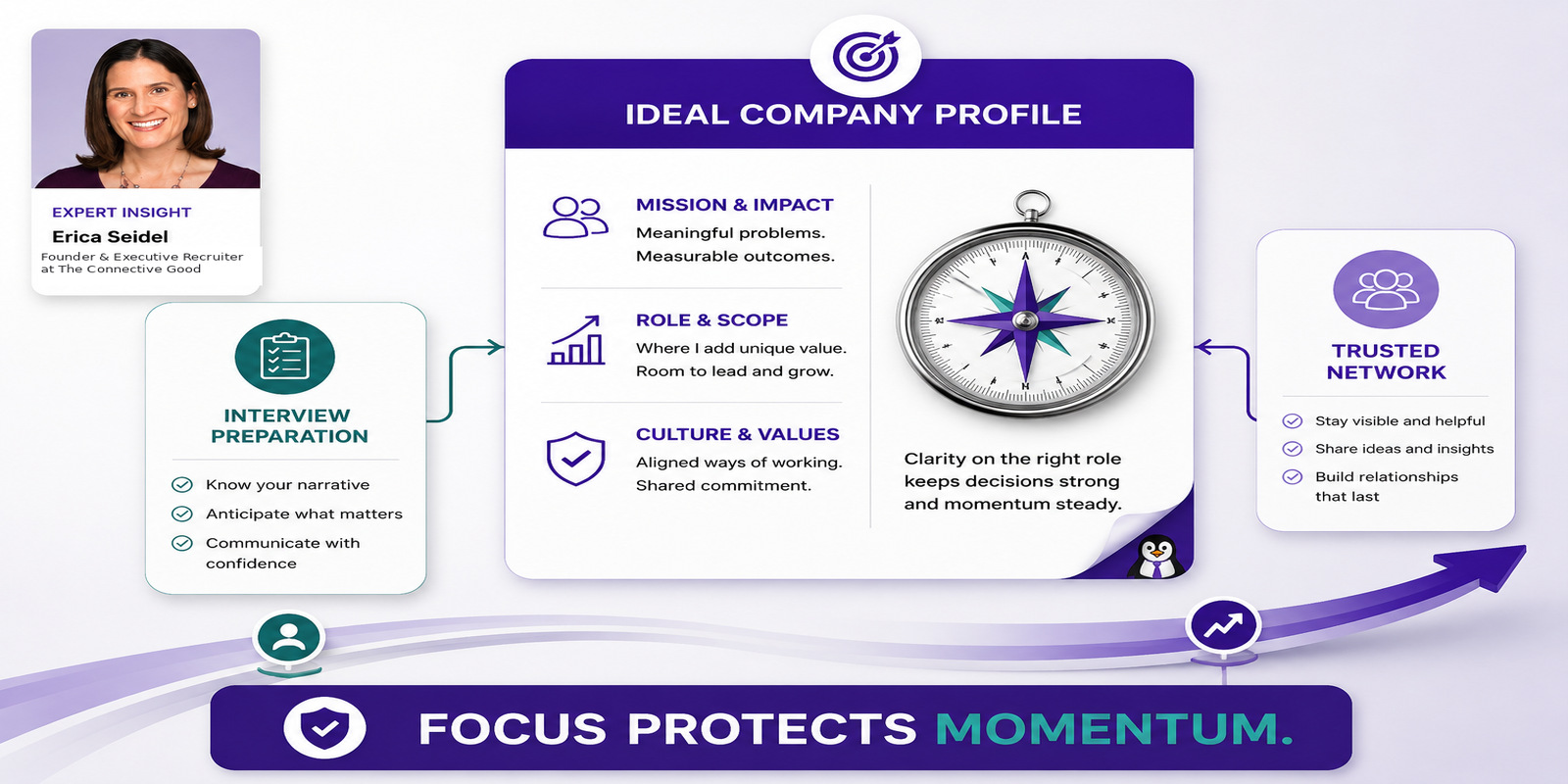
A long CMO job search can test confidence without defining capability. Executive recruiter Erica Seidel explains how focus, preparation, community, and a clear ideal company profile can make the search more intentional. The strongest candidates protect their energy, investigate fit, show their thinking, and stay visible while waiting confidently for the right opportunity to emerge.
An extended executive search can feel intensely personal. Promising conversations stall, seemingly perfect opportunities disappear, and hiring teams sometimes offer little explanation. None of those experiences provides a reliable verdict on a marketing leader’s ability.
Progress may be easier to see through the clarity the search produces. That includes clarity about the companies worth pursuing, the environments in which the leader is most likely to succeed, and the evidence that differentiates the candidate from a crowded field.
In a Renegade Marketers Unite conversation about owning the CMO job search, executive recruiter Erica Seidel, founder of The Connective Good, explored how experienced marketing leaders can approach a demanding transition with greater intention.
A broad search can create plenty of activity without producing meaningful progress. During the conversation, Erica considered how candidates can bring greater discipline to the opportunities they evaluate.
“Everybody defines it differently,” Erica said. “The key thing is having some specific criteria that you are going to use when you evaluate roles.”
Those criteria form an ideal company profile. Depending on the candidate, the profile might cover company stage, ownership structure, product-market fit, industry, CEO experience, leadership culture, team maturity, available resources, and the balance between immediate pipeline pressure and long-term brand building. Current hiring conditions add another consideration.
“In this industry, CEOs and investors are looking for 11 out of 10 requirements, and in this market, they can usually find that,” Erica said. “So if you have specific industry experience in one area, try to leverage that as much as possible because that’s going to help you.”
A candidate can still pursue an opportunity outside the most obvious pattern match. The story connecting past experience to the new environment simply becomes more important when the candidate’s background departs from what the hiring team expects. The conversation also addressed the point at which an attractive opportunity may no longer deserve further investment.
“Know when to say ‘no’ to a role. Some roles are just not set up for success. The sooner you figure it out, the better.”
That judgment can be difficult during a long transition, when any active process may feel better than waiting. An ideal company profile provides a stable basis for deciding whether an opportunity deserves further investment.
A résumé records titles, dates, and selected accomplishments. It rarely captures the operating conditions behind those results or the choices that shaped a leader’s progression.
Erica recommends preparing a concise account of each significant role: Why the leader joined, why they left, what they inherited, and how the company, team, budget, and responsibilities developed. She offered a sample narrative during the discussion. “Join the company at 20 million, help get to 50 million, started with a team of two and a budget of 1 million, and got to a team of 10 and a budget of 4 million,” Erica said.
The numbers make the scale of the work tangible, while the surrounding story clarifies what changed and where the candidate contributed. Together, they help the hiring team understand what that experience prepared the leader to handle next.
The same preparation becomes important when interviewers move from individual roles to the candidate’s overall career trajectory. “It’s the white space in between jobs,” Erica said. “Why did you leave this job and why did you enter this other one? People care, especially early on in a process. They’re very risk-averse.”
Unexplained transitions can increase the perceived risk of an executive hire, even when the underlying story is reasonable. A concise narrative can acknowledge what happened, identify what was learned, and connect that experience to the opportunity under discussion.
Candidates between roles often have more time for company research than executives interviewing while managing a full-time position. That time can become an advantage when it produces relevant evidence without pretending to provide a complete strategy based on public information.
Preparation can also change what a candidate brings into the interview itself. “I love it when people come to an interview and say, ‘Oh, here’s my dashboard,’ or ‘Here’s my ROI model. Let me walk you through this.’”
An anonymized dashboard or planning framework gives interviewers a concrete view of how the candidate approaches a problem. A researched hypothesis can serve the same purpose when presented as a starting point for discussion rather than a finished answer.
Erica also considered the additional time available to candidates between roles. “If you’re in between jobs and you use your time wisely, you can research the hell out of companies, do some work to differentiate yourself,” Erica said.
Public research rarely reveals enough to diagnose a company fully. It can still support an informed question, an initial point of view, or a model the candidate and interviewer can examine together. Availability may offer another advantage. Erica described a client who viewed a candidate’s ability to begin quickly as a reason to advance that person. Time between roles can signal readiness when the candidate has used it to research, reflect, and prepare.
A strong match on paper does not guarantee that the organization has created a workable mandate. The interview process offers a chance to investigate the relationship among expectations, authority, resources, incentives, and time.
During the conversation, Erica outlined an alignment test for evaluating the role: “There has to be a straight line from CEO expectations to CMO responsibilities to CMO authority, incentives, and resources.”
A break anywhere along that line can create trouble. A CEO may expect transformation while providing a limited budget, an undersized team, or little authority over the broader customer journey. The organization may also expect immediate pipeline while describing the role as a long-term brand transformation.
Short-term and long-term expectations deserve direct discussion. Erica compared the difference to “fast food marketing” and “farm-to-table marketing.” Some companies need a quick response to immediate pipeline pressure, while others are prepared to invest in positioning, reputation, customer experience, and future demand.
Fit depends on whether the organization and candidate share an honest understanding of the work, the available levers, and when meaningful results could appear. The same discussion can reveal whether the company is facing a marketing problem or a broader go-to-market problem involving product-market fit, sales execution, or customer experience.
Executive searches rarely follow a predictable timeline. Relationships provide access to opportunities, but they also provide perspective when the process becomes discouraging. Later in the conversation, Erica turned to the emotional and professional support surrounding an executive transition.
“This is not a market, and not a time to go it alone. I think the best people are tapping their networks to help them find jobs, having curated personal boards of advisors before they make decisions, before they have critical meetings or presentations.”
A small advisory group can pressure-test an important interview, assess an opportunity from outside the candidate’s anxiety, and identify warning signs that are difficult to see from inside the process. Those relationships also help keep a delayed search from becoming the candidate’s only source of professional identity.
Visibility does not require constant self-promotion. Sharing useful ideas, helping peers, participating in substantive conversations, and staying close to trusted relationships can keep a leader present without turning every interaction into a request.
Long searches can distort the story candidates tell themselves. Community provides a more accurate mirror while the right opportunity takes shape.
Not necessarily. Hiring timelines reflect company conditions, executive expectations, market fit, budgets, and role design. A clear transition story provides more useful context than elapsed time alone.
It is a set of criteria for evaluating employers and opportunities, including company stage, market, product fit, CEO profile, ownership, culture, resources, and expectations.
Anonymized dashboards, operating frameworks, business outcomes, and researched hypotheses can reveal how the candidate thinks without claiming complete knowledge of the company.
Peer communities, advisor relationships, useful content, industry conversations, and meaningful networking can maintain visibility while allowing the search to remain selective.
Listen to the full conversation with Erica Seidel.
CMO Huddles has a dedicated Transition Team for experienced B2B marketing executives navigating what comes next.