
Back to Blogs
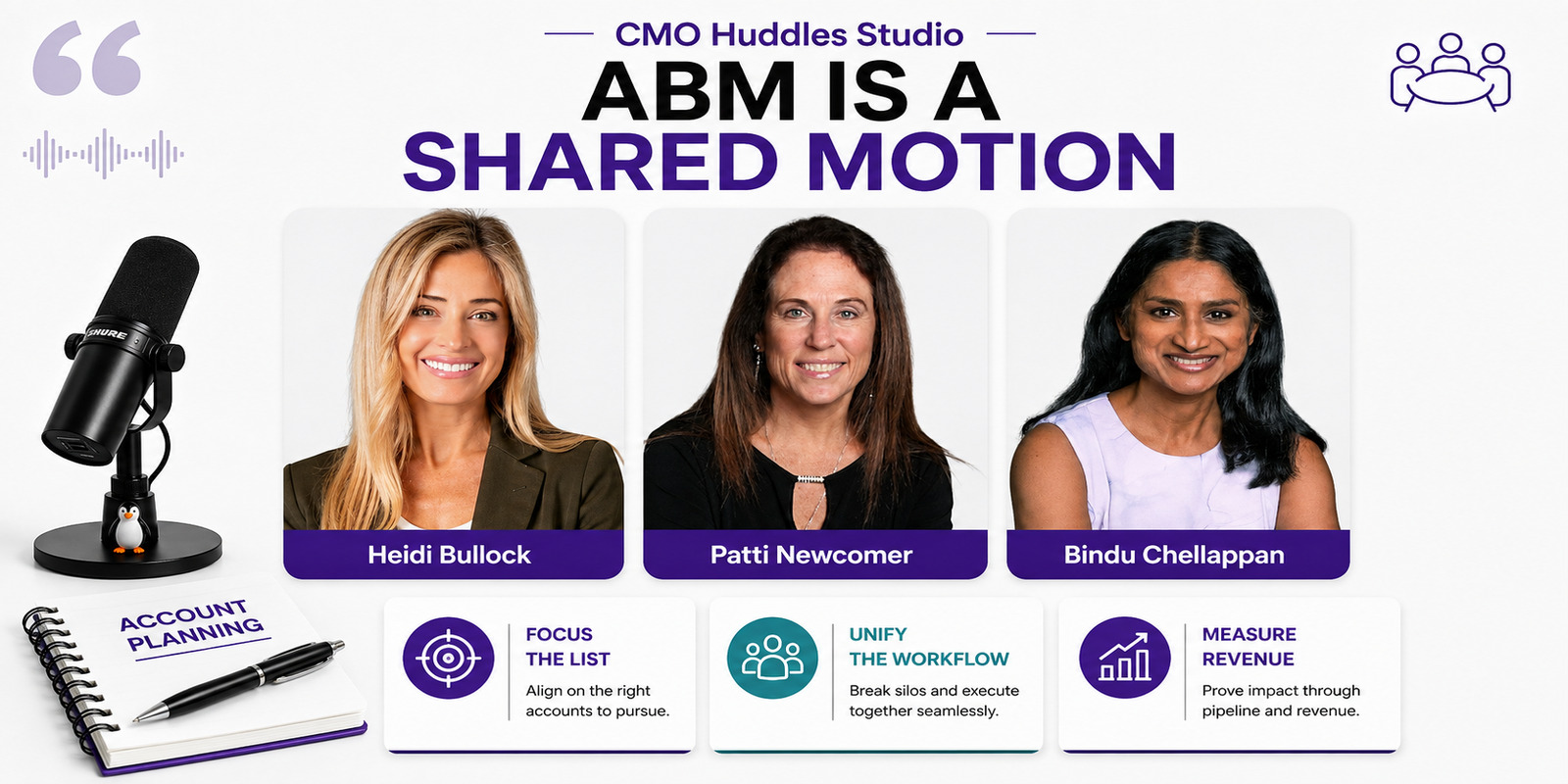
ABM works best as a shared growth motion, not a collection of marketing tactics. Heidi Bullock, Patti Newcomer, and Bindu Chellappan connect focused account selection with clean data, seller-friendly workflows, cross-functional pods, and shared measurement. Their experiences show how alignment and process give account-based marketing staying power from initial engagement through expansion and sustainable retention.
Account-based marketing can quickly become a collection of disconnected tactics. One team builds a target list, another buys technology, and sellers receive campaigns that do not fit their workflow.
A CMO Huddles Studio conversation hosted by Jon Russo of B2B Fusion brought together Heidi Bullock, then CMO of Tealium, Patti Newcomer, then CMO of Centerbase, and Bindu Chellappan, then a marketing leader at Corpay, to examine what gives ABM staying power.
ABM depends on agreement about which accounts matter and why. Heidi described how greater focus at Tealium was associated with stronger expansion, retention, and contract value.
That focus began with ICP definition, industry priorities, and shared criteria for account selection. It came before campaign tactics.
Jon captured the underlying risk:
“You really have to understand what you’re going after, what the end point is, before you jump off into ABM and get random acts of marketing as opposed to an ABX type approach.”
A smaller, defensible account universe often creates more clarity than a large list assembled from incompatible sales and marketing assumptions.
Heidi described cross-functional pods that brought marketing, SDRs, and sellers together around selected accounts. The operating question was not simply which campaign marketing could launch. It was how useful intelligence could reach sellers in the systems where they already worked.
Signals from multiple sources were consolidated in Salesforce so sellers did not need to search across disconnected platforms or depend on one marketer to interpret every account.
“It’s an ongoing motion that you’re living together.”
That shared motion can extend from early engagement through opportunity development, customer success, retention, and expansion.
Heidi separated the technology decision from the operating model:
“A tool is not going to solve your problems. Your tool is not your ABM strategy.”
Bindu made the operational consequence equally clear:
“If your existing processes are broken to start with, ABM will only make it worse.”
Before additional technology contributes value, teams benefit from common account definitions, agreed ownership, usable data, and a documented way to act on signals.
Patti shifted the discussion from acquisition activity to the full revenue journey:
“It doesn’t matter what we bring into the top of the funnel if we’re not working with the team to drive stuff through the funnel and have it come out the bottom.”
That perspective expands ABM measurement beyond campaign engagement. Depending on the business, the shared view may include account progression, opportunity creation, deal velocity, win rate, expansion, and retention.
The metric set matters less than whether the teams recognize the same account journey and use the data to decide what happens next.
It is a coordinated approach in which marketing, sales, SDRs, and customer success work from shared account priorities and revenue goals.
Clear account criteria, reliable data, cross-functional ownership, defined processes, and agreement about the intended business outcome.
ABM can consolidate useful account signals, provide relevant messaging and proof, and coordinate engagement within seller workflows.
Measures may include account progression, opportunities, pipeline, velocity, win rate, expansion, and retention rather than lead volume alone.
Listen to the full ABM conversation.
CMO Huddles helps B2B marketing leaders win by bringing together peers, fresh perspectives, and opportunities to build stronger personal brands. Want to join the huddle? Learn more about CMO Huddles and apply to join the community.