
Back to Blogs
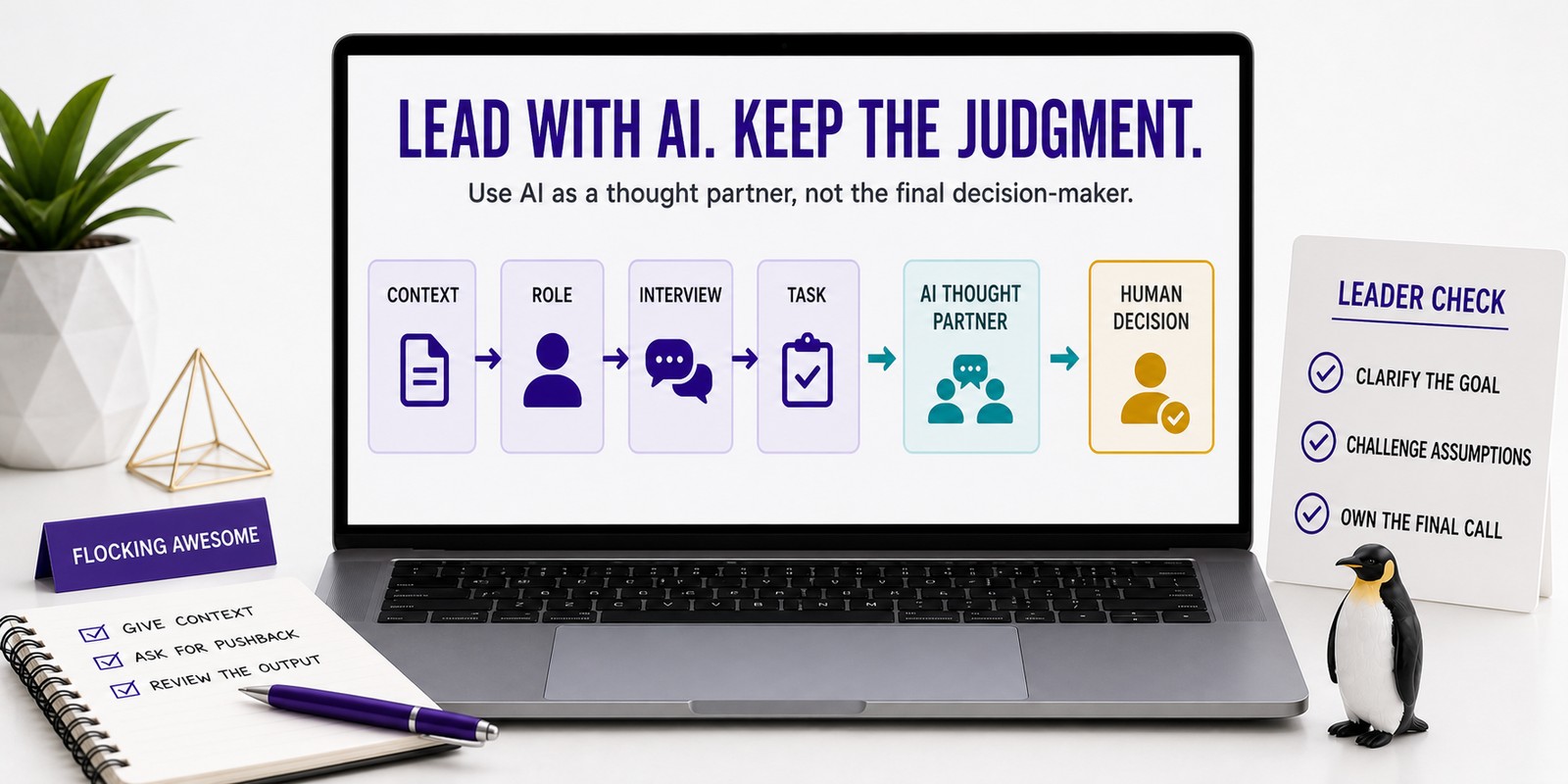
AI-driven leadership is less about mastering tools and more about using AI to improve strategic thinking, decision-making, and organizational change. Geoff Woods explains how leaders can focus on high-value problems, turn AI into an interviewer instead of an oracle, and remain responsible for judgment. His CRIT framework adds context, role, interview, and task to interaction.
The AI conversation often begins with tools, prompts, speed, and output.
Those applications can be useful, but they represent a narrow view of what AI can contribute to leadership.
Geoff Woods, author of The AI-Driven Leader, argues that leaders can create more value by applying AI to consequential problems, strategic decisions, and organizational change.
His approach does not position AI as an oracle. It positions AI as a thought partner that can ask questions, expose assumptions, and help a leader examine a decision more thoroughly.
Geoff identified three common leadership mistakes:
The first two are closely related. Leaders may delegate AI adoption while personally using the technology only for emails, summaries, or search.
Those applications can save time, but they may not affect the decisions that determine business performance.
Geoff uses an 80/20 lens. The more strategic opportunity is to identify the smaller set of decisions and problems that drive a disproportionate share of results.
This could include:
The technology becomes more consequential when the question is consequential.
Many people ask AI a broad question and accept the first polished response.
Geoff reverses that interaction. Instead of immediately asking AI for an answer, he instructs it to interview the leader one question at a time.
This allows each answer to shape the next question. The system collects context that the leader may not have thought to provide initially.
The resulting conversation can surface assumptions, missing information, and competing priorities before the system proposes an output.
That is the purpose of Geoff’s CRIT framework:
The interview instruction is particularly important because it turns a one-way request into an iterative exchange.
Geoff cautions against treating a convincing answer as a correct answer.
“Don’t expect perfection. Expect this to be a draft.”
He recommends reviewing the first result through three questions:
That process keeps the leader responsible for the outcome.
It also prevents AI from weakening the critical-thinking skills it is meant to support. The leader remains the thought leader, while AI remains the thought partner.
Geoff distinguishes AI expertise from AI-driven leadership.
“You don’t actually have to become an AI expert at all, but you do have to become an AI-driven leader.”
Personal use gives leaders enough experience to recognize meaningful applications, understand limitations, and communicate a credible vision.
It also makes it easier to set the pace for the organization. A leader who has used AI for strategic thinking can discuss adoption in terms of actual decisions and work instead of issuing a general mandate.
Technical teams still play an essential role in security, governance, architecture, and implementation. Leadership remains responsible for deciding what the organization is trying to accomplish.
Geoff’s definition of AI-driven leadership extends beyond shareholder or enterprise value. It includes better leaders, better businesses, and better lives.
That matters because AI can amplify poor priorities just as easily as strong ones.
A useful leadership assessment considers:
Naming those tradeoffs helps keep speed from becoming the only measure of progress.
An AI-driven leader uses AI personally and strategically to improve thinking, decisions, and organizational change without needing to become a technical AI expert.
CRIT stands for context, role, interview, and task. The framework gives AI clearer information and asks it to collect additional context before producing an answer.
One-question-at-a-time interviews can uncover information, assumptions, and tradeoffs that a leader may not include in an initial prompt.
AI can produce confident but incomplete results. Reviewing what works, what does not, and what needs to change keeps the leader responsible for the final decision.
Listen to the full conversation with Geoff Woods.
CMO Huddles helps B2B marketing leaders win by bringing together peers, fresh perspectives, and opportunities to build stronger personal brands. Want to join the huddle? Learn more about CMO Huddles and apply to join the community.