
Back to Blogs
Drew Neisser is the founder of CMO Huddles and a globally recognized authority on B2B marketing. He’s an AdAge columnist, LinkedIn TopVoice, leading CMO coach, podcast host & friend of penguins everywhere.
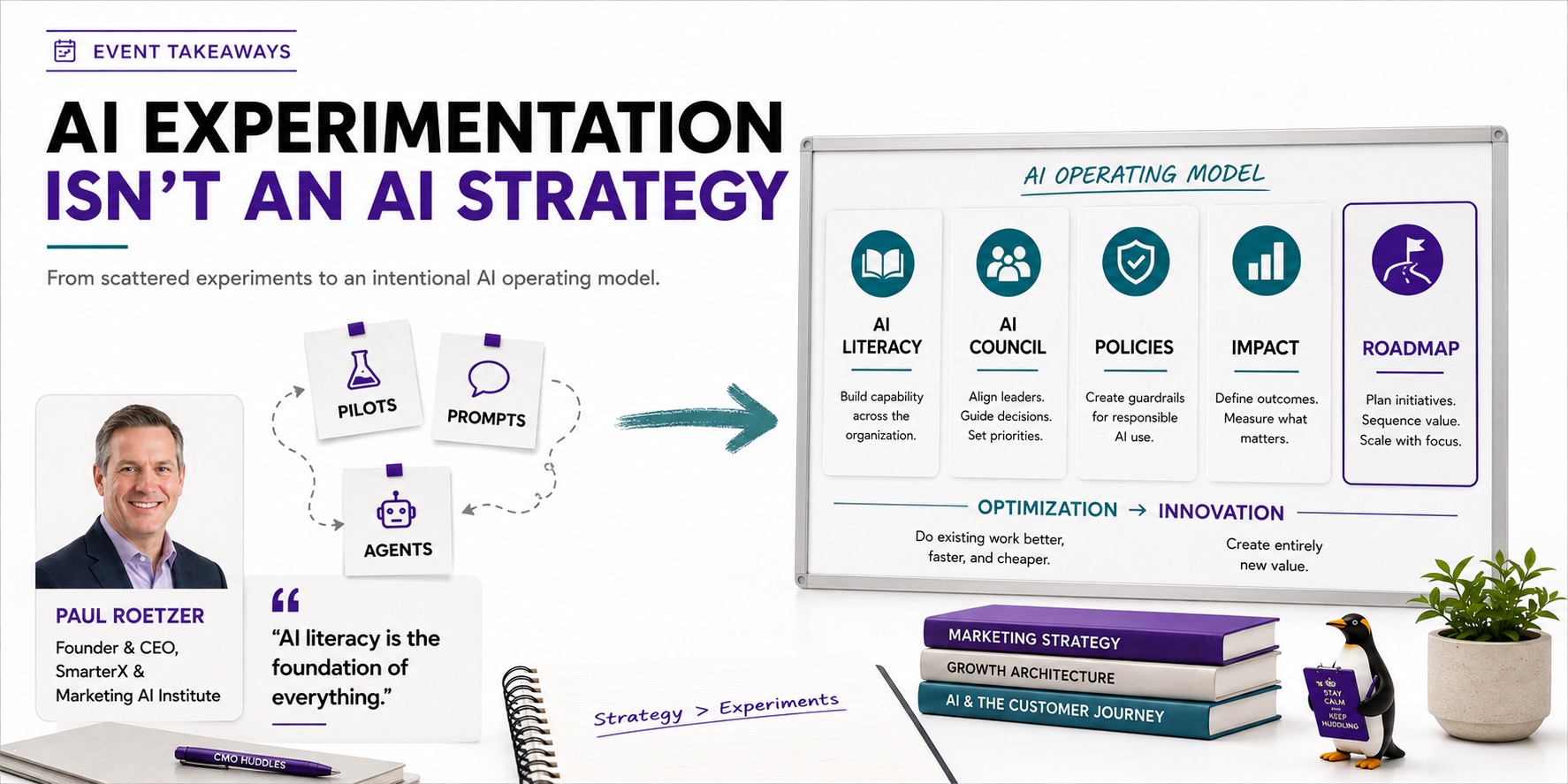
Paul Roetzer's AI transformation framework shows why CMOs need to move from scattered experiments to literacy, governance, accountability, dynamic roadmaps, and growth-focused innovation.
I have a confession: I did not make it through the entire Sequel "Human Moments. Agentic Momentum." webinar live.
At 1:55 p.m., I had to jump off to moderate my own webinar for Conversion.ai. The irony, of course, was that my webinar was also on Sequel. Fortunately, Sequel recorded the session, which meant I could come back later and watch Paul Roetzer, Founder and CEO of SmarterX and the Marketing AI Institute, lay out his framework for human-centered AI transformation.
Before getting to Paul, a quick tip of the penguin cap to Sequel, a Founding Sponsor of the 2026 CMO Super Huddle. The session was highly informative and impressively slick from a production standpoint. Suffice it to say, Sequel drinks its own champagne with gusto.
Paul's presentation was worth returning to because it was not another shiny tour of what AI can do. His central point was more useful and more urgent: AI adoption and transformation needs to be part of a broad change management process, and it cannot just be an IT initiative. For CMOs, that distinction matters enormously.
AI experimentation is not an AI strategy.
Here are seven takeaways from Paul's presentation that B2B CMOs should be thinking about right now.
If LinkedIn is your measuring stick for AI maturity, you might assume every marketing organization except yours has a battalion of autonomous agents running campaigns while the CMO enjoys an afternoon espresso.
Paul offered a useful reality check. According to his latest research, only about a quarter of organizations consider themselves to be at the scaling stage. Most are still understanding, experimenting, or piloting. So no, you probably are not hopelessly behind.
But that should not be comforting for long. The technology is moving too quickly for endless experimentation. The CMO's job now is to turn scattered pilots into organizational learning: What have we tried? What worked? What did not? What should we scale? And what should we stop doing?
Pilots produce activity. Learning produces advantage.
Paul was unequivocal that "AI literacy is the foundation of everything," which sounds obvious until you get to his data. Lack of education and training has remained the number-one barrier to responsible AI adoption in his research. Even now, more than half of organizations provide no formal AI-focused education or training.
CMOs cannot outsource this problem to HR, IT, or the one prompt wizard on the marketing team.
Paul makes an important distinction between comprehension and competency. People need to understand what AI can do, but they also need to use it regularly enough to develop proficiency and confidence. Training should not be one-size-fits-all either. Your AI power users and AI avoiders do not need the same curriculum.
For CMOs, I would add a third C: curiosity. Leaders need to create enough psychological and practical space for their teams to explore what is possible without turning every experiment into a mandate.
Governance is too often treated as the place good ideas go to get laminated and forgotten. Paul's framing was better. AI policies should give people the freedom to be responsible in their experimentation. That is a wonderfully practical way to think about guardrails.
Good policies should not exist simply to tell employees what they cannot do. They should clarify which tools are approved, what data can be shared, where disclosure is required, how outputs should be reviewed, and when a human needs to remain in the decision loop.
That becomes even more important with agents. An employee using AI to brainstorm subject lines is one thing. An agent taking actions across systems is quite another.
The more autonomy we give machines, the clearer human accountability needs to become.
This may have been my favorite practical idea from Paul's presentation. Rather than asking whether AI can "replace" a particular marketing role, break that role into its component tasks. Then assess each task based on what AI can do today, what it may soon be able to do, and how much human involvement you actually want.
That is a far more useful conversation than "Will AI replace marketers?"
Take content marketing. Research, transcription, summarization, versioning, repurposing, quality assurance, and performance analysis may all have very different AI profiles. The answer is not necessarily to automate the role. It is to redesign the workflow so humans spend more time where judgment, creativity, customer understanding, and differentiation matter most.
Paul also reminded the audience that even if you're using AI agents, at the end of the day, the human is still responsible for what that agent does. That sentence belongs on every CMO's wall before the first autonomous workflow goes live.
One of my favorite moments came when Paul described his own writing. AI could produce his newsletter, LinkedIn posts, presentations, and podcast notes, but he generally chooses not to let it. Why? To me, the process is the point. Writing is how he thinks, learns, and develops confidence in an idea.
That struck a chord. In our rush to identify everything AI can do, CMOs also need to identify the work we deliberately want humans to keep doing.
Customer conversations might take longer than an AI summary. Writing something yourself may be less efficient than generating it. Wrestling with a positioning problem may take longer than asking a model for 20 options. But some forms of friction create understanding, and understanding is still one of marketing's most precious assets.
Efficiency is valuable. So is the struggle that produces insight.
Only a minority of organizations in Paul's research have an AI roadmap. But he also warned against interpreting "roadmap" as a traditional two-year transformation plan. Nobody knows precisely what these models will be capable of two years from now.
Amen to that.
CMOs need direction, priorities, ownership, use cases, and measures of success. But the roadmap needs to be dynamic enough to change as capabilities improve and the organization learns. Think quarterly learning agenda, not stone tablet.
This is where many AI experiments currently go to die. Someone builds something clever. Everyone applauds. Then nobody decides whether it belongs in a workflow, who owns it, how its performance gets measured, or whether it should replace what came before.
A collection of AI projects is not an AI roadmap.
Paul offered perhaps the most important distinction of the session when he described optimization as "doing the same things better, faster, cheaper," while innovation means creating "new forms of value." He calls the former, "10% thinking" and the latter, "10x thinking."
Most marketing AI conversations are still dominated by the first category. How many hours did we save? How much more content did we produce? How much more can the existing team accomplish?
Those are legitimate questions. They just are not sufficient.
If AI makes your marketing organization dramatically more productive, what are you going to do with that newfound capacity? Can you understand customers more deeply? Personalize experiences that were previously impossible? Enter markets you could not afford to pursue? Develop products faster? Create entirely new sources of revenue?
That is where the CMO conversation gets really interesting.
Paul closed with five building blocks for becoming an AI-forward organization: education and training, an AI council, responsible AI principles and policies, impact assessments, and an AI roadmap. I would encourage CMOs to use that list as a quick gut check.
If you have dozens of experiments underway but cannot answer who governs AI, how your people are being trained, which tasks you want humans to retain, which use cases deserve investment, and how all of this connects to growth, you probably do not have an AI strategy yet.
And that is okay. But it is time to build one.
Paul's reminder that "the future is human plus AI, and that future is happening right now‚" is exactly the conversation we will be continuing at the 2026 CMO Super Huddle. It will be one of the most important topics on the agenda, and it is where we will reveal the results of the Benchmarkit x CMO Huddles AI Maturity Study.
I am particularly eager to see how CMOs stack up against the broader organizational benchmarks Paul shared and, more importantly, what separates the AI experimenters from the AI transformers.
Because at this point, experimenting with AI is easy. Turning it into competitive advantage is the hard part.