
Back to Blogs
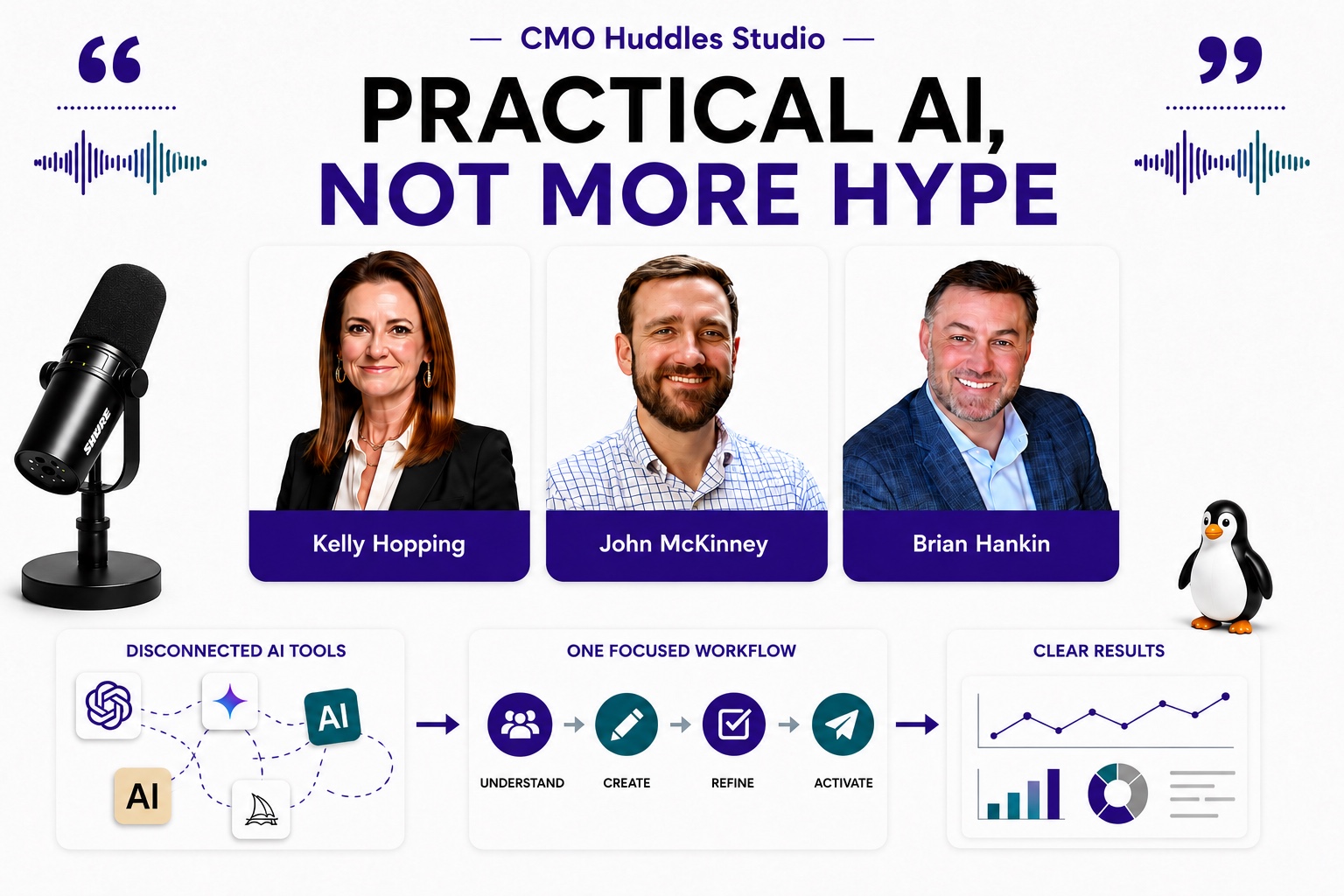
Practical AI adoption begins with useful work, reliable inputs, and firm human oversight rather than hype. Kelly Hopping, John McKinney, and Brian Hankin share applications across content, competitive intelligence, campaigns, SDR workflows, pipeline, and search. Their experiences show how experimentation, learning, cross-functional champions, and outcome measurement can turn isolated tools into a stronger marketing capability.
AI discussions often swing between sweeping transformation and narrow productivity tricks. Marketing teams need a more grounded view of where the technology contributes and what the work requires.
A CMO Huddles Studio conversation about AI in B2B marketing featured Kelly Hopping, John McKinney, and Brian Hankin.
Their examples covered content, competitive intelligence, SDR workflows, web experiences, campaigns, pipeline, and search. None depended on removing human responsibility from the result.
“Use it as a sparring partner. Let it be the thing that tells you that you’re wrong about something so you can defend that before you present it to your board.”
John’s approach moves beyond asking AI to produce an answer. The system can challenge assumptions, generate counterarguments, identify missing evidence, and simulate questions a skeptical executive might raise.
The leader still decides which criticism is valid. AI may misunderstand the context, overstate a risk, or invent a concern. Its value comes from widening the preparation process before the work reaches a higher-stakes audience.
The same approach can pressure-test positioning, campaign logic, investment proposals, customer narratives, and competitive claims. It gives the team a way to discover weaknesses while there is still time to address them.
An AI agent can monitor competitor sites, product announcements, messaging, content, and market activity. Collecting information is only the first step.
The workflow needs a clear destination. A meaningful change might trigger analysis, update a battlecard, notify a product marketer, or prompt a discussion with sales.
Without that connection, the organization creates a faster stream of competitive noise. The value appears when intelligence reaches a person who can interpret and use it.
Prioritization also matters. A competitor changing a homepage headline may warrant observation. A new product, pricing model, partnership, or positioning shift may deserve immediate discussion.
A useful workflow distinguishes between routine activity and a change that could affect the company’s strategy.
Brian described an AI-supported campaign engine capable of creating multi-touch programs across personas. The system becomes more credible when it works from company-specific inputs and includes human editing.
Proprietary data, approved messaging, customer insight, brand standards, and product knowledge give the system relevant context. Human review protects accuracy, differentiation, and strategic judgment.
Campaign output can then be evaluated through engagement, qualified leads, proposals, wins, and other progression measures. Production speed matters, but the commercial response determines whether the workflow adds value.
An AI system can create more variations than a team could produce manually. That advantage becomes useful when the variations reflect meaningful differences among buyers instead of multiplying generic copy.
AI can support SDR research, outreach preparation, data augmentation, scheduling, and web conversations. Kelly said these workflows can increasingly surround SDRs with automation, but “we still need humans in the middle.” Routine questions may work well inside an AI experience grounded in reliable information, while complex buying situations still depend on someone who can interpret ambiguity, build trust, and understand the organization behind the question.
The balance can change throughout the journey. AI may help identify relevant account information, prepare a seller, or answer an initial question. A person can step in when the conversation requires negotiation, judgment, or knowledge the system does not possess.
Human involvement is not a ceremonial safeguard. It supplies context, accountability, and relationship awareness that a model may not have.
“Get comfortable with it, start somewhere if you haven’t, and then keep growing and learning from others.”
Brian’s advice recognizes that individual experimentation creates initial momentum while organizational capability requires shared learning.
Teams need access, training, examples, review standards, and time to practice on real workflows. Internal demonstrations can make success visible and reduce the distance between advanced users and cautious beginners.
Certifications and adoption goals may encourage participation, but usage alone does not show whether the work improved. A team member who uses AI less frequently may still create a high-value workflow with stronger business impact.
Leaders influence adoption by sharing their own uses, failures, and learning. That transparency makes experimentation feel like part of the work instead of a technical test employees are expected to pass privately.
“AEO, GEO, and AIO are all a load of crap. SEO is SEO.”
Kelly’s phrasing challenges the tendency to present every change in discovery as a separate discipline. AI-mediated search introduces new behaviors, but many foundations remain familiar: Clear information, audience relevance, technical accessibility, authority, and distinctive expertise.
Teams still need to understand how buyers discover information and how AI systems represent the brand. Structured content, credible evidence, clear positioning, and original expertise can help both traditional search engines and AI systems interpret the company.
This does not mean discovery is unchanged. Buyers may receive an answer without visiting the source, and AI systems may combine information from several places. The practical response begins with making the company’s value accurate, accessible, and worth citing.
AI activity is easy to count. Teams can report generated assets, active users, prompts, and hours saved.
Those measures become more useful when connected with quality, customer response, pipeline movement, conversion, cost, or capacity reinvestment.
A workflow deserves to scale when it repeatedly improves something the organization values without introducing unacceptable risk. Until then, it remains an experiment.
Measurement also helps teams decide which applications no longer deserve attention. An interesting demonstration may fail to improve the work once maintenance, review, and integration costs are included.
New AI tools arrive faster than most teams can evaluate them. A focused portfolio can prevent experimentation from becoming another source of operational complexity.
The team can identify a small number of workflows connected with real priorities, assign owners, define measures, and document what it learns. Successful experiments can receive additional support, while weak ideas can end without becoming permanent stack additions.
That discipline preserves room for curiosity while giving the organization a basis for deciding what to scale.
Current applications include research, content, competitive intelligence, campaigns, SDR support, pipeline analysis, search, and customer-facing experiences.
It means using the system to challenge assumptions, generate counterarguments, and identify weaknesses before a high-stakes discussion.
They give the system company-specific context that generic models cannot independently supply.
Measures may include quality, engagement, qualified leads, proposals, wins, cycle time, cost, or capacity redirected to higher-value work.
Listen to the full conversation with Kelly Hopping, John McKinney, and Brian Hankin.
CMO Huddles helps B2B marketing leaders win by bringing together peers, fresh perspectives, and opportunities to build stronger personal brands. Want to join the huddle? Learn more about CMO Huddles and join CMO Huddles Starter.