
Back to Blogs
Drew Neisser is the founder of CMO Huddles and a globally recognized authority on B2B marketing. He’s an AdAge columnist, LinkedIn TopVoice, leading CMO coach, podcast host & friend of penguins everywhere.
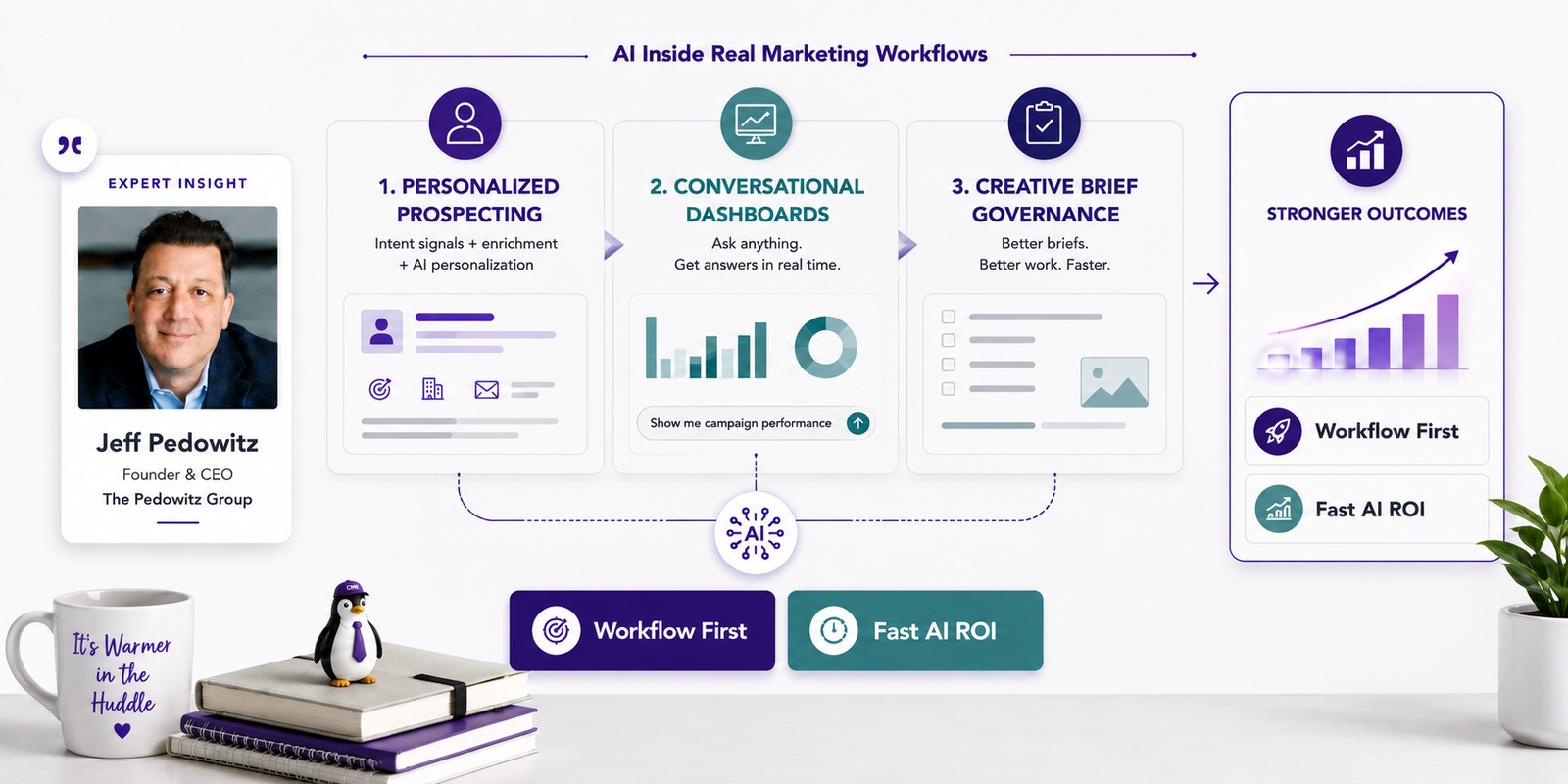
B2B CMOs do not need another abstract AI sermon. Jeff Pedowitz, founder and CEO of The Pedowitz Group, shared three AI-powered workflows already delivering value: Personalized prospecting, conversational dashboards, and creative brief governance. The lesson is clear: fast ROI comes when AI improves real marketing workflows, not when it floats around as a disconnected experiment.
Every CMO has heard some version of the AI pep talk by now. Move faster. Do more with less. Transform the function. Rebuild the org. Become “AI-native,” preferably by Thursday.
Helpful? Occasionally. Exhausting? Absolutely.
The more useful question is simpler: Which AI workflows are actually delivering value for B2B marketing teams right now? That was the focus of a recent conversation with Jeff Pedowitz, founder and CEO of The Pedowitz Group, who has spent decades helping companies modernize revenue and marketing operations.
Jeff’s examples were refreshingly specific. No magic wand. No “just prompt better” fairy dust. Just AI layered into workflows that already matter: Prospecting, reporting, and marketing intake.
Fast ROI comes when AI is connected to data, systems, business rules, and real operating pain.
Workflow first. Prompt second.
The first workflow Jeff described was not generic AI copywriting. It was a full revenue workflow that combines buyer intent, enrichment, and AI-generated personalization into outbound that is both individualized and scalable.
As Jeff put it, “We’re combining several different things.” The workflow starts with buyer intent and behavioral signals from a marketing automation platform like Marketo, HubSpot, or Eloqua, then enriches that data through tools like ZoomInfo, Apollo, or Clay before AI assembles the message.
“We take the buyer intent, the cookie information that’s coming from any marketing automation system,” Jeff explained. From there, “we’re then looking up the ICP, all the relevant people the client would look at,” and using that intelligence to connect the client’s value proposition to the recipient’s likely needs.
This is where many CMOs should pause. The value is not that AI can write a passable email. That ship has sailed, circled the harbor, and been turned into a LinkedIn carousel.
The value is that AI can turn live buying signals into relevant outreach at a scale humans could not reasonably manage. Jeff described it this way: “Then we combine it into a super prompt that builds a unique personalized email that matches our client’s value proposition to that individual.”
The results, according to Jeff, are not theoretical. The program is “producing leads every single week,” unsubscribe rates have been “really, really low,” and the revenue impact has reached “probably close to about three quarters of a million dollars so far this year.”
That is the kind of sentence that gets a CFO to look up from the spreadsheet.
The distinction matters because personalization has been badly abused. Adding a first name, company name, and synthetic compliment about a podcast appearance from 2021 is not personalization. It is mail merge with better manners.
Jeff’s workflow aims higher: “We’re doing this hundreds of thousands of times per week,” he said, with “everybody getting a unique individualized email.” The CMO lesson is that AI prospecting can work when it is grounded in intent, enrichment, segmentation, and relevance; without those ingredients, it is just faster spam wearing a nicer jacket.
The second workflow hits a different CMO pain point: Reporting. Marketing leaders have spent years building dashboards, rebuilding dashboards, arguing over dashboards, explaining dashboards, and wondering why the one number the CEO wants is always missing from the dashboard.
Jeff has lived this movie. After “over 20 years literally building thousands of reports and dashboards,” he started asking whether AI could make reporting more interactive and less dependent on endless chart requests.
The idea is to put a simple front end on top of multiple data systems and layer an LLM over it, so executives can interact with reporting in real time. As Jeff framed it, “Could we put a simple HTML front end that pulls all the data from all the systems, however the CMO wants to see it, and put LLM on top of it?”
In this model, the executive does not need to wait for a BI team to rebuild a view. Jeff described a dashboard where “the executive can actually interact with their dashboard in real time and change it,” asking things like, “Let me see this chart by quarter,” “Let me see it by campaign type,” or “Let me see it color code.”
Dashboards are the sensible shoes of marketing leadership.
Not glamorous. Necessary.
If the CMO can get faster answers from connected data, the organization can make faster decisions. Jeff said the time savings have been significant, noting, “We’ve been able to save our clients thousands of hours,” and even adding that in some cases, “They don’t need their BI tools anymore.”
That is a bold claim, so let’s add the necessary CMO caveat: This only works if the underlying data is strong. AI does not magically purify messy source systems, reconcile broken attribution, dedupe records, standardize campaign naming, or explain why someone created a field called “Lead Source 2 Final Final.”
Jeff agreed that data quality is the foundation. The LLM layer can improve access, flexibility, and usability, but it cannot rescue bad plumbing.
The CMO lesson is straightforward: Conversational dashboards can save time and improve decision-making, but only when they sit on top of trusted data architecture. Otherwise, you have a very articulate confusion machine.
The third workflow may sound less flashy than AI prospecting or dashboards, but it may be the one your marketing team secretly wants most. Creative intake is where many marketing organizations lose their minds one “quick request” at a time.
Jeff described large companies that already use systems like ServiceNow, Jira, Monday, or Asana to manage creative briefs, approvals, and workflows. Even with those systems in place, he said, “There was still a lot of opportunities for improvement,” especially “when things have to go back for revision or you need multiple levels of approval.”
The AI solution he described is a governing agent layered on top of the workflow. Its job is not to “be creative.” Its job is to evaluate requests against business rules, route them properly, and keep bad inputs from clogging the system.
As Jeff explained, “We redesigned this, with AI basically acting as a governing agent.” If the request meets the rules, “it passes it forward,” and if it does not, “it sends it back.”
This is not just a speed play. It is a governance play.
The system can also update workflows and notify the right people. “It updates the workflows and automatically notifies everybody,” Jeff said, while also “helping to stop things from getting into the system to begin with to clutter things up.”
That may be one of the most underrated AI use cases in marketing: Helping the team say no without turning every no into an emotional support meeting. As Jeff put it, “Now with this process in place, you have a professional way of saying no.”
For CMOs, that matters. Marketing teams are drowning in requests, and AI can help enforce rules, clarify expectations, and prevent low-value work from consuming high-value people.
Sometimes sanity is the ROI.
Across all three examples, Jeff was not describing AI as a standalone tool. He was describing AI as a layer inside existing business workflows, which is the shift CMOs need to make.
The question is not, “Which AI tool should we buy?” The better question is, “Which painful workflow would become materially better if intelligence, automation, and natural-language interaction were built into it?”
The three workflows Jeff shared map neatly to three kinds of CMO value: Revenue generation, decision velocity, and operational discipline. AI prospecting turns intent and enrichment into relevant outbound; AI dashboards help executives query data in real time; AI governance improves intake, approvals, and prioritization.
None of these require CMOs to boil the ocean, reinvent marketing, or hold a three-day offsite called “The Future of Us.” Start with work that already matters. Make it faster, smarter, cleaner, or more measurable.
One note of disclosure: The Pedowitz Group is one of twenty-three preferred partners of CMO Huddles, all of whom were recommended by members of our community. That said, the reason Jeff’s examples are worth sharing is not the partner relationship. It is the specificity.
CMOs need more concrete use cases and fewer floating AI abstractions.
If you are looking for fast AI ROI, start by identifying workflows with four characteristics: High volume, clear inputs, visible pain, and measurable output. In other words, pick a workflow that happens often, has enough structure for AI to help, creates obvious friction today, and can be judged by something more concrete than “the team seems excited.”
Then resist the temptation to start with the shiniest use case. Start with the one where the business case is easiest to prove.
For some CMOs, that will be outbound personalization. For others, it will be reporting. For others, it will be workflow governance.
The right starting point depends on where your team is leaking time, money, or momentum.
And yes, your data matters. So do your rules. So does your process design. AI is powerful, but it is not a substitute for operational thinking.
The machine still needs a map.
The fastest AI ROI will not come from random experimentation. It will come from redesigning specific workflows where AI can improve speed, relevance, decision-making, or governance.
Jeff’s three examples make the opportunity tangible. Use AI to convert intent and enrichment into relevant prospecting. Use AI to make reporting conversational and faster to act on. Use AI to enforce creative brief standards and reduce operational clutter.
The lesson for CMOs is wonderfully practical: Stop asking your team to “use AI more.” Pick one workflow that matters, define the business outcome, clean up the inputs, and build from there.
That may not sound as exciting as “transform the entire marketing function.” Good. Excitement is overrated. ROI still has a lovely ring to it.
Three strong candidates are AI-powered prospecting, conversational dashboards, and AI-governed creative intake workflows. Each can deliver value because it improves an existing business process rather than introducing AI as a disconnected experiment.
Intent data gives AI a better starting point. Instead of generating generic outbound copy, the system can tailor messaging based on buyer behavior, account fit, enrichment data, and the company’s value proposition.
In some cases, AI-powered reporting layers can reduce reliance on traditional BI tools by letting executives query data conversationally. But the results depend heavily on clean, connected, trusted data sources.
AI can act as a governing layer that checks requests against business rules, routes complete briefs forward, sends incomplete briefs back, and prevents low-priority work from cluttering the system.
Start with a high-volume, high-friction workflow that has clear inputs and measurable outputs. The best early use cases are not always the flashiest. They are the ones where the business impact can be proven quickly.
CMO Huddles helps B2B marketing leaders win by bringing together peers, fresh perspectives, and opportunities to build stronger personal brands. Want to join the huddle? Learn more about CMO Huddles and apply to join the community.