
Back to Blogs
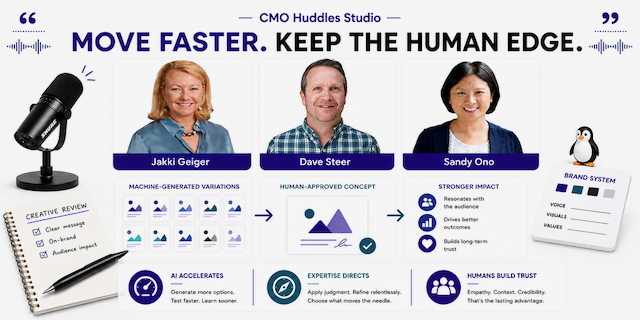
AI can increase marketing velocity, but speed alone does not create distinctive work. The CMO’s role is to decide where automation adds leverage and where human judgment, originality, empathy, and taste remain decisive. This conversation examines how leaders can accelerate production without allowing efficient tools to flatten the ideas, experiences, and creative standards buyers remember.
AI has given marketing teams the ability to research, prototype, produce, adapt, and distribute work faster. That capability creates leverage only when the underlying work deserves acceleration.
A weak idea can now flood the market before anyone pauses to examine it. A strong idea can travel further, reach more audiences, and become useful in more formats. The CMO must help the organization distinguish between those two outcomes.
In a CMO Huddles Studio conversation, Jakki Geiger of Arango, Dave Steer of Webflow, and Sandy Ono examined where automation helps and where human judgment remains essential.
Their examples suggest that the most useful question is not whether AI can perform a task. It is what quality, risk, originality, and human understanding the task requires.
Jakki joined Arango with a demanding assignment. The company needed new positioning, a refreshed brand, and a functional website in time for a major NVIDIA event. She had approximately sixty days and no fully established marketing team.
A similar project had taken nine months in a previous role. AI helped compress research, content development, and early exploration, while an experienced agency partner handled work requiring deeper creative expertise.
Jakki described the combination:
“I would not have been able to do it without AI and a trusted agency partner. For me, that was the killer combination.”
The technology increased the amount of strategic and production work the small team could complete. It did not eliminate the need for experienced people who could recognize a distinctive idea, create a coherent identity, and produce an outcome suitable for a serious enterprise brand.
This distinction matters when leaders compare AI with outside expertise. AI may reduce hours spent assembling inputs and generating options. It does not automatically reproduce years of craft, market intuition, or judgment.
Jakki created digital twins representing leaders and customer personas. These tools helped the team explore messaging, create thought leadership, and move faster during a compressed schedule.
She did not treat the synthetic feedback as sufficient. The team also spoke with actual customers and tested the positioning with people who understood the market firsthand.
Jakki explained her confidence boundary:
“For me, the human in the loop is still very important, because in the world of AI, the currency is trust, and I don’t one hundred percent trust it yet.”
The human validation protected the company from building its market story around a convincing simulation that failed to represent real customer understanding. Digital twins created speed, while customer conversations created evidence.
This pattern can apply beyond positioning. AI can identify themes in call transcripts, propose survey questions, simulate objections, and generate variations. People still need to determine whether the inputs are representative and whether the output reflects how buyers actually think.
Jakki did not attempt to become a senior graphic designer because AI could generate visual options. Her agency possessed the experience to use the tools more effectively and recognize mediocre work before it reached the market.
She observed that domain expertise changes the quality of AI-assisted output. Experienced practitioners know what details to provide, which conventions to challenge, and how to evaluate what the model returns.
That creates an important talent question. If companies automate every entry-level task, future marketers may lose the practice through which expertise develops. Leaders need to redesign early-career work so employees can still learn research, writing, editing, analysis, and creative judgment even as AI handles parts of execution.
An efficient team without a path to deeper expertise may perform well today while weakening its future capability.
One of Arango’s strongest creative ideas was “Frankenstack,” a memorable name for the complicated collection of databases and pipelines enterprises assemble to support AI applications.
The idea came from human observation and language, then became the center of an AI-assisted campaign. The team created an explainer video and adapted the concept for different industries and use cases.
The phrase gave salespeople a discovery tool. They could ask prospects what their Frankenstack looked like, identify its components, and connect the buyer’s complexity to Arango’s value.
The result demonstrates the difference between clarity and blandness. “Complex AI data infrastructure” may be technically understandable. “Frankenstack” gives the problem an image and emotional quality that people can remember and repeat.
AI can help extend such an idea. Human judgment is still required to recognize that the idea is worth owning.
Dave drew a sharp distinction between producing more assets and moving valuable insight into the market faster.
“Speed alone has stopped being much of an advantage. The bigger opportunity is using automation to shorten the distance between insight and action while human judgment protects the trust, quality, and creative spark that make the work worth noticing.”
Webflow applies this principle to webinars. A live conversation produces original expert insight. An automated workflow processes the transcript, identifies themes, extracts quotations and keywords, and generates additional content assets.
A subject-matter expert reviews the output before publication. That review catches hallucinations, protects nuance, and confirms that the content remains accurate.
The workflow does not begin with an AI prompt asking for generic material about a topic. It begins with a substantive conversation among knowledgeable people. Automation helps the insight travel.
AI content performs differently when it has proprietary, high-quality inputs. A transcript from an expert discussion, customer research, product data, or an internal point of view gives the model material it cannot retrieve from generic web patterns alone.
Webflow reported more than 330 new citations from FAQ automation connected to webinar content, along with a 24 percent increase in impressions. Those results came from extending original material rather than multiplying interchangeable blog posts.
This suggests a practical content hierarchy:
The human contribution remains central at the beginning and end. People create the source insight and take responsibility for what reaches the market.
Sandy proposed separating decisions by level and required fidelity. Some tasks can tolerate rough, exploratory output. Others require accuracy, consistency, and expert accountability.
She explained: “Once you break down your decision levels, know where you need high fidelity, low fidelity, it helps you answer these questions around what should be automated and what still needs a human-in-the-loop.”
Low-fidelity work might include brainstorming, early visual concepts, rough outlines, format variations, or internal prototypes. The purpose is exploration, so imperfect output may be acceptable.
High-fidelity work includes competitive claims, pricing, legal language, technical comparisons, executive communications, and material that could affect customer trust. These tasks require stronger review and may not be appropriate for unsupervised automation.
The framework is more useful than a blanket rule requiring identical human oversight for everything. It directs scarce expert attention toward the work with the greatest consequences.
AI-powered discovery rewards clarity, structure, consistency, and accessible information. Human memory responds to relevance, emotion, surprise, and distinctive ideas.
Sandy described these as parallel needs. A company may need explicit product information and structured answers for machines while also creating stories and experiences that remain memorable to people.
The two goals do not have to conflict. A creative campaign can lead to a clear product page. A memorable phrase can be supported by precise definitions. A compelling video can be accompanied by a structured transcript, FAQ, and schema.
The danger appears when the team optimizes exclusively for one audience. Content designed only for machines may become forgettable. Creative work without enough clarity may be difficult for buyers and AI systems to understand.
Generative systems make it easy to create many variations. That capability can weaken a brand if each output introduces new terminology, tone, claims, or visual conventions.
Brand systems need more than a style guide. They need approved messages, product facts, audience definitions, examples, prohibited claims, terminology, and escalation rules.
Human reviewers should examine whether content is accurate and whether it reinforces the company’s intended position. A polished asset can still be strategically wrong if it introduces language that dilutes the brand.
Consistency does not require repeating identical sentences everywhere. It means preserving the core idea while adapting the expression appropriately to the audience and channel.
Adding AI to a confused workflow can make the confusion move faster. Teams need to clarify ownership, inputs, decisions, standards, review, and measurement before automating the process.
A useful workflow map can identify:
This also helps employees understand how their roles change. AI adoption is easier to trust when people can see which work is being automated and where their judgment becomes more important.
Volume means producing more material. Velocity means reducing the time between useful insight and meaningful action. Velocity is valuable when it helps strong ideas reach the market without sacrificing accuracy or quality.
Human review is particularly important for positioning, competitive claims, technical content, legal or regulatory language, customer-facing commitments, executive communications, and work where originality or cultural nuance matters.
AI can support research, exploration, production, and adaptation. Distinctiveness still depends heavily on human insight, taste, experience, and the ability to recognize an idea buyers will remember.
Provide structured brand context, approved terminology, product facts, message hierarchy, examples, and clear review ownership. Teams should evaluate strategic consistency as well as grammar and factual accuracy.
Listen to the full conversation about AI velocity and human creativity.
CMO Huddles brings B2B marketing leaders together to compare AI practices, protect the human judgment behind strong marketing, and learn from peers confronting similar operating decisions. Learn more about CMO Huddles or join CMO Huddles Starter.