
Back to Blogs
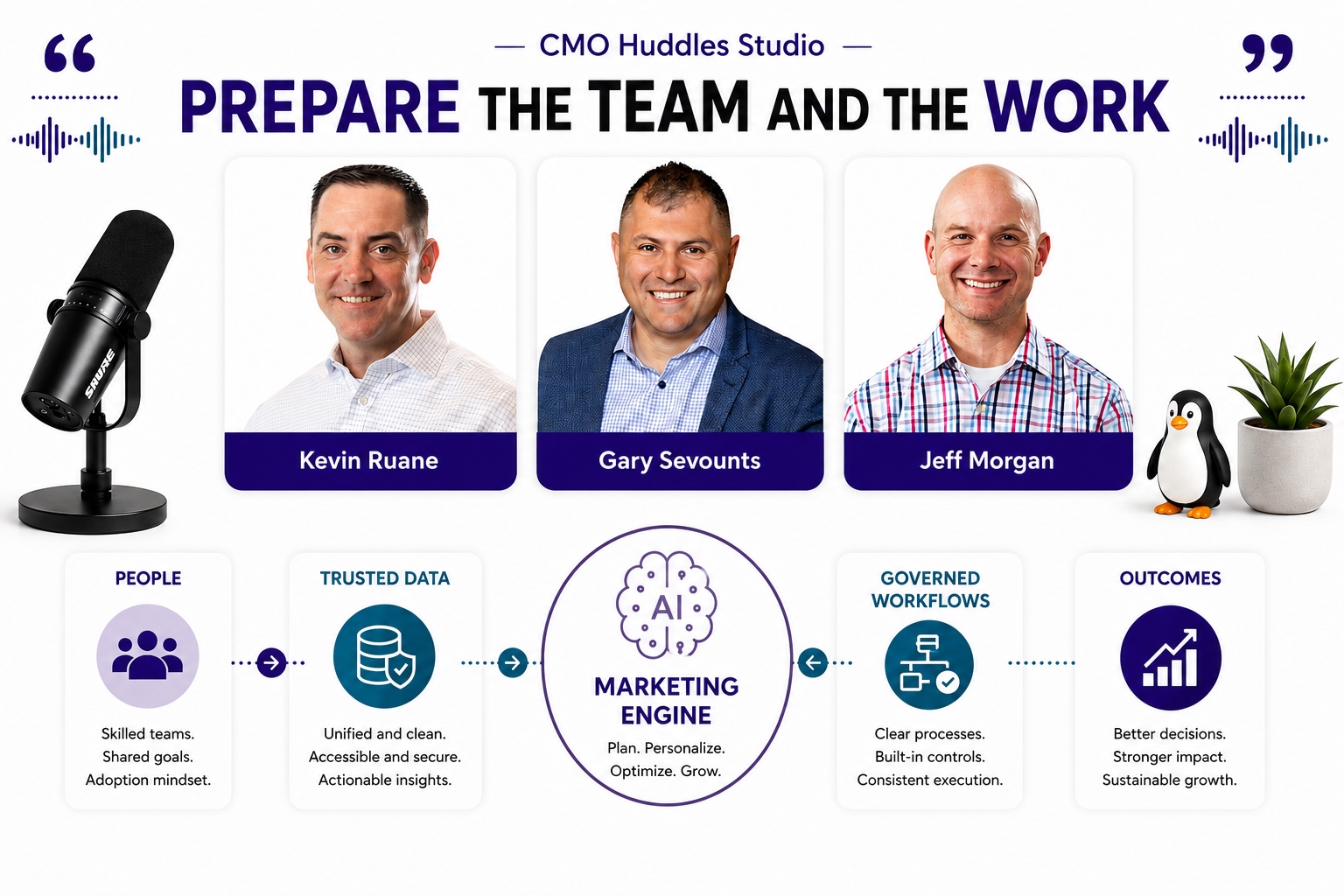
AI affects B2B marketing strategy, operations, content, pipeline, data, roles, and customer experience. Kevin Ruane, Gary Sevounts, and Jeff Morgan explain how councils, internal champions, reliable data, structured prompting, and workflow measurement can help teams prepare. The larger opportunity lies in redesigning useful work while preserving human judgment, accountability, and trust across the entire organization.
AI entered many marketing teams through individual tools and isolated productivity experiments. Its broader impact now reaches the operating model.
A CMO Huddles Studio conversation about AI’s impact on B2B marketing brought together Kevin Ruane, Gary Sevounts, and Jeff Morgan.
“GenAI is fundamentally changing everything for B2B marketing. It’s not merely about tools and efficiency. It is literally everything from strategy to all of the operations.”
Kevin’s perspective expands adoption beyond choosing software. AI affects how teams organize knowledge, design workflows, make decisions, create content, manage pipeline, and interact with customers. That scope turns adoption into a leadership and operating-design challenge.
An AI council can connect marketing with legal, IT, security, operations, product, and other teams affected by adoption. The group can clarify approved uses, identify risks, accelerate low-risk experiments, and share what the organization learns.
Kevin explained that Precisely worked to “have a structure in place and a functional leader who is the liaison to the AI Council.” Those functional leaders understand the work closely enough to translate companywide guidance into relevant experiments, surface concerns, and share useful practices across teams. A workflow developed in content may help sales enablement, while a research approach created in product marketing may support customer success.
The structure becomes more valuable when it enables progress as well as governance. A council that only rejects ideas may push experimentation into unapproved tools and private workflows.
AI systems depend on the information available to them. Fragmented, outdated, or inconsistent data can produce faster confusion.
Data readiness includes ownership, definitions, access, quality, privacy, and connections among systems. Teams also need clarity about which information may enter external models and which requires a protected environment.
A pilot can expose these issues before broader deployment. If the workflow repeatedly fails because the data is incomplete, adding a more advanced model will not solve the underlying problem.
AI often acts as a mirror for the operating system already in place. It can reveal inconsistencies and gaps that manual work allowed teams to manage informally. Resolving those foundations may produce value even before the AI workflow is scaled.
“AI can become like a central nervous system for the pipeline.”
Gary’s metaphor points toward a connected system instead of another static dashboard. AI can examine account activity, opportunity movement, engagement, and CRM information to identify where attention may be useful.
Human review remains important. A model may identify a pattern without understanding the relationship, political context, or customer history behind it.
The strongest use is often prioritization. AI helps teams notice what deserves investigation, while people determine the response.
A useful system can also reduce the time revenue teams spend assembling information from separate platforms. The value depends on whether the resulting signal is reliable enough to support action.
Jeff described SPARK, a framework for defining the role, workflow, brand voice, rules, and KPIs surrounding an AI task.
A structured prompt reduces ambiguity and gives employees a reusable way to provide context. It also makes the workflow easier to review because the team can see which inputs shaped the result.
The framework is especially valuable when several people need to produce consistent work. Instead of relying on one skilled user’s intuition, the organization captures part of that knowledge in a repeatable process.
Structured prompts do not eliminate review. They improve the starting conditions and make failures easier to diagnose.
If an output misses the mark, the team can examine the assigned role, source information, rules, or success criteria instead of treating the model as an unexplained black box.
“I can democratize the development of content to people who would have never been allowed to create content before.”
Employees across the company often hold valuable expertise but lack the time or writing experience to turn it into publishable material. AI can help capture, organize, and develop those ideas.
Democratization introduces a quality challenge. More contributors can produce more useful insight, but they can also create inconsistency, unsupported claims, and review bottlenecks.
Editorial standards, source verification, brand guidance, and accountable review help the organization increase participation without treating every generated draft as finished work.
Subject-matter experts remain responsible for the accuracy of the ideas attributed to them. Editors remain responsible for clarity, consistency, and audience value.
As AI takes on more execution, human work can shift toward strategy, interpretation, relationships, creativity, and judgment. This transition may require new skills and role definitions. Employees need opportunities to learn, experiment, and understand how expectations are changing.
Leaders also need to distinguish between reducing effort and improving value. Automating a low-value process may make it faster without making it more useful. Redesigning the workflow can remove unnecessary steps and create a better outcome. Human judgment becomes especially important when the work involves customer relationships, high-stakes claims, sensitive information, or decisions with consequences the model cannot understand.
A successful demonstration is not yet a standard operating process. The workflow needs to function beyond one carefully selected example or one highly skilled user.
The organization needs to understand its purpose, inputs, ownership, review, risks, measures, and downstream effects. It also needs evidence that the improvement persists when other people use it. Scaling then becomes an operating decision rather than an expression of enthusiasm.
Documentation helps the workflow spread without losing the knowledge developed during the pilot. Ongoing ownership ensures that the sources, instructions, integrations, and standards remain current.
It can influence strategy, operations, content, customer experiences, pipeline management, data, roles, and team design.
It can coordinate governance, approvals, shared learning, risk management, and cross-functional adoption.
AI systems cannot reliably compensate for fragmented, outdated, inaccessible, or poorly defined information.
When its purpose, workflow, ownership, review, risks, and business impact are clear and repeatable.
Listen to the full conversation with Kevin Ruane, Gary Sevounts, and Jeff Morgan.
CMO Huddles helps B2B marketing leaders win by bringing together peers, fresh perspectives, and opportunities to build stronger personal brands. Want to join the huddle? Learn more about CMO Huddles and join CMO Huddles Starter.