
Back to Blogs
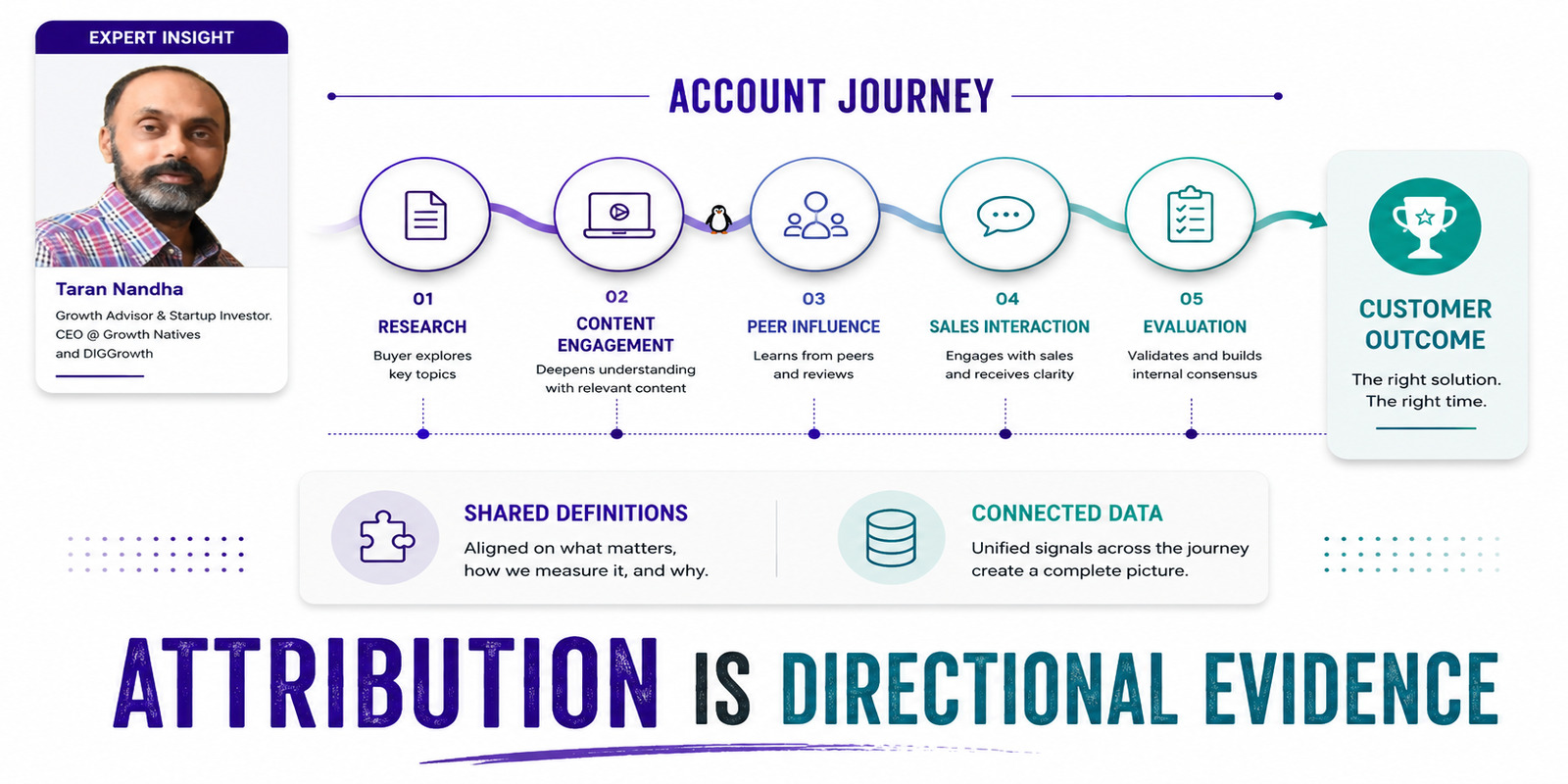
Marketing attribution becomes more useful when it explains a complex buying journey instead of assigning one winner. Growth Natives CEO Taran Nandha connects multi-touch analysis with clean data, shared definitions, offline interactions, account-level insight, and business objectives. Directional evidence can support more informed decisions about investment, coordination, measurement, and customer progress across the revenue team.
Complex B2B purchases involve multiple people, channels, conversations, and periods of private research. Giving all the credit to the first or last recorded interaction simplifies reporting, but it rarely represents the full journey.
In a Renegade Marketers Unite conversation about marketing attribution, Taran Nandha, founder and CEO of Growth Natives, explored how data, processes, and organizational alignment shape attribution.
“For true attribution reporting, you need to have a consolidated view of your customer’s journey. Not just a digital footprint, but also offline things like events and the efforts of the sales team to get a comprehensive picture.”
That consolidated view changes attribution from a channel-ranking exercise into a way of understanding how customers progress. It recognizes that marketing, sales, partners, events, customer references, and private research may all contribute to a decision.
First-touch attribution identifies the recorded entry point. Last-touch attribution identifies the final recorded interaction before conversion. Both can answer specific questions, but neither explains everything between those moments.
A buyer may encounter original research, attend an event, return through search, speak with a peer, review customer evidence, and engage with sales. The buying group may also contain several people whose activities are stored as separate contact records.
Giving one interaction all the credit overlooks the assists that build familiarity, reduce uncertainty, or help the group reach agreement. It can also distort investment decisions by rewarding whichever channels happen to sit closest to a trackable conversion.
Multi-touch attribution distributes influence across recorded interactions. Account-level analysis adds another layer by connecting activity from several contacts to a shared company journey.
The resulting model will not deliver an indisputable credit score. It can provide a more useful view of the patterns associated with customer progress.
A company can invest heavily in attribution technology and still produce reports nobody uses. The model becomes useful when it begins with a specific decision.
That decision might involve channel investment, event strategy, account progression, campaign combinations, or the relationship between digital and sales activity. Different questions require different data and different levels of analytical sophistication.
Shared definitions become especially important here. Marketing, sales, finance, and revenue operations may interpret the same terms differently. Before choosing a model, the organization needs agreement on what counts as a meaningful touch, when an opportunity enters the journey, how accounts are identified, and how influence differs from sourcing.
Without that alignment, a sophisticated model can produce a more elaborate disagreement. The technology may calculate a precise answer to a question the leadership team never agreed to ask.
Taran then described the information included in a comprehensive attribution model.
“At a minimum, you need data from all your ad platforms, all your events, all your top-of-the-funnel activities. Then you need data from all the touchpoints activated through your marketing automation platform. And then finally, the revenue data is coming from your CRM.”
Connecting the systems is only part of the work. The information also needs consistent campaign structures, account identifiers, lifecycle stages, and definitions
Identity resolution becomes particularly important when a buyer visits anonymously before completing a form or when several people from the same company engage through different channels. Poorly connected records can make one buying journey appear to be several unrelated ones.
Data hygiene affects credibility and analytical accuracy. When sales and marketing recognize obvious gaps in the underlying information, they have little reason to trust a complex attribution output built on top of it. Clean data will not reveal every influence, but it improves the reliability of what can be observed.
Executive conversations, peer recommendations, analyst relationships, events, communities, and private research may never appear as neatly trackable interactions. This does not make them irrelevant. It exposes the dataset's limits.
An event may influence an account months before an opportunity opens. A customer recommendation may give the buying group confidence without producing a trackable click. A sales conversation may resolve the objection that kept the deal from progressing.
Marketing attribution becomes more credible when it is presented as directional evidence. The model can reveal patterns among observable interactions while acknowledging that some of the journey remains private.
That distinction protects the analysis from false precision. It also gives executives a more honest basis for making decisions about programs whose value develops through relationships, trust, and long buying cycles.
Large customer-journey datasets can contain more combinations than a person can reasonably analyze manually.
Taran described how “AI and machine learning” can help identify “the most preferable paths of least resistance,” including commonly traveled journeys that lead toward revenue.
These tools may help teams compare cohorts, find recurring sequences, and recognize where accounts tend to stall. A company might discover that certain combinations of content, events, and sales engagement appear more frequently among successful opportunities.
AI does not eliminate the need for shared definitions or reliable data. Automated analysis can scale existing errors as easily as it scales insight.
The output becomes most useful when it helps the organization form and test a business hypothesis. A pattern can direct attention toward a question without being presented as proof that one interaction caused the outcome.
Deep attribution requires technology, implementation, governance, maintenance, and analytical expertise. The cost needs to make sense relative to the decisions the system will support.
“For deep marketing attribution analytics, you have to be spending at least half a million on paid media and other campaigns. You should be willing to spend anywhere between 5–7% of that budget to actually measure the success.”
That rule of thumb will not fit every organization, but it highlights an important tradeoff. A smaller marketing program may gain more from improving data quality, campaign governance, and shared reporting than from building a complicated attribution model.
A larger organization with substantial cross-channel investment may benefit from deeper analysis because small improvements in allocation can have meaningful financial consequences. The appropriate level of sophistication is the one that produces evidence the organization can understand and use.
Attribution conversations can easily become contests over who created the opportunity. That framing encourages functions to defend their numbers instead of examining the customer’s experience.
A team-based approach asks different questions. Which interactions helped the account progress? Where did confidence increase? Which combinations appear repeatedly among strong opportunities? Where do accounts stall?
Those questions recognize that revenue emerges from a connected system. Marketing may create awareness and useful content. Sales may build the commercial relationship. Customer advocates may reduce risk. Product and reputation influence the decision before either team can observe it. Attribution becomes strategically useful when it improves coordination instead of distributing trophies.
It distributes credit or influence across several recorded interactions in a customer journey.
They recognize one moment while excluding other interactions that may have influenced the buying group.
Rarely. Peer conversations, communities, offline activity, and private research may remain invisible.
Clear questions, shared definitions, connected data, executive agreement, and a decision the analysis can inform.
Listen to the full conversation with Taran Nandha.
CMO Huddles helps B2B marketing leaders win by bringing together peers, fresh perspectives, and opportunities to build stronger personal brands. Want to join the huddle? Learn more about CMO Huddles and join CMO Huddles Starter.