
Back to Blogs
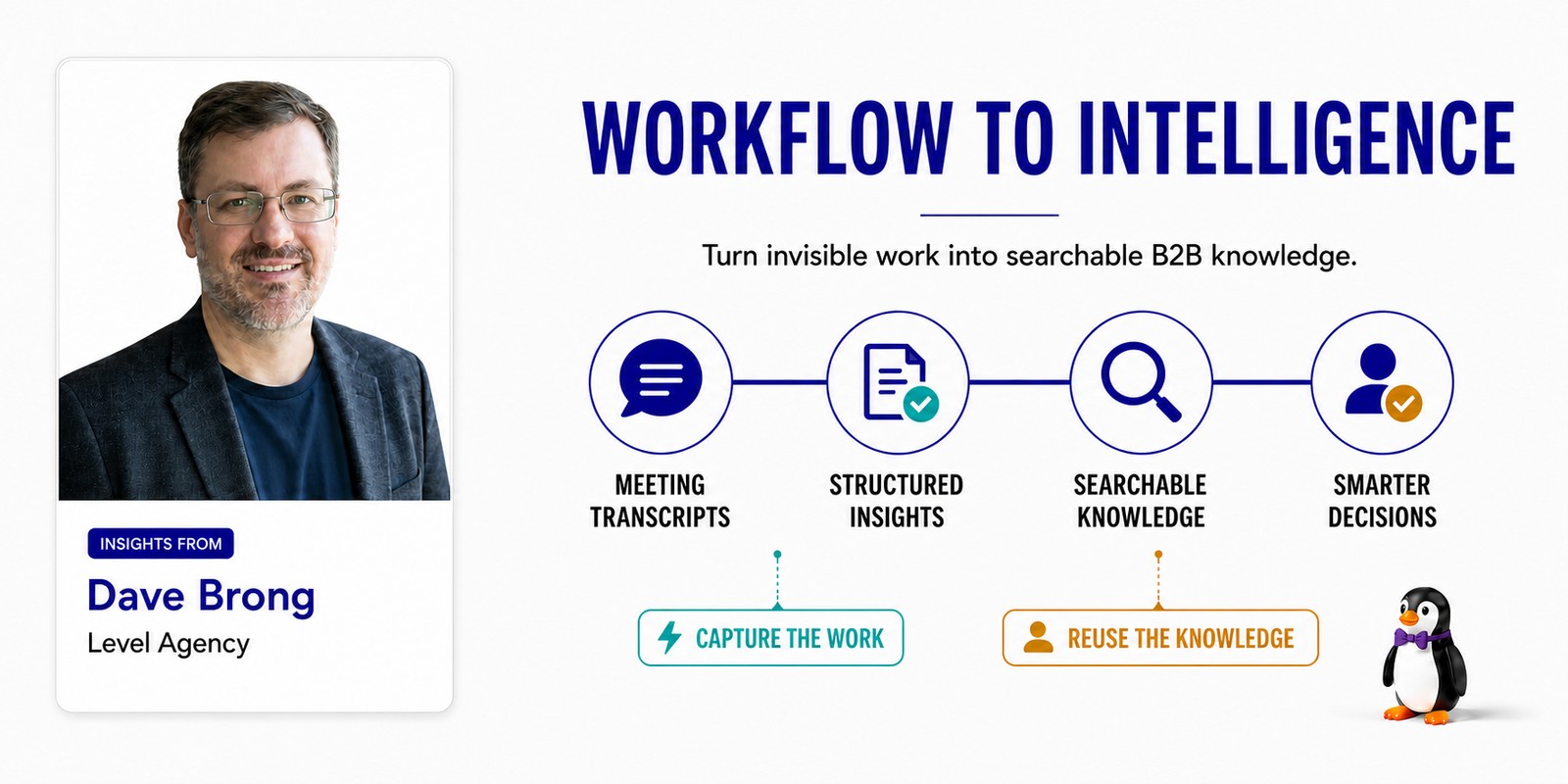
Marketing workflows become more valuable when automation captures the context buried inside repetitive work. Dave Brong explains how CMO Huddles transformed meeting transcripts into structured B2B intelligence that improves search, member matching, recaps, and institutional memory. The lesson is simple: Begin with the business problem, combine reliable automation with selective AI, and preserve human judgment.
Every marketing team carries invisible work. It lives in transcript cleanup, meeting recaps, manual tagging, document searches, CRM updates, and the repeated effort required to find something the organization already knows.
Automating those steps can save time. Connecting them can create something more valuable: Institutional intelligence that becomes easier to search, analyze, and apply.
That distinction emerged when CMO Huddles worked with Dave Brong, VP of Technology & AI at Level Agency, to transform hundreds of recorded conversations into a structured knowledge system.
The project began as an efficiency play. It became a way to improve recaps, surface insights, find relevant expertise, and understand how member needs change over time.
The project did not begin with a model or tool. It began with repetitive work.
Meeting transcripts were scattered across folders. Creating recaps required manual cleanup. Finding an earlier insight meant remembering which conversation contained it and searching through the transcript.
Dave’s first lesson was to articulate the challenge before designing the system.
“Articulate your challenges up front, try to get the idea out and put it on paper.”
That definition created practical success criteria. The system needed to collect transcripts consistently, clean them reliably, extract useful information, and make that information searchable.
Starting with the problem also made it easier to separate work that required AI from work that did not.
Only a small portion of the finished system relied on AI.
Standard code handled deterministic tasks such as removing timestamps and cleaning transcript formatting. That approach produced the same result every time.
AI handled work that required interpretation, including identifying quotations, extracting takeaways, and recognizing details such as:
This separation matters because AI is not automatically the best answer for every step. Reliable processing works well when consistency is the goal. AI becomes more useful when the task requires understanding language or context.
The resulting workflow combines both.
A transcript contains information, but information alone is difficult to apply at scale.
The system converts selected details into structured metadata. That structure makes it possible to search across conversations and see how an organization, challenge, or participant has changed over time.
Dave described this as temporal intelligence. A conversation may reveal that a company is considering a platform change. A later conversation may show whether that transition happened. Instead of treating each meeting as an isolated event, the system builds a more useful history.
That intelligence can support:
The value comes from making existing knowledge easier to reach.
Automation can surface options without making the final decision.
When the system identifies possible quotations, Drew Neisser still chooses the one that best supports an editorial argument. When it produces a recap, a person can review the result before distribution. When it suggests a member match, human context still determines whether the introduction makes sense.
“My approach is always amplifying the human value or the human potential.”
That principle keeps the workflow focused on amplification. The system handles repetitive work and expands what people can see. Humans remain responsible for judgment, relationships, and interpretation.
The project also demonstrates why workflow design cannot stop at the visible output.
Private conversations may contain personal, strategic, or company-specific information. Dave emphasized that the database remained private and that preprocessing removed information that did not need to enter the AI layer.
Security was not added after the workflow worked. It shaped the workflow from the beginning.
That includes deciding:
The more useful a knowledge system becomes, the more important those boundaries become.
The original goal was to reduce manual work. The larger opportunity came from what the captured time and information made possible.
“It’s amplification.”
A workflow that produces more recaps is efficient. A workflow that also improves peer connections, reveals recurring needs, and makes years of conversations searchable creates additional business value.
That is the difference between automating a task and designing an intelligence system.
AI workflow automation connects repeatable marketing steps, systems, and data while using AI selectively for tasks that require interpretation, classification, or extraction.
No. Standard automation is often more reliable for deterministic work such as transcript cleanup or data movement. AI is more useful when the workflow needs to understand meaning or context.
Useful safeguards include private databases, preprocessing, access controls, data minimization, approved AI providers, and human review before information is distributed.
A workflow becomes more valuable when it improves decisions, customer understanding, institutional memory, or business outcomes in addition to saving time.
Listen to the full conversation about B2B intelligence and AI workflows.
CMO Huddles helps B2B marketing leaders win by bringing together peers, fresh perspectives, and opportunities to build stronger personal brands. Want to join the huddle? Learn more about CMO Huddles and apply to join the community.