
Back to Blogs
Drew Neisser is the founder of CMO Huddles and a globally recognized authority on B2B marketing. He’s an AdAge columnist, LinkedIn TopVoice, leading CMO coach, podcast host & friend of penguins everywhere.
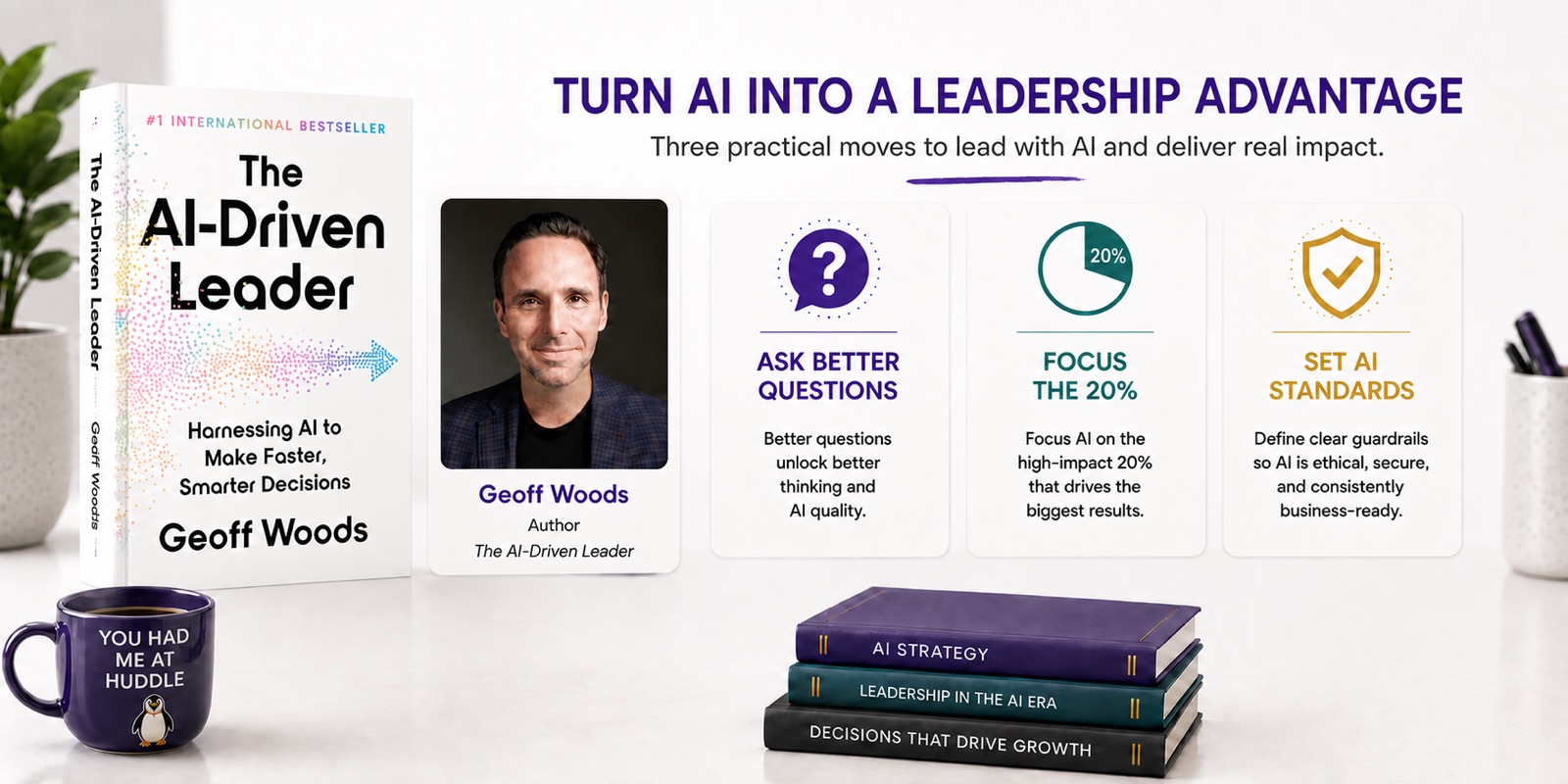
Geoff Woods, author of The AI-Driven Leader, argues that executives are misusing AI when they treat it as IT’s job, chase low-value use cases, or ask it for answers instead of better questions. For B2B CMOs, the opportunity is bigger: use AI to sharpen strategy, strengthen leadership, and focus teams on work that matters.
When Geoff Woods joined a recent CMO Huddles Expert Huddle, he did not ease into the conversation.
Asked what executives are getting wrong about leadership in the AI era, Geoff started with this: “They think it’s IT’s job, not their job.”
That one landed.
Geoff, author of The AI-Driven Leader, is not saying IT has no role. Of course IT matters. Security, systems, infrastructure, governance, data access, and vendor management all require serious technical ownership. But AI leadership cannot be outsourced to the team that manages the stack.
As Geoff put it, leaders do not need to become AI experts, but they do need to become “AI-driven leaders,” meaning they understand enough about the technology because they use it personally. Only then can they “define and cast your vision for the future,” “define strategy for how you are going to win,” and “start to lead the change.”
In CMO Huddles language, I’d adjust that slightly.
The goal is not to be AI-driven. The goal is to be AI-empowered.
That distinction matters. AI-driven can sound like the machine is steering. AI-empowered puts the leader back where they belong: in charge of the questions, the judgment, the standards, and the outcomes.
The penguin holds the wheel.
Geoff’s second warning was just as direct: executives are using AI “for 80% of the tasks that only drive 20% of the results, not the 20% that drive 80% of the results.”
That is painfully familiar.
Too many teams are still using AI mainly to write better emails, summarize meetings, polish copy, or act like “really smart Google.” Useful? Sure. Transformational? Not usually.
Geoff framed his filter this way: “Will this help me create better leaders who can create a better business, who can create better lives? If it can help me achieve my goals, then it’s a 20% priority. Otherwise, it is literally a distraction.”
That is the CMO challenge in miniature.
AI makes it seductively easy to do more. More campaigns. More content. More experiments. More dashboards. More drafts. More synthetic productivity flying around like confetti in a wind tunnel.
But more is not the same as better.
CMOs already live in a world of too many meetings, too many requests, too many dashboards, and too many “quick asks” that somehow require nine people and a goat sacrifice to complete. AI should help marketing leaders focus on the few things that create outsized impact, not accelerate the junk drawer.
The question is not, “What can AI help us do?”
The sharper question is, “What work matters enough for AI to help us do it dramatically better?”
The biggest lightbulb moment from Geoff’s book, at least for me, is the CRIT method.
CRIT stands for:
It is simple enough to remember and powerful enough to change the quality of your thinking.
The basic move is this: instead of asking AI for an answer, give it context, assign it a role, have it interview you one question at a time, and then ask it to complete a specific task.
Geoff explained the key line this way: “Interview me. Ask me one question at a time, up to three questions, to gain deeper context.”
That “one question at a time” part is not decorative. It is the magic. As Geoff noted, if AI asks all the questions at once, it becomes overwhelming and shallow. But when it asks one question, listens, and then asks a better follow-up, it pulls context out of your head that you would not have thought to provide.
This is why I use CRIT all the time.
And yes, I insist the CMO Huddles team uses it too. Not because we need everyone to become prompt engineers. We don’t. But we do need everyone to become better thinkers, better briefers, better question-askers, and better collaborators with the tools now sitting at our digital conference table.
Geoff shared a powerful example from his time as chief growth officer at Jindal Steel. He uploaded an annual business plan into a secure ChatGPT instance and prompted AI to act as “an aggressive, growth-minded board member with deep expertise in the steel industry.” Then he had it interview him to identify where the plan was insufficient and recommend changes that could improve results in the next 30 days.
The result, he said, was “profoundly deep, industry-specific questions” and a roadmap for strengthening the plan.
That is not AI as a copywriter.
That is AI as a thinking partner.
One of the strongest ideas from the conversation was this: AI does not replace leadership. It exposes it.
If your strategy is fuzzy, AI will expose that. If your data is messy, AI will expose that. If your priorities are unclear, AI will expose that. If your team is confusing activity with impact, AI will help them do that faster and with better formatting.
Progress, sort of.
Geoff’s view is that the AI era requires a “new category of leader.” He connected this to a deeper historical shift, arguing that the industrial education system trained people to “show up to work on time, take direction from a boss, do something repetitively with minimal error and maximum efficiency.”
Then he offered the bigger provocation: “We stopped building the skills that make us human and started building the skills that make us act like machines. Isn’t it interesting that it might be a machine that returns us back to being human?”
That is the heart of the leadership opportunity.
The best use of AI is not to make humans more machine-like. It is to free humans to do more of the work that requires judgment, creativity, empathy, discernment, courage, and strategic clarity.
For CMOs, that means rethinking roles around strengths, not just job descriptions. Geoff argued that leaders need to ask: “Who are you? What are your God-given strengths that could become superpowers? How do we harness those strengths, focus them on the 20% priorities of the role in alignment with company goals, and use AI to turn those strengths into superpowers?”
That is a very different talent conversation.
It is also a much better one.
Geoff is not soft on accountability. He calls his approach “leading with empathetic strength,” which means meeting people where they are while also making the standard clear.
Some employees are optimistic about AI. Give them a challenge.
Some are fearful. Meet them with empathy, but do not let fear become a permanent exemption from change.
Geoff’s suggested conversation is blunt: “You didn’t pop out of the womb knowing all the skills to do this job today. You learned them.” Because of AI, some skills and processes are going up in value while others are going down. Leaders need to help people master the skills that are rising.
Then comes the line CMOs may want to tape to their office door: “Standards without consequences are merely suggestions.”
That is a bracing sentence. It is also a useful test.
Is AI adoption a standard in your marketing organization, or is it a suggestion?
Geoff shared that he asks team members to put two sticky notes on their desk. One says, “How can AI help me do this?” The other says, “Context, Role, Interview, Task.” Then, once a day for 30 business days, they need to write a CRIT on something they are already doing.
Not someday.
Not after the AI committee blesses the laminated acronym.
Today.
Geoff also shared a provocative example from his own company. He hired a potential CRO who was not yet an AI-driven leader and made daily AI usage a requirement. After repeated conversations and no use cases, Geoff said, “28 days in, I terminated him. This was not optional in our company.”
That story will make some leaders uncomfortable. It should.
Not because every company should copy the exact consequence. But because every CMO does need to decide whether AI fluency is becoming part of the job or staying a polite suggestion in the employee newsletter.
Chapter 12 of Geoff’s book focuses on creating 10x impact from employees. That number gave me pause.
CMOs are already being asked to do more with less. Sometimes much more with much less. A 50% budget cut paired with a 40% growth target is not exactly a spa day.
So when someone says every employee can create 10x impact, the natural response is skepticism with a side order of panic.
Geoff’s answer: “I think I’m sandbagging it.”
He told the story of his executive assistant, who used CRIT to rethink her own role. She identified the 20% of work she should double down on, the work she should stop doing, the work AI could automate or augment, and the human work that still needed to be done. Then she drafted a job description for her replacement, a 90-day onboarding plan, compensation research, and a new way to make Geoff dramatically more valuable.
Geoff’s conclusion: “Did she bring 10 times more value in that single use case? Way more.”
That is the real promise. Not AI as a productivity hack. AI as a way to redesign work around value.
The same principle applied at organizational scale in Geoff’s example from T-Mobile. After a major restructuring, the talent organization needed to identify what to continue, pause, and stop; where to embed AI to do more with less; and how to protect culture. Geoff said his team helped them do in one day what would normally take months.
The line that stuck came from the executive: “We didn’t just talk about changing the way we work. We just did it.”
That is the bar.
For B2B CMOs, becoming AI-empowered starts with personal practice and visible leadership.
You cannot delegate this entirely to IT. You cannot let your team confuse tactical experimentation with strategic transformation. And you cannot ask employees to build AI fluency if you are not building it yourself.
Here are five practical moves.
Pick something you are already doing and apply CRIT. Do this once a day for 30 business days. Not for trivia. Not for polish. Use it on strategic thinking, prioritization, meeting design, board prep, campaign tradeoffs, customer insight, or team development.
Stop treating AI like an oracle. Geoff’s advice is to turn the tables. Have it interview you one question at a time so it can unlock better context and improve the quality of the output.
Do not chase every shiny tool or use case. Ask whether the work improves leadership, business performance, customer value, or team capacity. If not, it may be a distraction with a subscription fee.
Help the fearful. Challenge the optimistic. But make expectations clear. If AI fluency matters, say so. If daily practice is required, make it visible. If standards have no consequences, they are suggestions.
The goal is not better prompting for its own sake. The goal is better decisions, faster alignment, clearer priorities, stronger teams, and more valuable work.
That is what AI-empowered leadership looks like.
At the CMO Super Huddle in Palo Alto on October 22-23, we hope every attendee leaves more AI-empowered.
That means more than knowing which tools are hot this quarter. It means spending a day and a half with fellow B2B CMOs exploring how AI is changing leadership, org design, decision-making, team development, growth strategy, and the work of marketing itself.
The CMOs who win this next chapter will not be the ones collecting the most tools.
They will be the ones asking better questions, setting clearer standards, and using AI to become more human, more strategic, and more effective leaders.
An AI-empowered CMO uses AI as a thought partner, not just a productivity tool. They stay in control of strategy, judgment, priorities, and outcomes while using AI to improve thinking, alignment, decision-making, and execution.
CRIT stands for Context, Role, Interview, and Task. You give AI background context, assign it a role, ask it to interview you one question at a time, and then give it a specific task. This helps AI generate better outputs by first extracting better inputs.
AI gives better answers when it has better context. Having AI interview you one question at a time helps uncover assumptions, gaps, priorities, and details you may not have thought to include in the initial prompt.
CMOs should combine empathy with clear standards. Support employees who are fearful, challenge those who are optimistic, and define what AI fluency means in practice. If AI usage is a standard, it needs visible expectations and follow-through.
The biggest mistake is using AI mostly for low-value tasks while ignoring the strategic work that drives real impact. AI should help CMOs focus on the 20% of work that creates the most value for the business, the team, and customers.
CMO Huddles helps B2B marketing leaders win by bringing together peers, fresh perspectives, and opportunities to build stronger personal brands. Want to join the huddle? Learn more about CMO Huddles and apply to join the community.