
Back to Blogs
Drew Neisser is the founder of CMO Huddles and a globally recognized authority on B2B marketing. He’s an AdAge columnist, LinkedIn TopVoice, leading CMO coach, podcast host & friend of penguins everywhere.
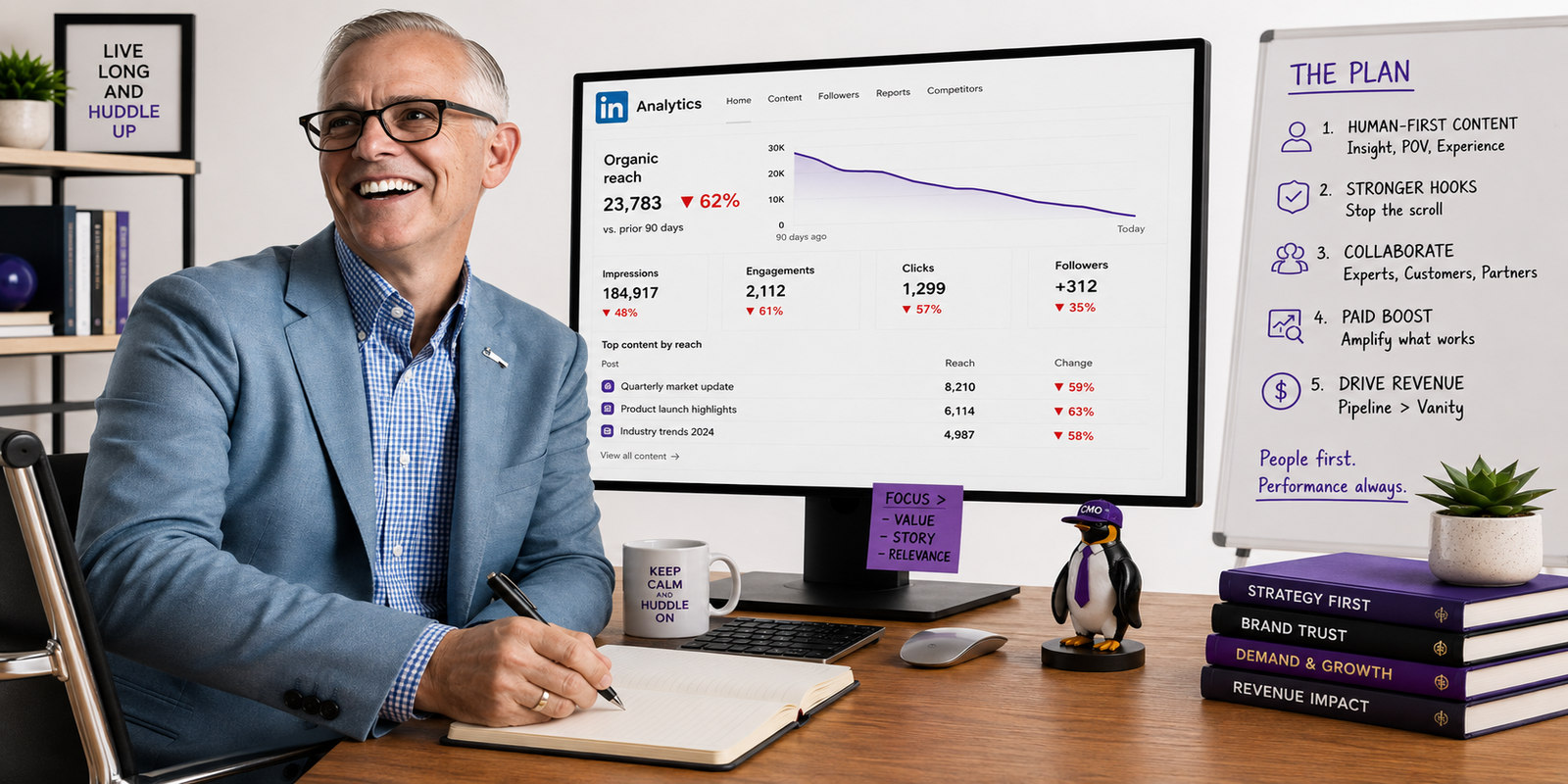
If your LinkedIn organic impressions have fallen off a cliff lately, you are not imagining it. Many creators are seeing the same decline. So what should B2B CMOs do when organic reach nosedives? Not panic or punish the social team. Adapt your strategy to the platform we have, not the one we wish we still had.
Why is this happening? We can only speculate. My theory is that LinkedIn is doing two things at once. First, it is competing for attention with consumer social networks by rewarding more visually sticky, personality-driven content. Second, it is optimizing for revenue by nudging brands and creators toward paid amplification.
The result is a strange new reality where thoughtful business content often loses out to selfies, smiling team shots, and posts that feel suspiciously Instagram-adjacent. Annoying? Yes. Surprising? Not really.
For CMOs, the practical question is not whether this is fair. Platforms do not run on fairness. They run on incentives. The better question is how to keep LinkedIn useful when organic distribution becomes less dependable.
Let’s start here, because this matters.
If impressions are down, that does not automatically mean your social team forgot how to do their jobs. Platform dynamics change. Algorithms shift. Distribution contracts. Sometimes the game board changes in the middle of the quarter and nobody sends you a memo, because apparently even memos now need paid amplification.
Before marching into the next marketing meeting demanding to know why reach is down 40, 50, or 75 percent, take a breath. This appears to be broader than your company, your content calendar, or your latest campaign.
One of the more maddening realities of LinkedIn in 2026 is that human faces often outperform polished brand content.
As Mandy McEwen of Luminetics put it, people are craving humans right now because they are trying to cut through what she called “AI slop.”
That does not mean every post needs to look like an audition reel for a lifestyle influencer. But it does mean brands need to stop hiding behind logos, stock art, and bloodless corporate graphics.
Real people. Real team members. Real moments. More humanity.
And yes, it pains me a bit to write that selfies may now be part of the B2B marketing toolkit. But here we are.
Because it does.
According to Mandy, the hook is now more important than ever. If the first sentence of a post does not stop the scroll, the content may be dead before it has a chance. The same goes for video: The first words out of your mouth matter more than the production quality.
That means CMOs need to push their teams to spend less time polishing paragraph four and more time nailing line one. A smart idea buried under a soft opening is still buried.
If you cannot earn attention immediately, the algorithm is not going to do you any favors.
Mandy’s other big recommendation: Get more collaborative.
That means partnering with industry peers, customers, advocates, and adjacent brands. It means finding smart ways to create content that includes other credible humans rather than broadcasting solo into the void. Mandy also noted that LinkedIn is leaning further into collaboration features, which should tell CMOs something about where the platform is headed.
In a lower-organic environment, collaboration can do two useful things at once:
And right now, both matter.
This is the part nobody loves, but most CMOs should probably accept it and move on.
Mandy’s view was blunt: LinkedIn is becoming “pay-to-play,” much like Facebook did years ago.
If you have an important post and you want it in front of a specific audience, you may need to put budget behind it. That is not a moral failure. It is not proof that content is dead. It is just the economics of the platform asserting themselves.
You can keep shaking your fist at the algorithm if that brings you joy. But if the post matters, fund the distribution.
Not every post deserves paid support. And not every account is the right vehicle.
Mandy recommends boosting strategic posts from an executive’s personal account rather than a company page whenever possible. She also shared practical benchmarks: Around $250 per post as a starting point, and roughly $750 per month as a reasonable test budget.
That does not mean spraying money at everything with a headline and a hashtag. It means identifying the posts that matter most, aiming them at a specific audience, and giving them enough support to actually get seen.
If you are promoting a key point of view, a major initiative, or a message that should drive pipeline, hoping organic will somehow do the job is increasingly optimistic.
This may be the most important shift of all.
Mandy described what she calls a “10K post” framework: A lead-generation post structure built around prospect pain first and the solution second.
The formula is straightforward: Spend about 80 percent of the post focused on the prospect’s pain points and only 20 percent on the solution, which comes at the end.
These posts are not designed to win popularity contests. In fact, Mandy made it clear that they may not perform particularly well organically. But they can drive revenue when paired with targeted paid support.
That is a useful reminder for every CMO staring at impression charts too long: Visibility is nice, but pipeline is nicer. A post that gets modest engagement and drives qualified interest is more valuable than one that gets a flood of empty likes from people who will never buy anything from you.
Yes, LinkedIn’s organic decline is frustrating. Yes, it is annoying that business content now seems to compete with a parade of happy faces and carefully casual photos. And yes, there is something deeply irritating about watching a professional network behave more like a consumer platform.
But the answer is not despair. And it is definitely not yelling at your social media team.
The smarter response is to adapt:
And whatever you do, do not beat up your social media team about declining organic impression numbers. They did not cause the nosedive.
They just have to help you fly through it without losing the whole flock.
LinkedIn appears to be rewarding more human, visual, and engagement-friendly content while also encouraging brands and creators to use paid amplification. The exact algorithm is not public, so CMOs should treat this as a working reality rather than a settled science.
Yes, but expectations should change. Organic content still helps clarify point of view, build executive visibility, and test messages. The mistake is assuming organic reach alone will reliably carry strategic posts to the right audience.
Boost posts tied to strategic business outcomes: Category POVs, executive thought leadership, event follow-ups, major research, or demand-generation messages. Do not boost every post. Fund the posts that deserve targeted attention.
Often, executive accounts perform better because people trust people more than logos. Company pages still matter, but senior-leader posts can feel more human, credible, and conversational when done well.
Impressions and likes are useful directional signals, but they should not dominate the conversation. CMOs should also track qualified engagement, audience relevance, profile visits from target accounts, inquiries, influenced pipeline, and revenue impact.
CMO Huddles helps B2B marketing leaders win by bringing together peers, fresh perspectives, and opportunities to build stronger personal brands. Want to join the huddle? Learn more about CMO Huddles and apply to join the community.