
Back to Blogs
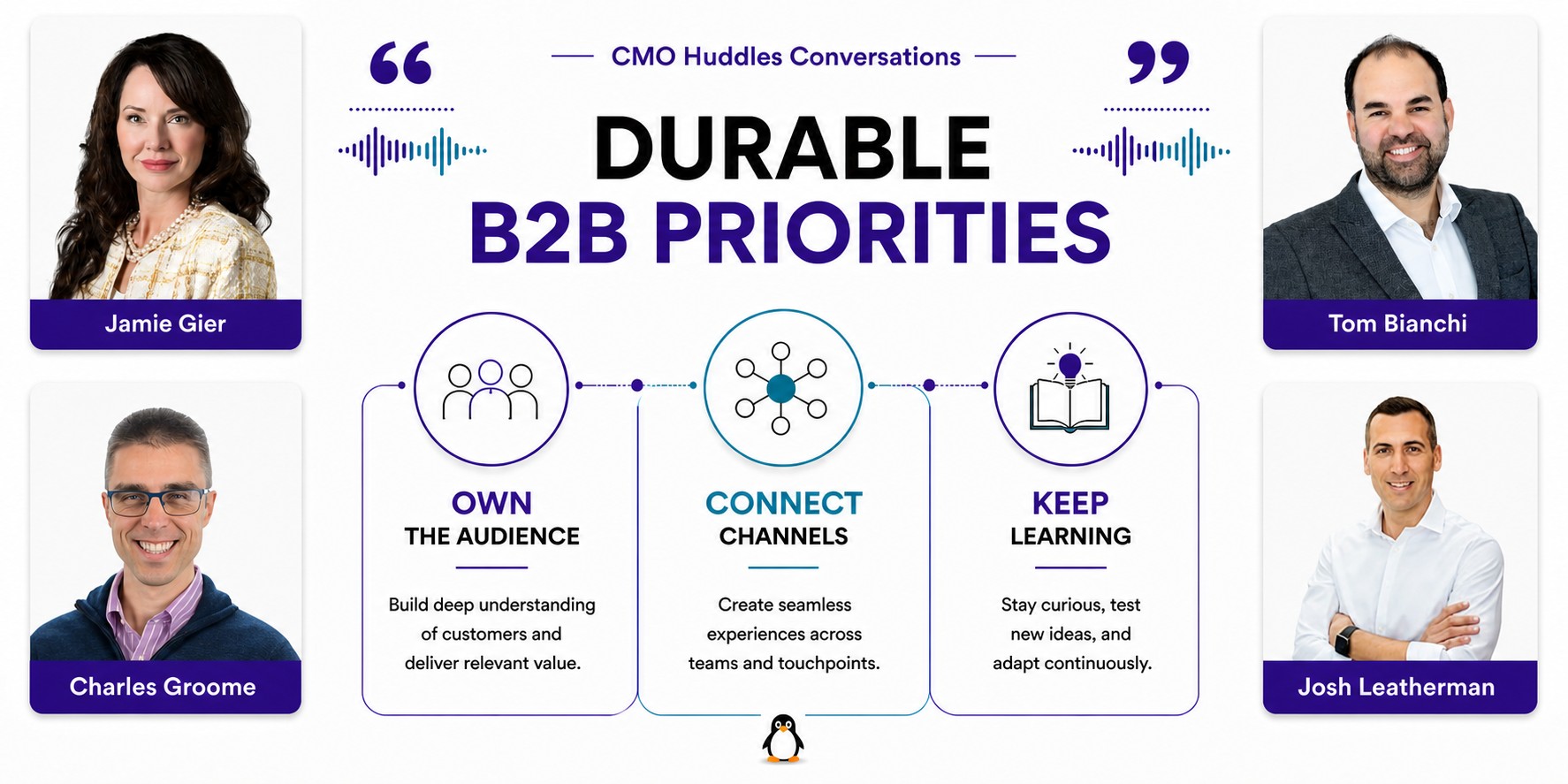
Annual predictions expire, but focused audiences, distinctive brands, connected channels, useful content, disciplined experimentation, and cross-functional collaboration remain durable. Drawing on perspectives from Jamie Gier, Charles Groome, Tom Bianchi, and Josh Leatherman, this conversation explores how marketing leaders can evaluate new opportunities while protecting the strategic foundations that make investments credible, connected, and commercially useful.
Annual predictions age quickly. The more useful question is which strategic ideas continue to hold up after the planning cycle ends.
A CMO Huddles Studio conversation about B2B marketing strategy featured guest host Jamie Gier with Charles Groome, Tom Bianchi, and Josh Leatherman.
At the time of the conversation, the panel represented DexCare, Biz2Credit, Acquia, and Service Express. Those company references provide historical context for the strategies discussed.
Jamie built the conversation around six LinkedIn polls examining where marketing leaders expected to place their 2025 bets. The resulting discussion covered events, ABM, brand, content, SEO, AI, talent, and collaboration.
The panel’s ideas remain useful because the tactics were connected to larger questions: Where are buyers paying attention? What helps the company remain memorable? Which investments deepen understanding? How can new bets strengthen an established growth system?
A planning process can become confusing when every investment is described as a bet. Established programs and new experiments have different jobs, risk levels, and measures of success.
“I’m going to interpret bets here in a very specific way, thinking about things we’re experimenting into, as opposed to those things that are kind of, you know, the house money.”
That framing allows a company to protect programs that reliably create value while reserving budget and capacity for learning. The experimental portfolio might include a new event format, audience, channel, partnership, or analytical capability.
Each experiment can be tied to a specific question. Did the format create deeper engagement? Did the channel reach a priority audience more efficiently? Did the partnership bring the company into a trusted conversation? A defined learning objective makes it easier to decide whether an experiment deserves expansion, revision, or a clean end.
Events are often evaluated as isolated lead-generation programs. The panel examined a broader role.
“In-house events are going to be a big bet area for us in 2025. There are two real value props here: Content creation and business development.”
A well-designed event can produce executive relationships, customer insight, peer discussion, sales progression, and reusable content. The commercial value may develop through follow-up conversations, while the intellectual value continues through articles, videos, research, and sales materials.
That broader view changes the event's design. Programming can surface useful disagreement, practical examples, and the language customers use to describe their priorities. Marketing can then turn those insights into material that extends the value beyond the people in the room. The event earns its place in the strategy when its audience, purpose, follow-up, and content plan reinforce one another.
ABM becomes limited when it is treated as a campaign confined to one advertising platform. Its value grows when audience selection, messaging, sales engagement, and channels operate as one motion.
Charles described expanding an ABM foundation “in a way that reaches our target accounts across all of the platforms where they happen to be online.”
The larger lesson concerns buyer behavior. Buyers do not organize their attention around a vendor’s preferred channel mix. They encounter ideas through communities, events, search, social platforms, colleagues, experts, and sales conversations.
Cross-channel execution works when the audience remains consistent, and each environment has a defined role. One channel may introduce an idea. Another can deepen understanding. A seller may add context when an account begins showing meaningful interest.
Adding channels without audience discipline creates noise. A clear audience allows new channels to extend the same strategic motion.
Influencer marketing in B2B often looks different from its consumer counterpart. The valuable voice may belong to a practitioner, analyst, consultant, community leader, customer, or specialist newsletter author.
Charles described the opportunity as finding “key voices in each of those segments that tend to drive the conversation.”
A respected person within a narrow buying community may contribute more than a broadly recognized name with limited relevance to the decision. Their value comes from authority, audience fit, and the quality of the conversation they can help create.
The relationship works best when the expert has room to contribute real perspective. A tightly controlled endorsement may generate a piece of content, but it rarely earns the trust that made the person influential in the first place.
Jamie used one of the poll findings to surface a persistent tension. Demand generation received the largest share of expected budget increases, followed by brand and reputation. She observed that marketers are often comfortable describing demand as revenue marketing while hesitating to discuss brand in the same commercial language, summing up the connection simply: “Today’s brand is tomorrow’s demand.”
“If you’ve got the wiggle room to bring your brand spend back, do it. You’ve got to be able to differentiate yourself from the competition and show the world what you do that’s better, that’s unique, that’s a new commercial proposition your competition doesn’t do.”
Demand programs operate differently when buyers already recognize, understand, and trust the company. Distinctive positioning gives events, content, ABM, search, and sales conversations a clearer reason to matter.
Brand investment still benefits from measurement. Recognition, direct traffic, branded search, consideration, conversion, retention, and pricing confidence can help reveal whether the company is becoming easier to remember and choose.
The poll audience identified owned content and SEO as the tactics expected to produce the highest return. The panel’s discussion made clear that content does more than populate a website. Content can extend the life of an event, support an ABM motion, help a buyer evaluate a decision, give sales a useful reason to follow up, and make the company’s expertise discoverable through search.
Josh noted that thoughtful content can keep contributing for years. Charles described content as a common denominator across event, paid, organic, and earned-media strategies.
That perspective shifts the planning question. Instead of treating content as another channel competing for budget, leaders can examine how it improves the performance and continuity of other investments.
The panel also considered where AI might create the most useful change in the year ahead.
“2025 will be the year of using AI in marketing for analytics and understanding the business better.”
That framing remains durable because it starts with a decision the organization wants to improve. AI can help synthesize signals, explore scenarios, identify patterns, and make complex information easier to examine.
Its usefulness depends on data quality, review, clear questions, and people who can interpret the output. Faster analysis does not compensate for inconsistent data or an unclear business problem.
The most promising applications connect technical capability with a specific decision, such as identifying changes in customer behavior, detecting pipeline patterns, or understanding which segments respond differently.
Later in the conversation, Jamie reflected on the work marketing still does to explain how buyers discover, evaluate, and purchase products. She connected that responsibility with collaboration across the organization.
Josh observed that marketing touches many departments and is therefore positioned to bring different groups into the same discussion. Charles suggested that marketing might even be viewed as the “clarity department.”
Those observations connect the panel’s different priorities. Events need agreement about audience and purpose. ABM requires coordination with sales. Brand depends on shared differentiation. Content draws on expertise across the company. AI analysis becomes useful when teams trust the inputs and understand the decision it informs.
A durable plan connects budget decisions with audience selection, market memory, and cross-functional execution. It clarifies whom the company intends to serve, which ideas it wants the market to remember, and how teams will work together to create a consistent experience.
Yes. The forecasts provide historical context, while the underlying principles remain relevant beyond that planning year.
Clear audience selection, useful programming, purposeful follow-up, and a plan for extending the content and commercial value.
Brand builds recognition, understanding, and preference. Demand programs help interested buyers continue toward a decision.
Analysis, synthesis, scenario exploration, and business understanding can create lasting value when supported by reliable data and human judgment.
Listen to the full conversation with Jamie Gier, Charles Groome, Tom Bianchi, and Josh Leatherman.
CMO Huddles helps B2B marketing leaders win by bringing together peers, fresh perspectives, and opportunities to build stronger personal brands. Want to join the huddle? Learn more about CMO Huddles and join CMO Huddles Starter.