
Back to Blogs
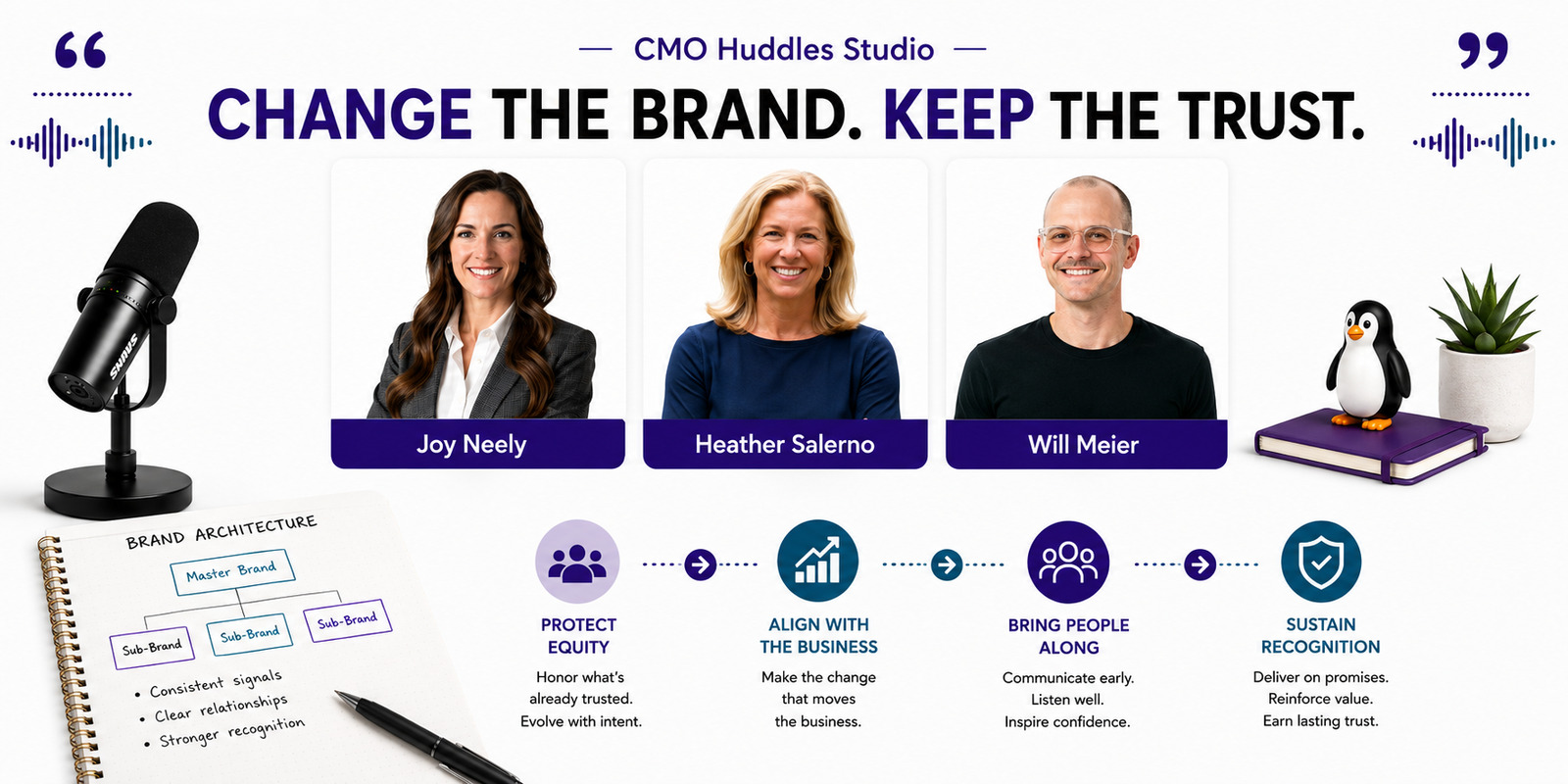
A successful B2B brand transformation begins with a business reason, protects valuable customer recognition, and gives employees a credible promise to deliver. Joy Neely, Heather Salerno, and Will Meier show how marketers can reclaim old equity, realign an evolving identity, manage multiple brands, and connect each change to customer needs and measurable growth over time.
A rebrand is easier to defend when the business has materially changed. A new logo may be the most visible outcome, but it is rarely the reason to begin. The stronger trigger is a gap between what the company has become and what its brand tells customers, employees, and prospects to expect.
In a CMO Huddles Studio conversation, Joy Neely of RedSail Technologies, Heather Salerno of Appcast, and Will Meier of FM described three different paths through that gap. One company reclaimed a familiar name, another realigned its identity after rapid growth, and the third built a family of distinct premium brands.
Their experiences point to a common principle: brand decisions work best when they clarify a real business strategy.
When Joy joined Medvantx, the organization had already moved away from the name customers knew. A previous leadership team had attempted to shift the business toward a different model under a new identity, creating confusion among customers who still associated the company with its established patient-assistance services.
The new leadership team decided to return to the Medvantx name and the company’s original strategic foundation. That choice preserved recognition the business had already earned while creating an opportunity to relaunch the company with a clearer service offering.
Joy explained why the organization chose to reclaim the older identity:
“There was discussion of, do we create a new name, or do we go back to an established brand that had positive brand equity in the market and build upon that?”
The value of the decision came from more than familiarity. Existing customers understood what Medvantx represented, and the name still carried positive associations. Returning to it reduced the burden of teaching the market an entirely unfamiliar identity.
That does not mean a company should always preserve an old name. It means leaders should understand exactly what they would be discarding. Awareness, search behavior, customer confidence, analyst understanding, and sales familiarity are business assets, even when they do not appear as individual lines on a balance sheet.
Medvantx did not relaunch its name in isolation. The company coordinated the return with a new service, conference activity, public relations, website updates, social promotion, and sales follow-up.
Joy summarized the lesson:
“Have a compelling story or platform for a successful rebrand. That’s one thing that really helped us, having a new service to launch and a lot of surround sound or an omni-channel plan to go with our rebrand.”
The conference gave the company access to a concentrated group of relevant buyers. Medvantx secured booth presence, arranged a main-stage speaking opportunity, announced the change publicly, scheduled customer meetings, and tracked the resulting sales opportunities.
This made the brand change part of a commercial motion. The relaunch was not merely an announcement that the company looked different. It gave customers a reason to reconsider what Medvantx could do for them.
The response was not immediate. Joy estimated that it took roughly nine to twelve months for the restored brand to regain broad recognition and begin contributing to closed business. That timeline matters because rebrands are often evaluated too quickly. Early indicators may include direct traffic, search recovery, customer recognition, employee adoption, and sales engagement before revenue becomes visible.
Appcast’s challenge was different. Heather had already led a substantial identity overhaul after joining the company in 2019. That work addressed a disconnect between a cold, technology-oriented presentation and the warmer, more human company customers and employees experienced.
Over the following years, Appcast grew rapidly, acquired another business, moved upmarket, and expanded its offering. The brand evolved along the way, but much of that evolution happened incrementally. Eventually, the pieces no longer felt like one coherent system.
Heather did not begin the next engagement assuming that Appcast needed another rebrand. The scope expanded as the team examined how much the business had changed. Acquisition, product development, audience shifts, and corporate alignment created reasons to reconsider the identity more deeply.
That distinction protects a CMO from the familiar accusation that every new marketing leader wants a new logo. The question is not whether the incoming CMO prefers the existing design. The question is whether the identity accurately supports the company’s current strategy and intended future.
Appcast returned to an agency with which it had developed considerable trust. The relationship allowed the agency to challenge assumptions and introduce possibilities the internal team had not initially placed within scope.
Heather offered practical advice about that relationship:
“Choose an agency that you like, because you’re going to spend more time with them than you think. It’s really important that they’re awesome at their jobs and awesome to work with.”
Compatibility alone is not enough. A productive agency must also be willing to make the team uncomfortable in useful ways. If every recommendation confirms what the organization already believes, the engagement may produce refinement without resolving the underlying strategic problem.
The internal team still owns the decision. External partners can identify inconsistencies, test language, expose weak logic, and create stronger creative options, but leadership must connect those recommendations to the business case and manage the resulting change.
Appcast did not attempt to update every artifact simultaneously. The team concentrated first on the properties that received most of the attention, while acknowledging that outdated materials would remain temporarily in less visible places.
Heather described the logic as updating the 10 percent of properties responsible for approximately 85 percent of views at launch. The rest would follow through a managed transition.
That approach avoids turning brand consistency into operational paralysis. High-priority touchpoints might include the website, sales presentation, product interface, recruitment materials, social profiles, customer communications, and major event assets. Lower-visibility materials can move through a scheduled migration.
The important requirement is transparency. Employees need to know which identity is current, where the approved assets live, what they can update themselves, and when remaining materials will change. A phased transition should feel intentional rather than accidental.
Will’s experience at FM centered on a different strategic choice: whether the company should operate as a branded house or a house of brands.
FM’s public-facing portfolio includes Musicbed, Film Supply, and Stills. Each serves distinct use cases and carries premium positioning in its respective market. Marketing and creative resources may be shared, but the brands require separate stories, experiences, and investments.
Will described the portfolio’s development as iterative rather than the product of one pristine master plan. The company launched new businesses as it recognized adjacent opportunities and learned from its existing brands.
The central question was whether extending an established name into a new category would create efficiency or dilute the premium position each offering could own independently. FM chose distinct brands, accepting the additional marketing burden in exchange for sharper category positions.
That tradeoff deserves explicit consideration. A branded house can concentrate awareness, simplify investment, and transfer trust across products. A house of brands can protect specialized positions, serve different audiences, and reduce the risk that one offering weakens another. Neither architecture is automatically correct.
Separate brands require separate attention. Each may need its own positioning, demand generation, website, customer experience, sales materials, and reputation-building effort. Shared services reduce some duplication, but they do not eliminate the work of earning recognition.
Will explained the economic value of a strong brand:
“If done well, in my experience, making the case for brand can make efficiencies in the rest of your spend. It’s cheaper to run and market a business that has a great brand than a brand that is poor or non-existent.”
That efficiency can appear through stronger conversion, lower resistance, greater pricing power, improved recruitment, higher employee confidence, and more productive sales conversations. The value is not that brand replaces demand generation. It is that demand generation performs differently when buyers already understand and trust the company.
For a portfolio business, leadership should periodically revisit whether the current architecture still justifies its cost. Cross-selling patterns, overlapping audiences, acquisition strategy, market awareness, and the strength of the parent company may eventually support a different approach.
A brand transition succeeds only when employees can recognize and deliver the promise behind it. Launch communication should therefore go beyond showing a new logo and explaining when to use it.
Employees need to understand what changed in the business, why the previous story no longer served it, what the new identity asks customers to believe, and how their work supports that belief. Sales, customer success, product, recruiting, and leadership teams will each need role-specific guidance.
This is also where resistance becomes useful information. Employees may see customer expectations, product limitations, or operational contradictions that the brand team has missed. Treating their questions as input can strengthen the rollout and prevent the organization from making promises it cannot sustain.
No single measure proves that a rebrand succeeded. The appropriate scorecard depends on the business reason behind the change.
If the problem was market confusion, useful indicators may include aided awareness, direct traffic, branded search, analyst understanding, and sales feedback. If the company moved upmarket, the team may examine enterprise engagement, win rates, deal quality, and buying-committee response. If the goal was portfolio clarity, cross-sell behavior and customer comprehension may matter more.
Internal adoption also belongs on the scorecard. Employees should be able to explain the positioning consistently, find current assets, and connect the brand promise to their decisions.
Brand metrics become more credible when leaders connect them to the original business problem. That keeps the measurement conversation focused on whether the transformation improved how the company operates and competes.
A rebrand may be warranted when acquisitions, new products, new audiences, strategic repositioning, or rapid growth create a significant gap between the business and its current identity. A leadership change or aesthetic preference alone is not a sufficient business case.
The decision depends on the equity attached to that name. Leaders should examine customer recognition, reputation, search behavior, sales familiarity, and strategic relevance before abandoning or restoring it.
Operational changes may appear immediately, but market recognition and revenue effects can take several quarters. Medvantx’s experience suggests that rebuilding awareness and translating it into closed business may require nine to twelve months.
Prioritize the touchpoints with the highest customer and employee visibility, create a phased migration plan, establish clear governance, and explain where current assets live. Not every legacy item must change on launch day.
Listen to the full conversation about bold B2B brand journeys.
CMO Huddles brings B2B marketing leaders together to share practical experience, pressure-test important decisions, and build stronger professional relationships. Learn more about CMO Huddles or join CMO Huddles Starter.