
Back to Blogs
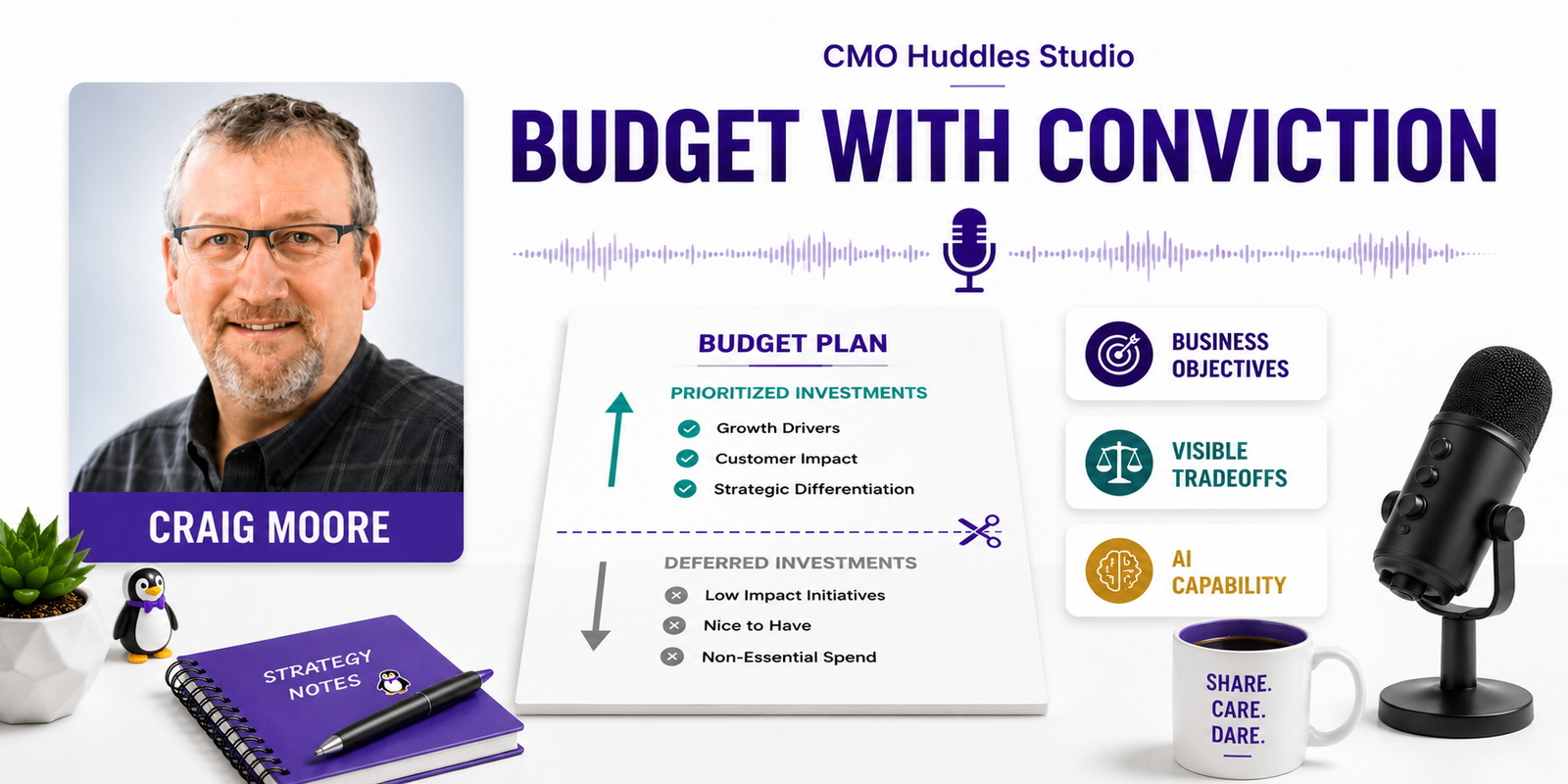
B2B marketing budgets are under more scrutiny than ever, but the strongest CMOs don’t defend spend line by line. They connect budget choices to business objectives, market segments, customer needs, and tradeoffs. In a CMO Huddles conversation with Forrester’s Craig Moore, one message came through clearly: Budgeting is no longer a finance exercise. It’s a strategy exercise.
Every CMO knows the budget conversation can get weird fast.
One minute, you’re talking about growth targets. The next, someone is asking why field marketing needs that much money, whether brand can wait, or whether AI should magically reduce headcount by next quarter. Meanwhile, expectations keep rising: More pipeline, more efficiency, more customer expansion, more proof.
That’s why the budget can’t just be a spreadsheet. For CMOs, it’s becoming one of the clearest tests of business leadership.
In a CMO Huddles conversation later shared on Renegade Marketers Unite, Drew Neisser spoke with Craig Moore, VP and Principal Analyst at Forrester, about what B2B CMOs get wrong in budget planning and how to make the conversation more strategic. Moore’s argument wasn’t that CMOs need prettier budget decks. It was that many marketing budgets are built on the wrong architecture.
The budget often mirrors the org chart. Demand gets a bucket. Field gets a bucket. Brand gets a bucket. Product marketing gets a bucket. Everyone protects their corner, finance sees cost centers, and the CMO is left trying to explain impact across a system that was never designed to show it.
That’s the first problem to fix.
Moore’s sharpest warning was that a budget organized by marketing discipline can accidentally create the exact silos CMOs are trying to break down. When money is allocated to departments first, campaign leaders end up begging for resources across functions instead of leading coordinated market initiatives.
That might feel normal internally, but it weakens the CMO’s position with the CEO, CFO, CRO, and board. If spend is organized around functions, the conversation naturally becomes: How much did events spend? How much did demand gen spend? How much did brand spend?
Those are not the questions that prove marketing is moving the business.
A stronger budget starts with business priorities and the market motions required to support them. Instead of asking each function to build its own plan, CMOs can organize spend around long-running campaigns tied to market segments, buyer needs, retention goals, expansion opportunities, or strategic growth bets.
That structure changes the conversation. Suddenly, the CMO isn’t defending a line item. They’re explaining a business initiative.
Moore framed the budgeting unlock as a shift from product-first planning to audience-first planning.
“Pivoting from a product orientation to an audience orientation gives you a whole new perspective on how to work with your markets.” — Craig Moore
For CMOs, that’s the budgeting unlock. A campaign-based model forces the team to ask who they’re trying to influence, what business outcome matters, which tactics need to work together, and how the investment will be judged over time.
The second mistake Moore called out is familiar: Marketing plans that recycle the old calendar instead of starting with business objectives.
A budget built around last year’s events, launches, and campaigns may be easy to assemble, but it can leave marketing trapped in activity reporting. Attendance, readership, MQLs, impressions, clicks — useful signals, but not enough to prove strategic contribution.
Moore’s alternative is a “plan on a page” that maps marketing investments directly to the company’s primary objectives. If the business needs to expand in a segment, improve retention, increase share of wallet, enter a new market, or protect revenue in a volatile category, marketing needs to show exactly how its plan supports that objective.
That doesn’t mean every marketing activity must produce revenue immediately. Research, enablement, customer insight, and capability building all matter. The difference is that they need to be placed in context: What business decision, growth motion, or future advantage do they support?
This is where CMOs can earn credibility with finance. The budget should make the tradeoffs visible before someone else makes them for you.
If the CFO asks for a cut, the answer shouldn’t be a panicked reduction across every line. It should be a clear “will do / will not do” conversation. Moore’s point was practical: Create a prioritized list with a cut line so the executive team can see what moves below the line if something else moves above it.
That’s the difference between budget defense and business leadership.
One trap for B2B CMOs is treating demand generation as synonymous with business impact.
Yes, net-new demand matters. But many B2B companies get a large share of revenue from existing customers through retention, upsell, cross-sell, and expansion. If the budget over-indexes on net-new acquisition, marketing may be underinvesting in the customer base that actually drives the majority of revenue.
That’s why Moore’s audience-first lens matters. A CMO should be able to distinguish between segments that need reputation-building, segments that need demand creation, and segments that need deeper engagement after purchase. Those motions require different investments and different timelines.
This also helps protect brand from becoming the easiest late-quarter cut. Brand is not a faucet CMOs can turn on and off without consequences. It moves more slowly, compounds over time, and influences whether sales conversations begin with trust or skepticism.
The more marketing can show how reputation, demand, and engagement work together across audience segments, the harder it becomes to isolate brand as a disposable line item.
For 2026 planning, Moore called out the volatility hanging over budget decisions: Economic uncertainty, geopolitical risk, supply chain disruption, and legal or contract instability. That context matters because a static budget can become obsolete quickly.
But flexibility doesn’t mean trimming everything equally.
Moore warned against “thinning out the butter on the bread.” It’s a memorable way to describe a common executive reflex: Cut a little from everywhere so no one feels singled out. The problem is that across-the-board cuts often weaken the entire plan without making any real strategic choice.
A better approach is to define priority tiers before pressure hits. Which investments are foundational? Which can move? Which should pause if a market becomes unstable? Which should accelerate if a segment proves more resilient than expected?
That gives the CMO a stronger answer when circumstances change. Instead of saying, “We’ll find the money somewhere,” the CMO can say, “Here are the tradeoffs, here is the impact, and here is what we recommend.”
That posture matters. It shows the CMO is managing uncertainty with business judgment, not simply reacting to it.
“You don’t necessarily want to use that as a strategy for managing your budgets.” — Craig Moore
AI entered the conversation the way it enters almost every CMO conversation now: With pressure.
Executives are asking whether marketing should be able to do more with less. Some of that pressure is fair. AI can reduce repetitive work, speed analysis, and help teams move faster. But Moore’s framing was more useful than the blunt “cut people because AI exists” version.
AI should create room for marketers to do more strategic work. That requires training, workflow redesign, governance, and clear choices about where AI actually improves the operating model.
If AI is going to show up in the budget, it shouldn’t just be a tool line item or a vague efficiency promise. It should be part of the capability plan: What work changes? What skills need to improve? Which processes get redesigned? Where does the team expect measurable leverage?
That’s a much stronger executive conversation than promising vague productivity gains and hoping the math works later.
“Marketing has to invest in helping people understand how to use these tools in an effective way.” — Craig Moore
One of the biggest mistakes is building the budget around the marketing org chart instead of business objectives, audience segments, and long-running strategic campaigns.
CMOs should connect budget choices to business outcomes, show tradeoffs clearly, and use a prioritized “will do / will not do” list instead of defending every line item equally.
Not automatically. Brand moves slowly and compounds over time, so CMOs should show how reputation, demand, and customer engagement work together before treating brand as an easy cut.
AI should be budgeted as a capability plan, not just a tool purchase. The budget should account for training, workflow changes, governance, and the specific work AI is expected to improve.
Want to hear more? Listen to the full conversation with Craig Moore on Renegade Marketers Unite.
CMO Huddles helps B2B marketing leaders win by bringing together peers, fresh perspectives, and opportunities to build stronger personal brands. Want to join the huddle? Learn more about CMO Huddles and apply to join the community.