
Back to Blogs
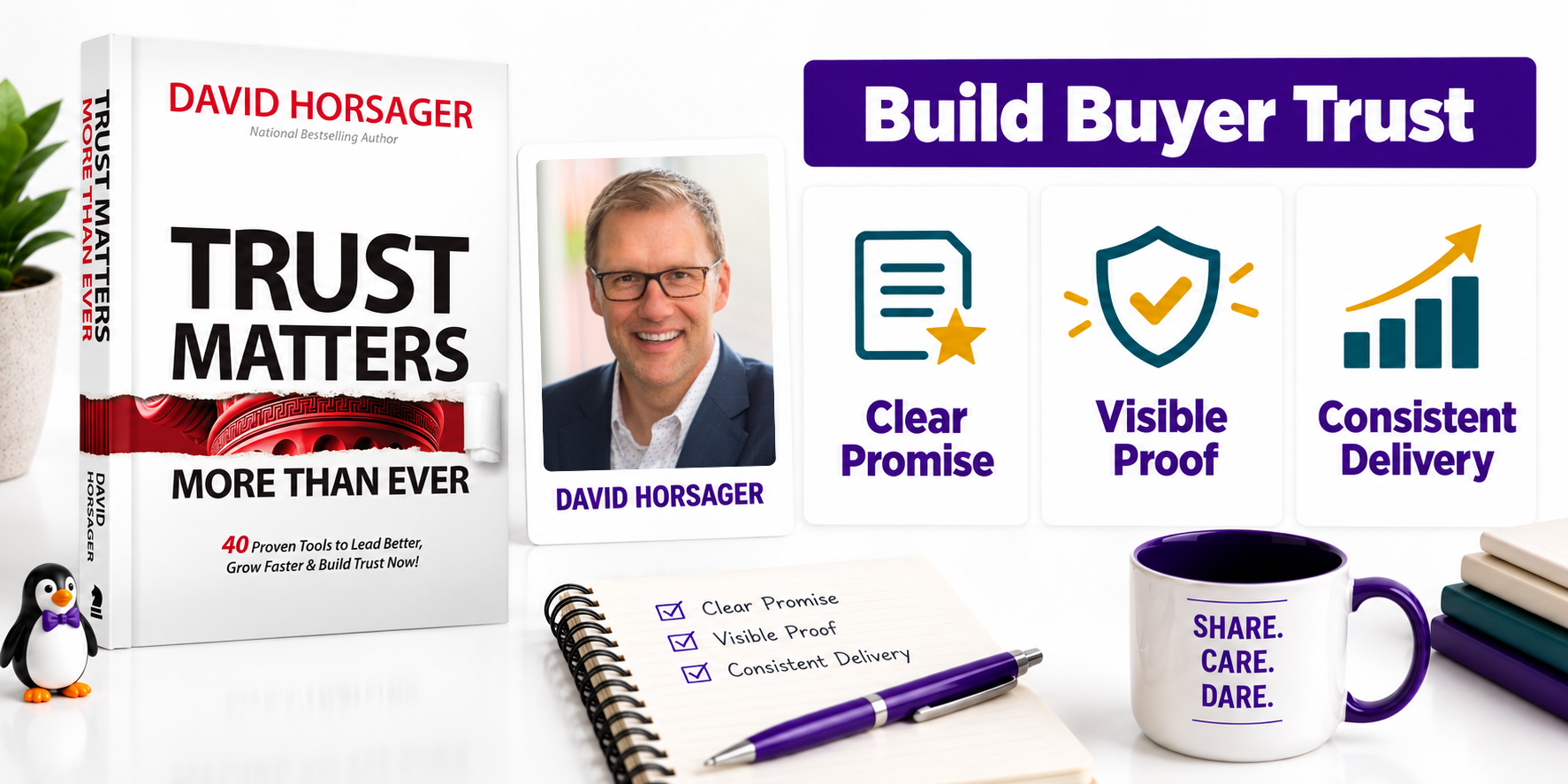
Trust deserves a place in the work between the campaign and the customer. David Horsager’s ideas offer a starting point for a practical review: make the promise understandable, check it against delivery, and give buyers a clear way to see what happens next.
Your landing page promises simplicity. The demo request leads to a form that could double as a mortgage application, followed by three emails from people who haven’t compared notes. Somewhere in there, a perfectly reasonable buyer starts wondering how difficult the actual product will be.
David Horsager, author of Trust Matters More Than Ever, connects trust with clarity and consistency in his conversation with Drew Neisser. For a CMO, that invites a useful exercise: follow one promise all the way through the buying experience.
The review below applies his ideas to everyday marketing decisions. The scenarios are illustrative, so you can adapt them to your own team.
Horsager’s warning is direct: “People trust the clear, and they mistrust or distrust the ambiguous or the overly complex.” That’s a useful challenge for a team that has spent weeks debating language it now knows by heart.
Choose one important page and ask someone outside marketing to read it once. Then have them describe the intended customer, the problem being solved, and the next step. Resist the urge to provide the explanation that the page forgot to include.
Imagine selling a service that helps finance teams reconcile invoices. If a reader remembers transformation but can’t tell you what gets easier on Monday morning, try a version that names the task and the benefit. Keep both versions and test comprehension again.
Horsager treats consistency as central to reputation. A CMO can make that tangible by comparing the advertised experience with the operational one.
Take a promise of a personalized assessment. Walk through the form, confirmation email, sales handoff, and meeting agenda with the teams responsible for each step. Does the buyer receive an assessment, or a standard presentation with their logo added?
If the delivery is useful but different, correct the description. If the promise is worth keeping, agree on the work required to fulfill it and who will own it. Either decision beats asking copy to perform another small miracle.
For your next review, make a simple claim-and-evidence list. Beside every important assertion on the page, record what a buyer can inspect: a documented example, an explanation of the process, or a demonstration of the relevant capability.
Suppose the page promises easy implementation. You could show the actual sequence, identify what the customer needs to provide, and explain which dependencies affect the timing. Have the delivery team check that description before it goes live.
This exercise may reveal that a narrower claim is more useful. An honest account of what happens during setup gives a buying committee material to discuss, including the effort their own people will need to contribute.
Horsager emphasizes that repairing trust requires making and keeping a new commitment. An apology can begin the conversation, but follow-through has to carry it.
For a missed follow-up, write down the outstanding request, assign an owner, and agree on a realistic response date. Send the customer that specific update, then check that the response actually resolves their question.
Bring one mismatch to your next meeting with sales or customer success. Choose the repair together, record the decision, and review a fresh example the following month. You’ll have something more useful to discuss than whether the latest headline feels trustworthy.
Choose one high-priority offer and trace it from the first message through the promised interaction. Involve the person delivering that interaction so you can compare the intended experience with a real one.
Ask a reader outside the project to explain the offer after a single reading. Note what they misunderstood before providing any clarification, then revise the page and repeat the exercise.
Show the steps, customer responsibilities, and conditions that affect the schedule. Use details your delivery team has confirmed rather than an idealized version of the process.
Assign the fix to the person who can change the relevant part of the experience. Marketing should stay involved when the public promise also needs updating, with a clear date to check the result.
David Horsager founded the Trust Edge Leadership Institute and wrote Trust Matters More Than Ever. His work focuses on trust in leadership and organizations.
Want to hear more? Listen to the full conversation on Renegade Marketers Unite.