
Back to Blogs
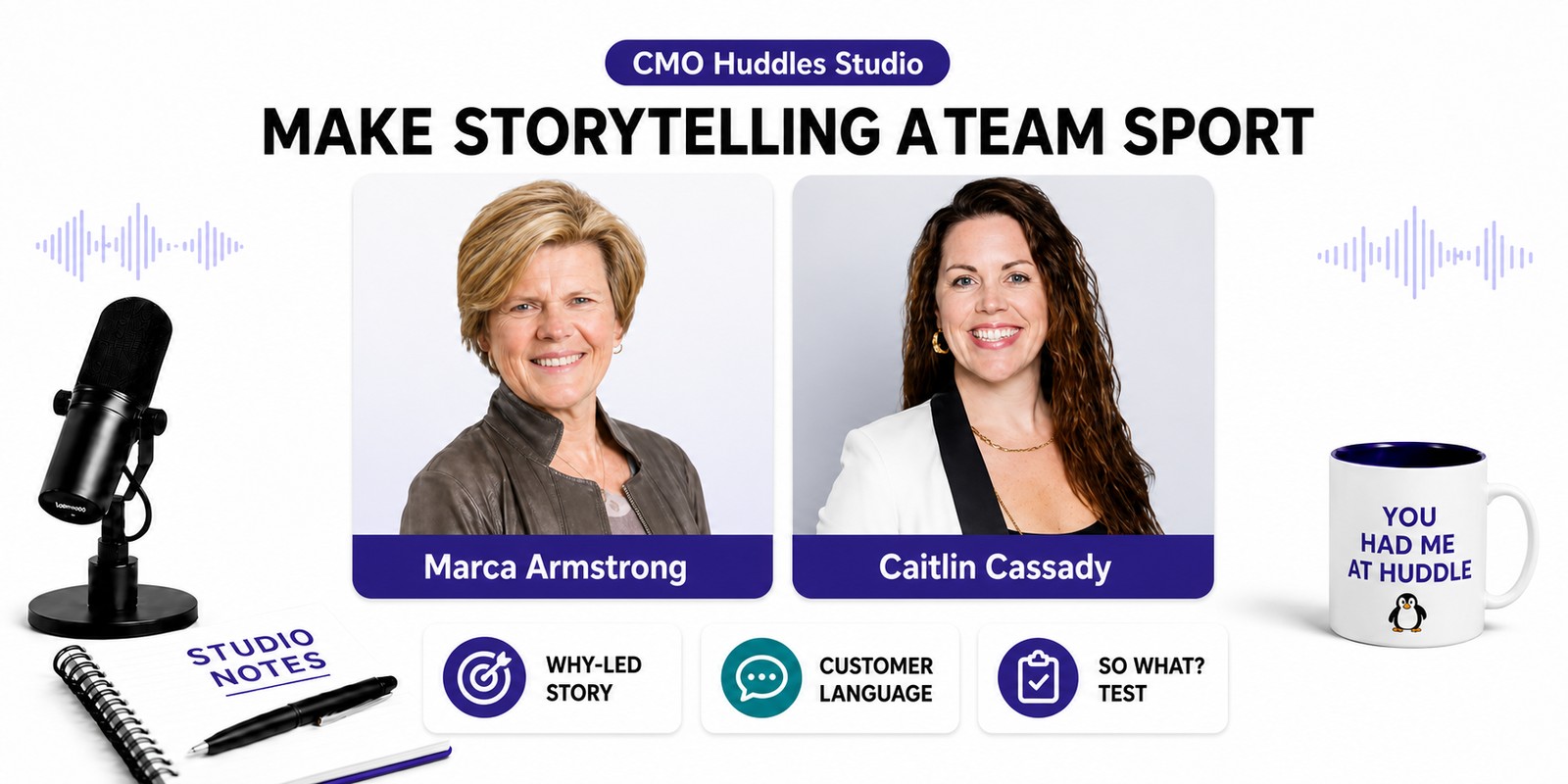
Company-wide storytelling becomes possible when the organization shares one clear narrative, listens closely to customers, and connects features with outcomes. Marca Armstrong and Caitlin Cassady explain how curiosity, a disciplined “so what?” test, customer language, and cross-functional coaching can help marketing, sales, and customer teams carry a consistent story without turning employee into a copywriter.
The strongest B2B stories cannot live only inside marketing.
Prospects hear versions of the company story from sales, customer success, product, executives, partners, and existing customers. When those versions conflict, the market has to assemble the meaning on its own.
In a CMO Huddles Studio conversation, Marca Armstrong of Sensera Systems and Caitlin Cassady of Beyond explored how storytelling can become a company-wide capability.
The objective is not turning every employee into a copywriter. It is giving people a clear, customer-relevant story they can recognize and carry.
Marca starts with the organization’s “why.”
At Sensera Systems, the headline story is “build with confidence.” The phrase connects the construction industry with the value customers receive from job-site intelligence.
The story sits above product features. Capabilities involving safety, security, and decision support explain how the company delivers that confidence.
Without that higher-level narrative, each team may lead with a separate feature or use case. The company sounds fragmented even when the products work together.
A scalable story provides:
Consistency does not require every person to repeat an identical script. It requires the different versions to reinforce the same meaning.
Marca looks for people who ask difficult questions.
“One of our values as an organization is curiosity, so the people that I look for are just infinitely curious because if you’re curious, you’re just going to ask all the hard questions.”
Curiosity helps marketers move beyond internal assumptions.
It creates questions such as:
Those questions improve the story before it becomes content.
Caitlin uses a direct filter when teams discuss a product feature:
“I’ve asked the whole team to infuse the principle of so what. So we’re launching this new product feature. So what? What does that mean to the customer?”
The test moves the conversation from capability to consequence.
A feature may improve forecast accuracy, reduce administrative work, protect revenue, or give a customer more confidence. The story begins when the organization can explain that change.
The “so what?” question also helps identify weak content. If the answer remains another feature or internal phrase, the customer outcome is still missing.
Customer stories are particularly valuable because they reveal how buyers describe the problem and outcome in their own words.
Useful sources include:
Marketing can organize this language into an accessible story library containing quotations, use cases, objections, outcomes, and proof.
The library becomes more useful when sales and customer teams can contribute to it and find relevant examples quickly.
A messaging document alone rarely changes how people communicate.
Storytelling scales through repeated use:
Cross-functional participation also reveals where the narrative does not match the customer experience.
Customer-success teams may notice promises that are difficult to deliver. Sales may identify language that creates confusion. Product may provide evidence that makes the story more credible.
Storytelling affects several stages of the buyer and customer journey.
Evidence may include:
One of the strongest signals is when the market begins using the company’s language without prompting.
That suggests the story has moved beyond a campaign and entered shared understanding.
Company-wide storytelling gives marketing, sales, customer success, product, and executives a shared narrative they can adapt while preserving the same customer-relevant meaning.
The test asks what a feature, announcement, or capability changes for the customer. It helps move messaging from internal description to customer outcome.
Interviews, sales calls, support conversations, advisory boards, reviews, and win-loss research can reveal useful language, outcomes, objections, and proof.
Employees do not need to become copywriters. They need enough clarity and evidence to explain the company’s value consistently within their roles.
Listen to the full conversation with Marca Armstrong and Caitlin Cassady.
CMO Huddles helps B2B marketing leaders win by bringing together peers, fresh perspectives, and opportunities to build stronger personal brands. Want to join the huddle? Learn more about CMO Huddles and apply to join the community.