
Back to Blogs
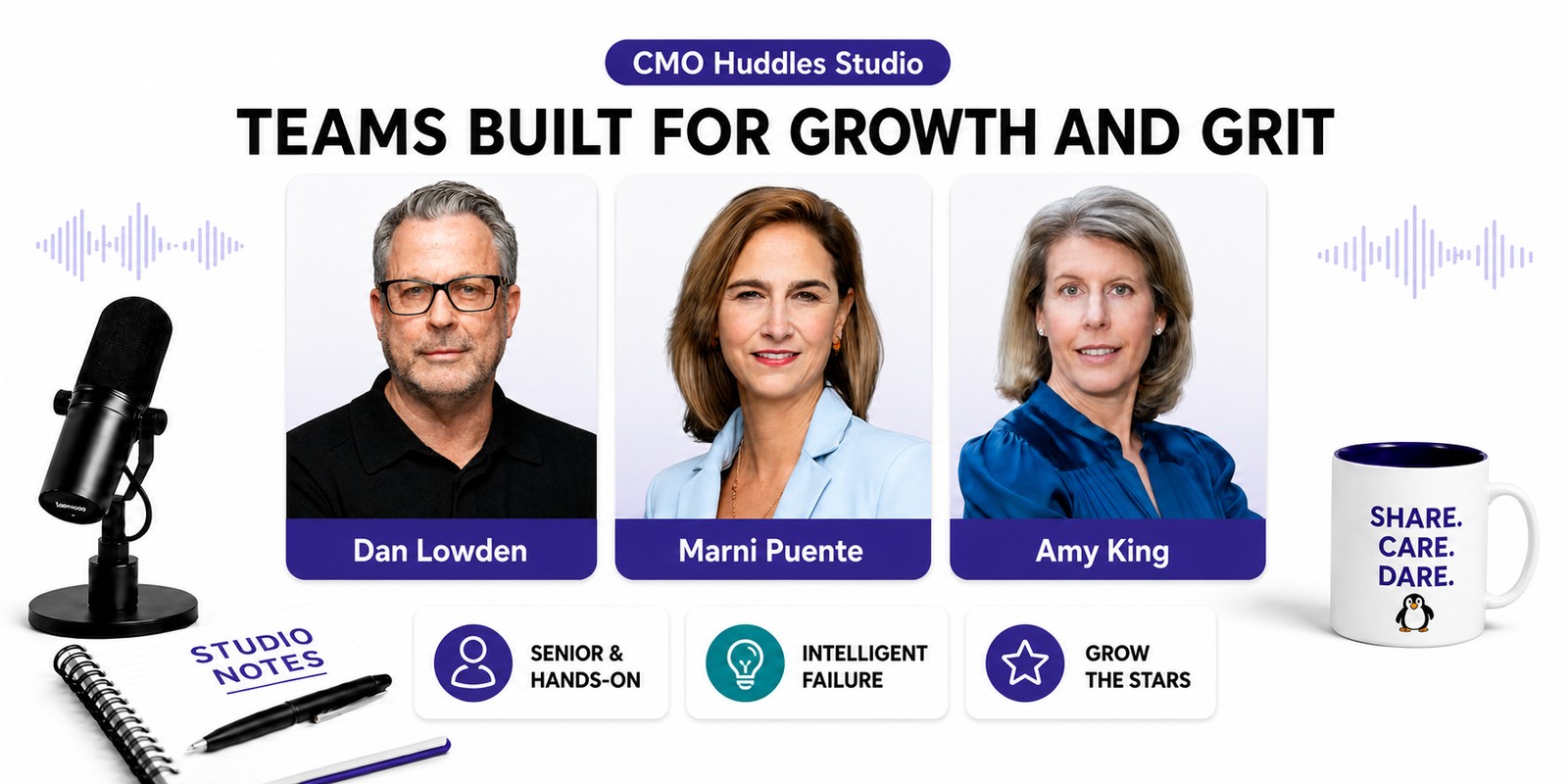
High-performing marketing teams are built through complementary strengths, clear priorities, trust, coaching, and room to learn. Dan Lowden, Marni Puente, and Amy King share how senior hands-on talent, transparent goals, intelligent failure, employee feedback, and shared AI learning can help teams sustain performance while developing the capabilities and career paths that encourage marketers to stay.
Hiring talented marketers is only the beginning.
Sustainable performance depends on how the team works together, responds to change, develops new skills, and understands what matters most.
Three B2B marketing leaders explored those systems in a CMO Huddles Studio conversation:
Their organizations differ significantly, but their experiences point to the same idea: High performance is easier to sustain when talent, trust, priorities, and learning reinforce one another.
Dan built Blackbird.AI’s marketing function from a team of one to a lean group of five.
In that environment, seniority does not remove the need for execution. Team members need enough experience to make decisions and enough flexibility to remain hands-on.
“It’s building a team that trusts each other, that complements each other, that challenges each other, that works together to improve on everything we do and have fun together.”
Complementary talent matters more than collecting similar high performers. A strong team combines different strengths while sharing expectations about collaboration, accountability, and pace.
Amy described a marketing reset at Relias that involved rebuilding leadership, clarifying structure, and strengthening alignment with sales and client care.
The strategy determined the team the organization needed.
This sequence avoids designing an organization around existing titles and then forcing strategic priorities into it. It also makes capability gaps easier to identify.
Useful questions include:
The answers shape a team that fits the business instead of an idealized marketing org chart.
Marni connected strong leadership with hiring people whose strengths exceed her own and giving them authority over meaningful problems.
“Being a good leader is hiring really great people that have strengths and talents you don’t have. It’s delegating authority and empowering them to take ownership of problems.”
Delegation is stronger when priorities, decision rights, and measures are visible.
OKRs, KPIs, scorecards, and focused dashboards can help teams understand which outcomes matter without turning leadership into constant inspection.
The measurement system creates value when it clarifies rather than multiplies reporting.
Amy incorporated intelligent failure into recurring team meetings.
“We have a section for every meeting where someone brings up an intelligent failure as an example, or a case study, and not just a failure, but then what they changed in terms of their behavior.”
The practice distinguishes learning from carelessness.
An intelligent failure begins with a reasonable hypothesis, occurs in uncertain territory, and produces evidence that changes what the team does next.
Discussing these examples can:
The emphasis remains on the adjustment, not the failure alone.
The leaders also discussed AI adoption as a team-learning challenge.
Committees, “battle buddies,” experimentation, and shared examples can make adoption less isolating. Team members learn from colleagues who are solving related problems rather than receiving only generic training.
Leaders can participate visibly by:
This keeps AI learning attached to the team’s work and culture.
Retention depends on more than compensation.
Strong marketers also look for:
Competency assessments, employee surveys, manager feedback, and development plans can reveal whether those conditions exist.
The goal is not keeping every employee indefinitely. It is creating an environment where strong performers can grow without needing to leave to find their next meaningful challenge.
High-performing teams combine complementary skills, clear priorities, trust, ownership, learning, and a shared understanding of business outcomes.
An intelligent failure comes from a reasonable experiment in uncertain territory and produces learning that changes future behavior or decisions.
Shared experiments, peer partners, approved tools, workflow-specific training, and visible leadership participation can make AI learning more practical and less isolating.
Meaningful work, ownership, coaching, career development, stretch opportunities, sustainable expectations, and trusted colleagues all contribute to retention.
Listen to the full conversation with Dan, Marni, and Amy.
CMO Huddles helps B2B marketing leaders win by bringing together peers, fresh perspectives, and opportunities to build stronger personal brands. Want to join the huddle? Learn more about CMO Huddles and apply to join the community.