
Back to Blogs
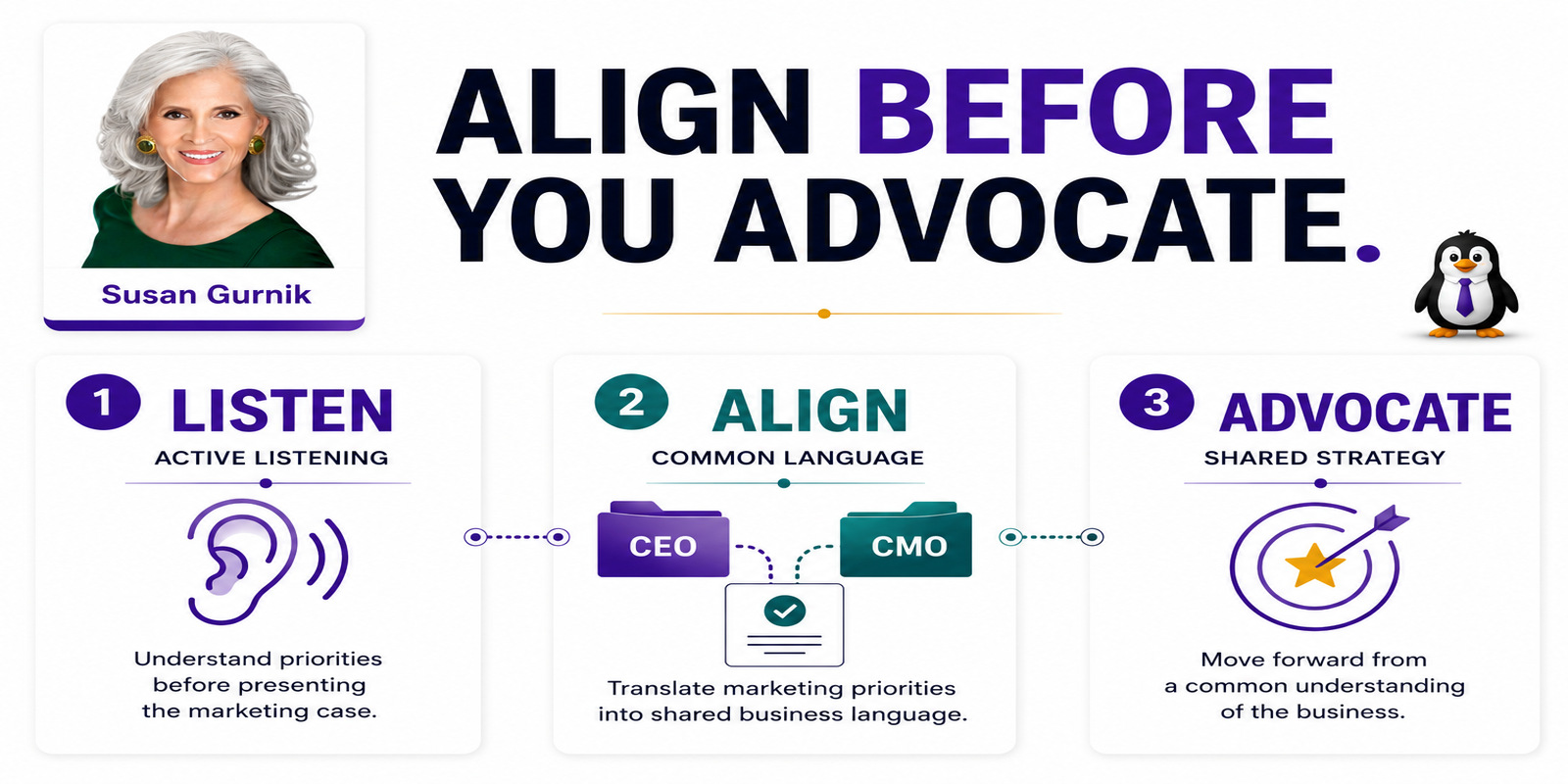
Strong CEO and CMO partnerships grow through active listening, shared language, clear boundaries, and respectful challenge. Executive coach Susan Gurnik explains how marketing leaders can surface a CEO’s intent, shape productive conversations, navigate disagreement, and demonstrate enterprise value. The work is subtle: coach through example while protecting focus, trust, and the company’s priorities over time.
A productive CEO-CMO relationship depends on more than frequent meetings or polished marketing updates. Both leaders need a common understanding of the company’s direction, marketing’s role, and how they will work through disagreements.
In a CMO Huddles conversation, executive coach Susan Gurnik explored how CMOs can strengthen that relationship without attempting to manage or manipulate their CEOs. Her approach starts with listening carefully, making intentions visible, and gradually establishing a more productive conversational rhythm.
Susan described the foundation as “listening to the CEO” while also helping the CEO learn how to listen in return. That reciprocity matters because marketing leaders frequently need to translate a developing vision into priorities, investments, and execution before every strategic question has been resolved.
Executive conversations often begin with competing agendas. The CEO arrives with an urgent concern or new idea. The CMO arrives with a recommendation, decision, or resource request. If both parties defend their opening positions, the conversation can stall before either understands the other’s reasoning.
Active listening creates room to investigate what sits beneath the initial request. A CMO might restate what was heard, ask whether the interpretation is accurate, and explain why the clarification matters. This is more useful than merely repeating the CEO’s words because it connects the conversation to the decision marketing needs to make.
Susan calls this “meta-communication,” or communicating about how the conversation itself is unfolding. A CMO can say, for example, “I want to make sure I understand the outcome you’re looking for because it will shape how we prioritize the team’s work.” That makes the purpose of the question clear and gives the CEO an opportunity to correct an assumption.
It also prevents marketing from reacting to a fragment of the CEO’s thinking. A request for a new campaign may reflect a deeper concern about growth. A sudden demand for more leads may originate in anxiety about an upcoming board meeting. The immediate request matters, but its context determines the best response.
Marketing vocabulary is not always business vocabulary. Terms such as awareness, demand, engagement, attribution, and pipeline may carry different meanings for the CEO, CMO, CRO, and CFO.
When those definitions remain implicit, executives can appear to agree while imagining different outcomes. Susan recommends asking the CEO what success looks like in concrete terms and how the company has approached similar priorities before. That conversation can reveal whether the disagreement concerns strategy, terminology, timing, or evidence.
The CMO can then connect marketing’s work to the language the CEO already uses. If the CEO speaks about market penetration, customer expansion, operating leverage, or enterprise value, marketing plans should clarify their contribution to those outcomes.
This does not require abandoning marketing expertise. It requires making that expertise legible to another executive. The CMO earns influence by showing how brand, customer understanding, product marketing, demand, and retention support the company’s priorities together.
A CMO rarely needs to announce that the CEO is being coached. Susan’s method is quieter: demonstrate the behavior, invite reciprocity, and create a repeatable cadence.
After presenting an initiative, a CMO might ask what the CEO heard, whether the level of detail was useful, or which concern deserves more attention. Those questions improve the immediate discussion while modeling a way of checking understanding.
Meeting design can reinforce the habit. The CMO and CEO can agree on the purpose of recurring meetings, the decisions that belong there, the appropriate level of detail, and how new ideas will be captured without displacing established priorities.
Boundaries are particularly valuable when a CEO generates ideas constantly. Rather than dismissing an unexpected suggestion or treating it as an immediate mandate, the CMO can record it, explore its intent, and return to it during an agreed planning discussion. The CEO knows the idea was heard, while the team retains enough stability to execute.
Different CEOs create different relationship challenges. A first-time CEO may need help translating vision into operating priorities. A highly creative CEO may introduce more ideas than the organization can pursue. A veteran CEO may carry assumptions formed under different market conditions. A high-ego CEO may react defensively when expertise is questioned.
Susan’s guidance begins with genuine respect for what the CEO contributes. Recognition can lower defensiveness and make it easier to discuss gaps without turning the conversation into a contest.
That respect must be specific and sincere. A CMO might acknowledge the CEO’s technical insight, customer intuition, or ability to rally investors, then explain how marketing can complement that strength with customer research, operating discipline, or market evidence.
This approach positions the CMO as a partner filling an organizational need rather than a functional leader defending territory.
A strategic disagreement deserves exploration before persuasion. If a CEO prioritizes new-customer acquisition while the CMO sees greater potential in customer expansion, repeating the marketing recommendation more forcefully is unlikely to resolve the difference.
The discussion can instead examine assumptions, options, and consequences. What evidence supports each path? What investment would each require? How quickly could the organization learn? Which risks would the company accept?
Susan advised leaders to “put that hammer aside.” The phrase captures the danger of treating every conversation as an opportunity to drive home a predetermined answer.
A CMO can still advocate strongly. The difference is that advocacy follows understanding. That leaves room for a stronger decision than either leader’s original position and makes the resulting commitment easier to sustain.
CEO confidence grows when the CMO consistently addresses company problems, not only marketing problems. That may involve helping clarify the company’s vision, improving cross-functional decisions, protecting customer trust, or identifying where resources can create the greatest return.
Susan emphasized the importance of showing that the CMO is focused on what is good for the company rather than acting in a self-serving way. That orientation becomes visible through decisions: sharing resources when another function has the stronger business case, challenging an attractive initiative that does not support the strategy, or helping peers solve issues that affect growth.
The CMO’s remit remains marketing, but the perspective becomes enterprise-wide. That is how the role moves from functional executor to trusted executive partner.
The coaching work begins during the interview process. Candidates can ask how the CEO develops strategy, handles disagreement, sets priorities, and works with executive leaders whose expertise differs from their own.
They can also listen for how the CEO defines marketing. Is the mandate primarily lead generation? Does it include positioning, customer experience, reputation, pricing, retention, or business strategy? Are the expectations realistic given the resources and timeline?
Candidates should also understand their own strengths well enough to explain how they complement the CEO. Susan noted that a CEO cannot hire someone effectively if they do not understand what that person can contribute.
The goal is not to find a CEO who shares every opinion. It is to determine whether the two leaders can build enough trust, clarity, and conversational discipline to work through the differences that will inevitably arise.
Start by clarifying the CEO’s intent, restating what you heard, and explaining why the information matters to marketing’s decisions. Agree on meeting purposes, decision rights, shared terminology, and how new ideas will be evaluated.
Create a visible place to capture new ideas and an agreed cadence for evaluating them. This acknowledges the CEO’s thinking without forcing the marketing team to interrupt execution every time a possibility surfaces.
Investigate the assumptions behind both positions, compare evidence and consequences, and connect the discussion to shared business outcomes. Advocate clearly after both sides understand what is actually driving the disagreement.
Ask how the CEO defines marketing, develops strategy, resolves executive disagreements, allocates resources, and measures success. The answers can reveal whether the role has sufficient clarity, support, and authority.
Listen to the full conversation with Susan Gurnik.
CMO Huddles helps B2B marketing leaders solve difficult problems alongside experienced peers. Apply to join the community.