
Back to Blogs
Drew Neisser is the founder of CMO Huddles and a globally recognized authority on B2B marketing. He’s an AdAge columnist, LinkedIn TopVoice, leading CMO coach, podcast host & friend of penguins everywhere.
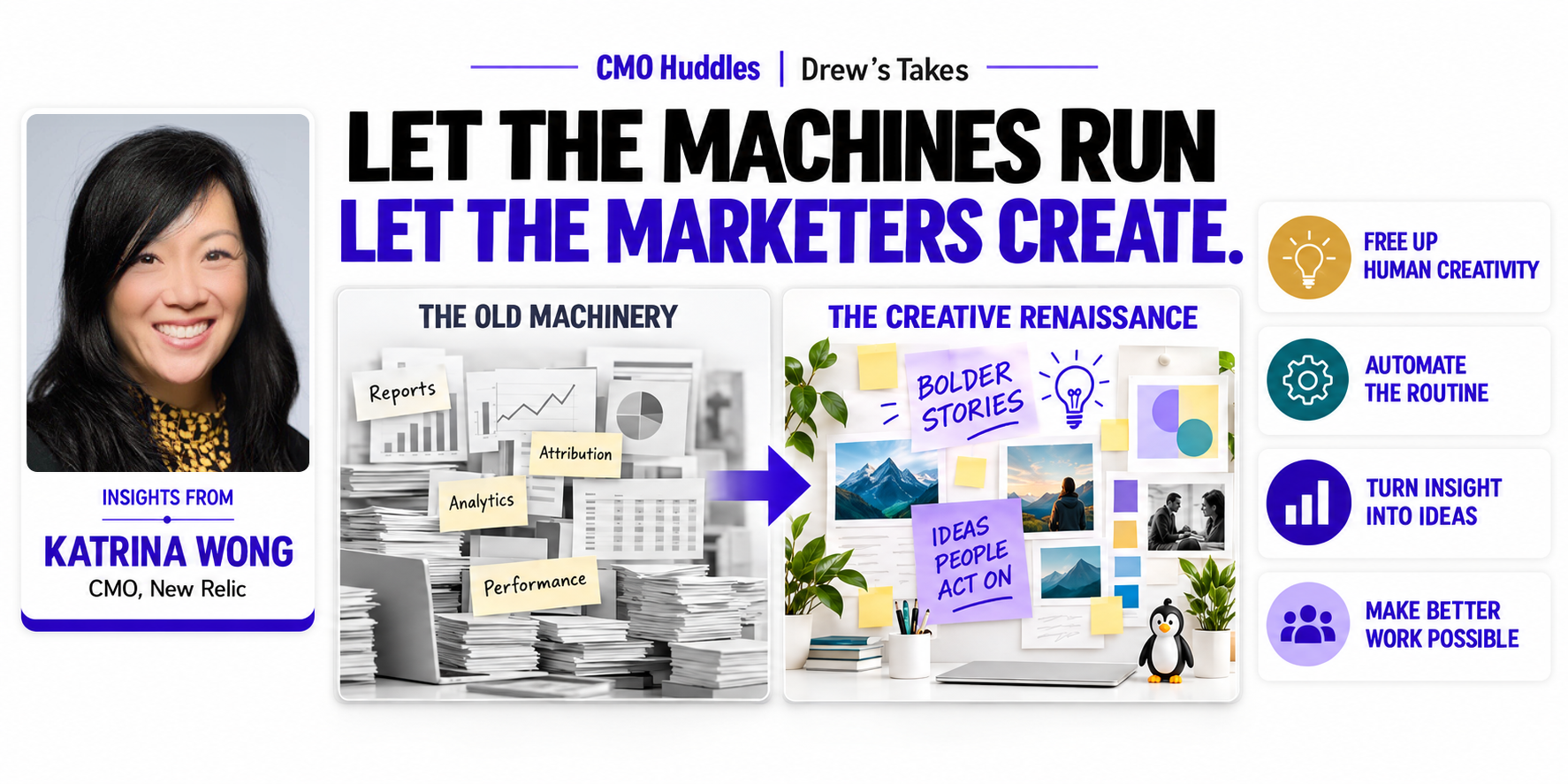
AI can free B2B marketers from operational machinery and return time to creativity, but only when leaders deliberately redesign work. New Relic CMO Katrina Wong shares how agents, cross-functional pods, data journalism, dedicated AI engineering, and careful build-versus-buy decisions are reshaping marketing while keeping human judgment, storytelling, and brand differentiation at the center of strategy.
For years, B2B marketers have invested staggering amounts of time, talent, and budget in the machinery of marketing. Martech stacks expanded, dashboards multiplied, attribution models became increasingly elaborate, and teams spent more time feeding systems that were supposed to make them productive.
The more martech we bought, the less creative many marketing organizations became.
That is why my recent conversation with Katrina Wong, CMO of New Relic, gave me hope. Katrina believes AI can do more than help marketers produce another email variation or summarize another meeting. It can absorb enough operational work to give marketers time to think, collaborate, and create again.
“In years past, we’ve had to put so much energy on just the machinery of execution in marketing, the demand gen engine machinery, plus the reporting out of numbers,” Katrina explained. AI has already changed that equation at New Relic. “We finally have dashboards that no one’s questioning because it matches up all the different data sources.”
Reliable dashboards may not sound like the beginning of a creative renaissance. But when marketers stop spending meetings debating whose numbers are correct, they recover time and mental bandwidth for better questions.
What does the market need? What should the brand stand for? What story could only we tell?
That reclaimed capacity helped New Relic undertake a substantial brand refresh, including a new visual identity, reworked webpages, and a campaign called “Welcome to the Superhuman Era.” The campaign grew out of a strategic tension familiar to many technology marketers: AI capabilities are advancing quickly, but their technical differences can be hard for customers to understand or believe.
Katrina’s team initially considered naming New Relic’s agents after different superheroes. Brand research pushed them in a more human direction. “They came back and said, ‘No, AI’s not the hero, humans are,’” Katrina recalled.
That insight helped the team place people at the center of the story. AI could give developers, engineers, and other customers superhuman capabilities, but the technology remained the supporting player. It is an appealing idea in a market crowded with brands presenting glowing machines as the answer to every business problem.
Katrina has long preferred “business to human” over the traditional B2B and B2C labels. The brand refresh gave New Relic a chance to express that belief while making its website more useful to both people and language models. The team refactored pages, added structured content, strengthened its third-party presence, and refreshed how the company presents itself visually and verbally.
AI may help produce the work. Humans still need to make it worth noticing.
Katrina sees the same opportunity beyond the brand team. “Everyone got into marketing because we wanted to do the more creative parts of marketing,” she said. Now she sees email, demand generation, content, and other specialists participating more actively in creative problem-solving.
“I predict a renaissance,” Katrina told me. As AI companies crowd into similar technical territory, she noted, they increasingly seek help with “storytelling and brand building” because technological advantages can be fleeting.
New Relic’s creative resurgence is not the result of handing every marketer a chatbot. The company has made consequential operating decisions about which work agents should handle, where humans remain essential, and how to redeploy capacity.
Competitive intelligence offers the most striking example. Katrina’s competitive-intelligence function once included four people. Today, approximately 85 agents conduct research and create most of the deliverables used by marketing and sales, with one person overseeing the system and providing human review.
Katrina was candid about the workforce implications. AI cannot fully replace the people doing the work, but New Relic has sometimes chosen not to backfill positions after attrition. That pattern has come up in dozens of my conversations with CMOs over the past year. The workforce transformation is arriving quietly, one unfilled role at a time.
Another example involves product-led onboarding. New Relic previously had 10 or 11 support representatives helping users navigate basic questions as they adopted a complex technical platform. The company became 1mind's first customer and used its Superhuman to handle much of that work, allowing New Relic to repurpose the associated headcount for other needs.
Being 1mind’s first customer says something important about Katrina. Her interest in creativity is matched by a willingness to experiment with emerging technology before the playbook has been written. She did not wait for the market to declare the solution safe, standard, and boring.
The objective is not to automate people out of the company. It is to move human talent toward work where judgment, imagination, relationships, and strategic thinking create more value. That transition still requires thoughtful change management, training, and honest conversations about how roles will evolve.
Katrina has also changed how the marketing organization works. She created a marketing engineering AI role responsible for orchestration and strategy across marketing departments and the handoffs connecting them. The role complements go-to-market engineering while giving marketing a dedicated owner for turning scattered use cases into a coherent system.
She also created cross-functional pods around priorities that do not fit neatly inside traditional departments. One pod focuses on answer-engine optimization and includes people from content, PR, SEO, and other specialties. Additional pods support database growth, integrated campaigns, and sales enablement.
The sales-enablement pod has already placed value-selling guidance, account research, and competitive talking points inside Gemini Gems. Instead of sending product marketers “a million Slacks before a big deal call,” sales representatives can retrieve approved information directly.
The pod model also supports a larger talent shift. Katrina is training specialists to become more full-stack and giving them “more agency to do work that extends beyond their day-to-day.” That does not eliminate specialized expertise. It helps specialists combine their expertise around an outcome instead of passing work through a sequence of departmental handoffs.
This aligns with what our Future of Marketing Org Design Task Force has been examining and what Culture Amp CMO Paige O’Neill described after breaking marketing into thousands of units of work and dozens of scenarios. Before redesigning the org chart, leaders need to understand what is happening to the work, which capabilities remain distinctly human, and where AI changes the operating model.
New tools layered over old structures produce faster silos.
Katrina’s approach to AEO shows creativity extending beyond traditional campaigns. Based on 100 prompts tracked through Profound, New Relic ranks first among the competitors it monitors. Katrina is careful not to claim complete certainty about what produces that position, but she identified several contributors.
The company strengthened PR, cleaned up its YouTube presence, placed executives on podcasts, and rebuilt webpages to be friendlier to language models. More distinctively, New Relic invested in data journalism: original reports based on commissioned surveys and anonymized platform data.
The reports generate coverage because they give reporters and industry audiences real news. That coverage then creates the third-party validation that language models often use when forming answers.
Katrina’s PR agency helps secure coverage, but New Relic does not expect the agency to invent the strategy or manufacture substance. Her internal team develops the reports and directs the program. As Katrina confirmed during our conversation, the company creates the news that its PR firm can market.
That is creative marketing with compounding value. One strong piece of proprietary research can inform PR, executive content, sales conversations, events, social posts, customer discussions, and AI-search visibility.
Katrina also surfaced the constraint keeping many companies from reaching this creative future. Marketing teams have only so many hours available, and AI implementation competes with the work required to keep the business running.
“You’re either running the business or improving the business,” she said. At New Relic, the team has often found itself “improving the business with AI nights and weekends.”
That is not a sustainable transformation model. CMOs cannot proclaim an AI renaissance while expecting employees to build and maintain the underlying systems after hours. The organization needs explicit priorities, dedicated ownership, realistic capacity, and a willingness to stop lower-value work.
The pressure will increase as tools release new features faster than teams can absorb them. Even as 1mind continued introducing capabilities Katrina wanted, her team could not implement every promising use case. Access to innovation is no longer the limiting factor. Organizational attention is.
This brings us to what Katrina called “a real battle” for CMOs: deciding what to build, what to buy, and what to leave alone.
A custom agent may look inexpensive during a demo. The economics get fuzzier once you add token consumption, integrations, engineering support, security, quality assurance, model changes, maintenance, and the risk that its original builder leaves.
Marketing also competes with product and engineering for AI resources. Katrina described the trade-off between tokens used to build and run the product and tokens used by marketers to take that product to market. When she needs more, her CEO tells her to ask the CTO.
The budgeting challenge is particularly difficult because companies often cannot estimate token requirements until they have built and tested the application. As Katrina acknowledged, “We don’t know” how to gauge those costs reliably in advance.
CMOs should therefore evaluate each opportunity against several questions:
Building feels innovative. Buying can preserve capacity for the creative work customers will actually notice.
Treat New Relic’s approach as inspiration, not a template. Different companies have different customers, capabilities, technical resources, risk tolerances, and business priorities. The useful lesson is the sequence of decisions.
Start by identifying which operational burdens are consuming the team’s capacity. Determine where agents can handle research, retrieval, reporting, basic support, and repeatable production work. Decide where the company needs dedicated AI orchestration and where cross-functional pods can organize specialists around shared outcomes.
Then decide what to do with the capacity AI creates.
CMOs can allow the gains to disappear into higher content volume and more campaigns. They can use the savings exclusively to reduce headcount. Or they can reinvest a meaningful portion in customer insight, brand building, original research, storytelling, and ideas that distinguish the company.
AI will not automatically make B2B marketing creative again. It may finally remove one of our favorite excuses.
Katrina Wong will join me for a conversation at the CMO Super Huddle in Palo Alto. We will explore New Relic’s brand refresh, creative renaissance, evolving organizational model, agent deployments, and the difficult economics behind buying versus building.
The state of the art could change significantly before then. That is precisely why CMOs need to compare notes with leaders who are experimenting now, learning quickly, and staying candid about what they haven't solved.
Disclosure: 1mind is a Founding Sponsor of the CMO Super Huddle and came up unprompted in my conversation with Katrina.
AI can remove reporting, research, retrieval, and repetitive production work that consumes marketers’ time. Creativity returns only when leaders deliberately reinvest the recovered capacity in customer insight, brand building, original research, collaboration, and storytelling instead of automatically converting every efficiency gain into more volume or fewer people.
New Relic uses agents for competitive intelligence, product-led onboarding, reporting, research, and sales enablement. The company has also created a marketing engineering AI role and cross-functional pods that organize specialists around shared outcomes, helping the team redirect human effort toward judgment, strategy, relationships, and creative problem-solving.
CMOs should ask whether the capability differentiates the company, whether a credible managed product exists, whether the organization can maintain a custom system, and whether total costs can be tied to a measurable outcome. Token consumption, integrations, security, quality assurance, model changes, and staff continuity all belong in the decision.
Begin with the work rather than the org chart. Map the tasks agents can perform, identify where human judgment remains essential, and organize teams around outcomes that cross traditional departments. Dedicated orchestration roles and cross-functional pods can help prevent disconnected agents and faster silos.
Original research creates useful, differentiated information that reporters, executives, sellers, customers, and industry audiences can cite. Earned coverage and third-party validation can then strengthen the signals language models use when forming answers, giving one substantive research program value across PR, content, sales, events, social media, and AEO.