
Back to Blogs
Drew Neisser is the founder of CMO Huddles and a globally recognized authority on B2B marketing. He’s an AdAge columnist, LinkedIn TopVoice, leading CMO coach, podcast host & friend of penguins everywhere.
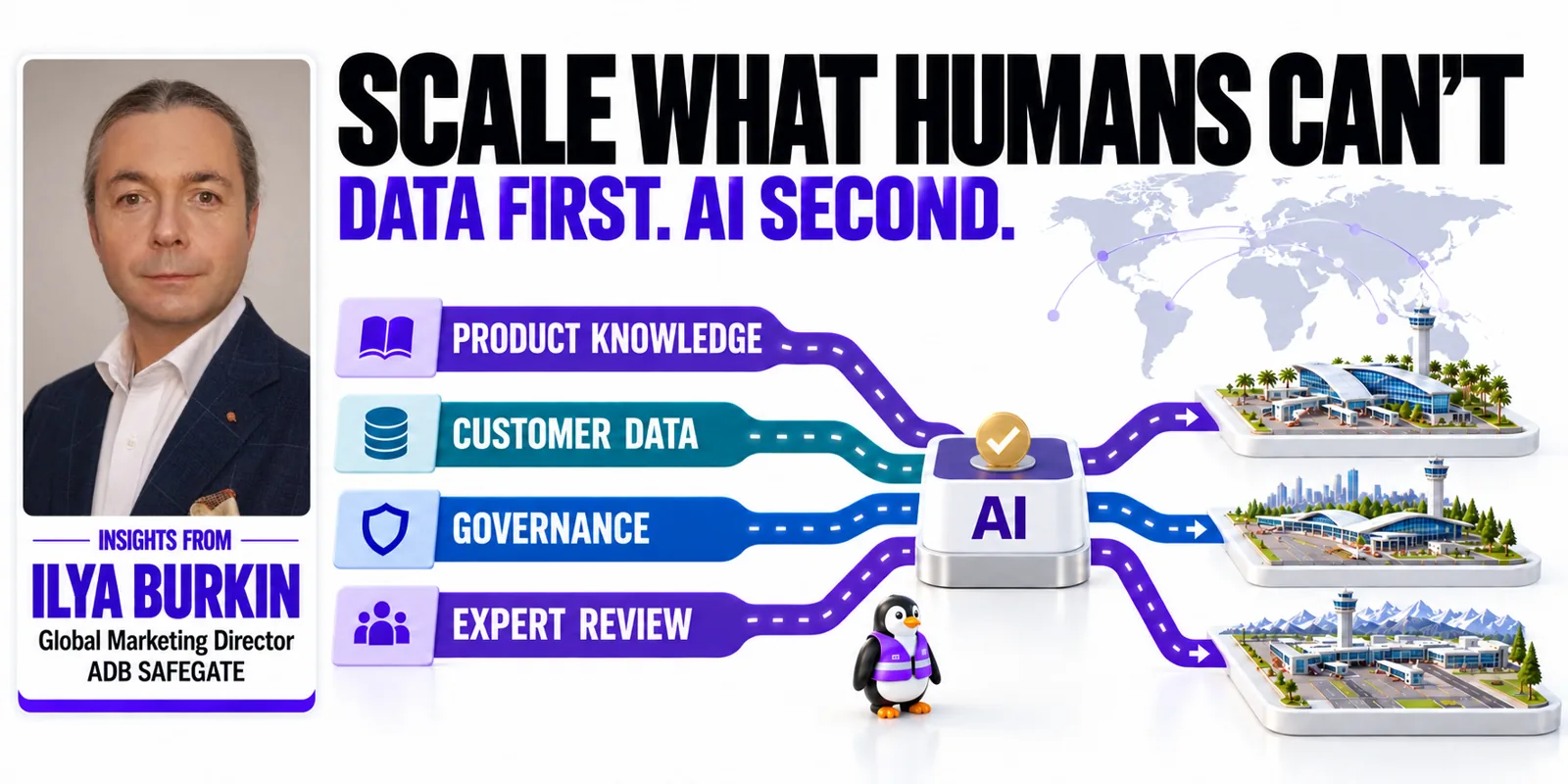
AI creates its greatest marketing value when it enables customer experiences that humans could never scale. ADB SAFEGATE’s Ilya Burkin explains how his team combined clean proprietary data, precise governance, and AI-assisted development to expand access to technical expertise, and why CMOs must decide when to build, buy, or safely leave an ambitious use case alone.
ADB SAFEGATE ran a focused digital campaign for one of its highly specialised airport technology solutions. Within two weeks, it generated far more requests for engineer-led demonstrations than the existing process could realistically support.
The good news was obvious. The problem was that those demonstrations depended heavily on a single subject-matter expert.
As Ilya Burkin, Global Marketing Director at ADB SAFEGATE, explained, the company depended on “the one guy who knows everything and can answer any question.” Unfortunately, that expert could not attend hundreds of meetings around the world at the same time.
This is exactly where AI gets interesting. ADB SAFEGATE didn't need another tool to produce more emails, social posts, or campaign variations. It needed a way to give serious prospects access to highly specialised technical knowledge without requiring its expert to repeat the same demonstration around the clock.
The best AI opportunities begin where human scalability ends.
ADB SAFEGATE is a global leader in airfield lighting and related airport technologies. Its products help airports operate safely, but the buying environment is unusually technical, highly regulated, and resistant to imprecision.
Ilya’s team created an AI-powered prequalification and demonstration experience. Prospects answer questions about their roles, airports, and priorities, and the system assembles a relevant product experience they can navigate on their own. From there, they can open a free account, request a human-led demonstration, or connect with the appropriate regional team.
The company is explicit that buyers are interacting with an automated system. According to Ilya, the response has been surprisingly positive because the experience is personalized: “They choose based on their specific role, specific airport, specific priorities.”
An engineering leader focused on maintenance, for example, does not need to follow the same path as an operations leader exploring a different problem. ADB SAFEGATE can use its established technical and product knowledge to shape a more relevant experience.
That is more consequential than completing an existing task faster. It creates access to expertise that the company could not previously deliver at the required volume, in every market and time zone.
The polished customer experience is only the visible layer. Behind any system like this sits a harder question: what information can it reliably use? Product documentation, approved technical knowledge and customer data may live across multiple systems, while CRM activity and commercial context add another layer. Making that information usable, governed and trustworthy is as important as the customer-facing interface.
Fortunately, ADB SAFEGATE had already been working to improve the quality and structure of data across several of the systems the project would depend on. The marketing team could build on that foundation instead of trying to repair the data while simultaneously launching an intelligent customer experience.
When I noted that this project would have been impossible without the data work, Ilya agreed and offered a warning every CMO should remember: “If you automate chaos, you get automated chaos.”
Bad data does not become intelligent because an agent can retrieve it faster.
This is where many ambitious AI projects hit the ground hard. Leaders become excited about the interface, the agent, or the demonstration before confirming that the underlying knowledge is complete, current, accessible, and governed. The result may look impressive until a customer asks a question that exposes conflicting product claims, outdated technical details, or missing context.
CMOs evaluating a similar opportunity should examine the data layer first:
The answers determine whether an AI experience becomes a scalable asset or a scalable liability.
AI-generated content carries particular risk in aviation.
“It’s a whole industry built on precision,” Ilya explained. Even carefully trained writing tools require close review because knowledgeable readers will challenge a single technically inaccurate sentence. For ADB SAFEGATE, accuracy is not simply a content-quality issue. It is brand protection.
That distinction should shape where CMOs deploy AI. A system grounded in approved technical knowledge, monitored by human experts, may reduce risk while expanding access to reliable information. A generic content engine asked to improvise technical claims or imagery may increase risk while producing more material nobody needed.
Volume is easy to automate. Trust is harder to rebuild.
ADB SAFEGATE first looked for an existing product. It also explored working with outside developers, but the company’s requirements were unusually specific, and it couldn't casually expose its proprietary knowledge to third parties.
External developers needed the team to define the entire user experience, integration model, and functional brief. As Ilya worked through those questions, building internally became increasingly practical. Using AI-assisted development, the marketing team turned that commercial design into a working application and tested it in approximately two months.
“It was marketing-led,” Ilya said. The unusual part was that Marketing was not simply writing the brief and handing development elsewhere. His sales background helped because the desired commercial journey was already clear: “I had the beginning, had the end. We just needed to fill the gap between.”
For Burkin, that made the project a marketing problem before it was a technology problem: the objective was to redesign how a customer could discover, evaluate and progress towards a commercial conversation.
Ilya’s story is compelling, but it is not an argument that every CMO should build a custom conversational system. Platforms such as 1mind and Qualified may provide similar capabilities for companies whose requirements fit a managed solution.
Buying can reduce development time, maintenance responsibilities, model risk, integration work, and dependence on the employee who constructed the original system. A vendor can also spread the cost of continuous improvement across multiple customers.
Building becomes more defensible when the use case is strategically differentiated, depends heavily on proprietary knowledge, requires specialized integrations, or cannot be served adequately by the available products. Even then, CMOs need to account for ongoing maintenance, security, token consumption, quality assurance, governance, and what happens when the original builder leaves.
The initial build is only the first invoice, even when nobody sends one.
Before choosing, CMOs should ask:
Ilya’s team built it because its environment was highly specialized and the available alternatives didn't meet its needs. Another CMO could face a similar problem and reach a completely different, equally sensible conclusion.
Many marketing teams still evaluate AI through the lens of speed. Can it write the post faster, summarize the meeting faster, produce more campaign assets, or reduce the time required to complete an existing workflow?
Those gains can be useful. They are also increasingly available to every competitor.
Ilya’s system points toward a more valuable question: What customer or commercial experience would create meaningful value but could never be delivered with the available human capacity?
For ADB SAFEGATE, the answer was personalized access to specialized engineering knowledge. For another company, it could be technical discovery, product configuration, multilingual onboarding, proposal development, account research, or round-the-clock support for a complex buying process.
Once the opportunity is clear, work backward. Define the desired customer outcome, map the journey, identify the required knowledge, strengthen the data foundation, establish governance, and then determine whether building or buying is the better route.
AI should expand what marketing can accomplish, not simply enlarge the pile of what marketing already produces.
I invited Ilya to complete the free CMO Huddles AI Maturity Calculator, and other B2B marketing leaders should do the same. Ilya reported a score of 68, a useful indicator of how far his team has progressed. The assessment examines strategy and leadership, workflow operationalization, talent and change readiness, governance and investment discipline, and measurement and business impact. It provides a useful reality check before an organization commits to a sophisticated build.
These are also the conversations we will continue at the CMO Super Huddle in Palo Alto. The goal is not to crown building or buying as the universal answer. It is to help CMOs identify AI investments that can produce differentiated, measurable value.
The strongest use cases create a customer or commercial capability that was previously impractical because it required unavailable expertise, continuous coverage, excessive manual effort, or personalization at an impossible scale. Efficiency matters, but differentiated business value matters more.
No. A managed platform may deliver the required outcome with lower maintenance, security, integration, and staffing demands. A custom build becomes more defensible when the use case depends on specialized proprietary knowledge, unique workflows, or integrations that existing products cannot support.
AI systems retrieve, combine, and act on the information available to them. Incomplete, contradictory, or outdated data can produce inaccurate customer experiences at scale. Teams need clear sources of truth, accountable owners, access controls, and review processes before increasing autonomy.
Use approved knowledge sources, limit the system’s freedom to improvise technical claims, maintain human review, test against realistic customer questions, and establish escalation paths for uncertainty. Treat accuracy as part of the brand promise.
Measure the business outcome the experience was created to improve. Depending on the use case, that may include qualified conversations, demonstration completion, sales acceptance, conversion, cycle time, customer satisfaction, cost to serve, or revenue influenced—not simply the number of interactions with the agent.