
Back to Blogs
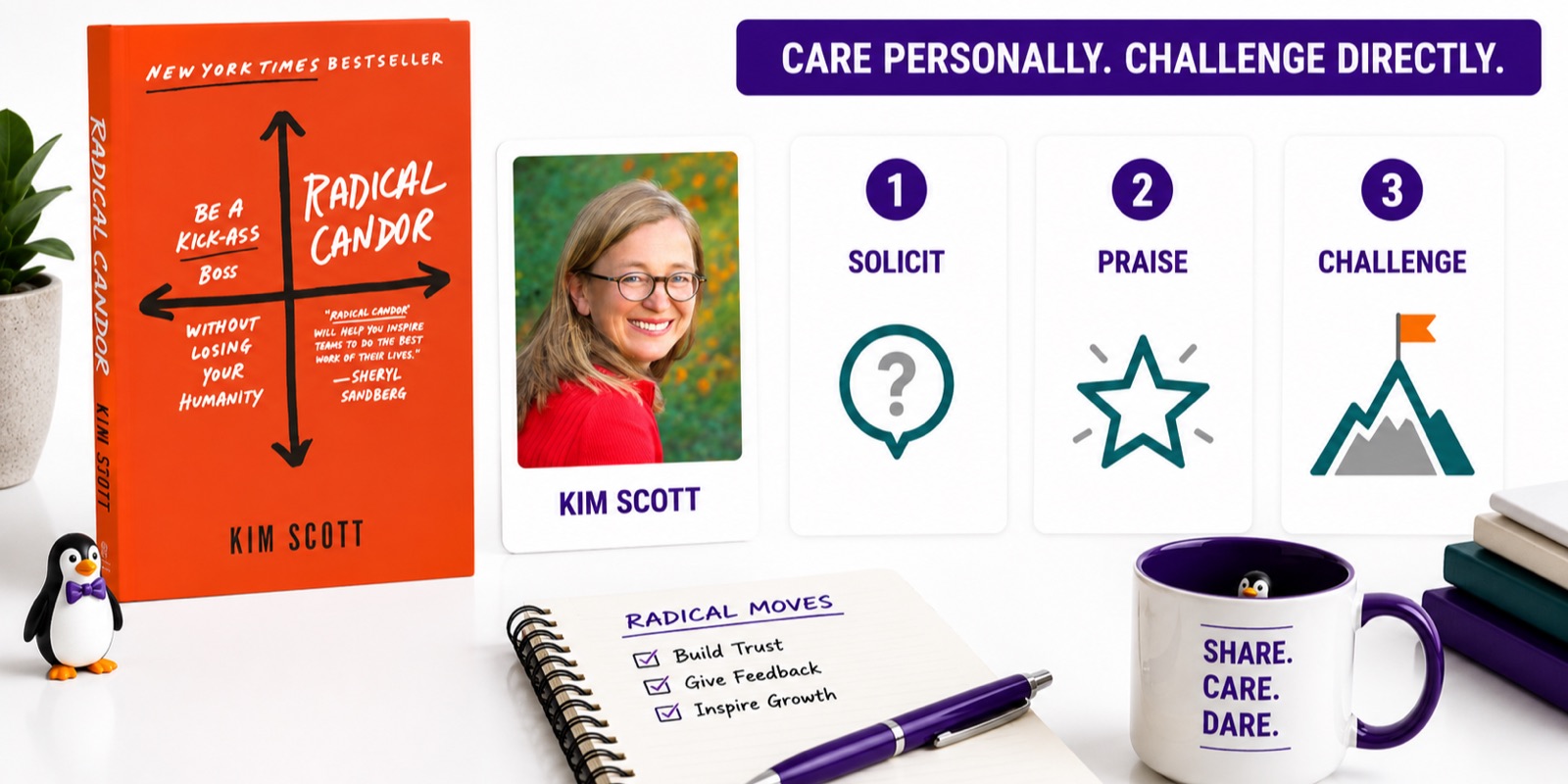
Radical Candor combines personal care with direct challenge so feedback improves performance without sacrificing trust. Author Kim Scott explains why leaders begin by inviting criticism, give praise independently, address problems promptly, and make listening visible. For CMO teams, the framework supports clearer decisions, disagreement, stronger relationships, and fewer conversations postponed in the name of kindness.
Marketing leaders operate inside a constant stream of feedback. They evaluate creative work, coach employees, negotiate with peers, challenge assumptions, and explain difficult tradeoffs to CEOs.
Avoiding a hard conversation may feel considerate in the moment. Over time, silence can allow a correctable problem to affect the employee, the team, and the business.
In a Book Huddle conversation about Radical Candor, Kim Scott, author of Radical Candor, introduced the framework she uses to evaluate workplace feedback.
“When you can care and challenge at the same time, that’s radical candor,” Kim said. “When you challenge but you forget to show you care, that’s obnoxious aggression.”
The model also identifies ruinous empathy, which occurs when concern about another person’s feelings prevents a leader from sharing information that person would benefit from knowing.
Kim illustrated ruinous empathy through the story of an employee she called Bob. He was popular, funny, and struggling badly with his work. Instead of addressing the performance problem clearly, she softened the message for months.
Her reluctance did not protect him. His colleagues had to redo work, deadlines suffered, and strong performers became frustrated. By the time Kim spoke plainly, the situation had progressed too far to recover.
After she explained that his employment would end, Bob asked why nobody had told him earlier. He had interpreted the absence of direct feedback as evidence that his performance was acceptable.
The story exposes a leadership contradiction. Avoiding discomfort can feel compassionate while denying someone the opportunity to improve.
Timely clarity gives the employee information they can use. It also protects colleagues from carrying the consequences of an unresolved performance issue.
“Radical candor should always start with soliciting feedback, not dishing it out. The next step after is to give praise, to back up a little bit and remember what you appreciate about this person and give voice to it.”
Beginning with an invitation demonstrates that candor is reciprocal. It also helps leaders understand how their behavior affects the environment in which other people are expected to perform.
Kim’s preferred question is, “What could I do or stop doing that would make it easier to work with me?” She also encouraged leaders to find language that sounds natural to them. A scripted question that feels out of character may make the invitation less believable.
The pause after asking matters. People may hesitate because they are deciding whether the request is sincere and whether honesty will carry consequences.
Filling that silence too quickly allows everyone to escape the uncomfortable moment without producing useful feedback. A leader who genuinely wants an answer can give the other person time to formulate one.
Receiving feedback does not require immediate agreement. It does require evidence that the leader has listened.
Kim recommended identifying the portion of the feedback that appears valid, asking follow-up questions, and returning to the conversation after considering the rest. A quick “thank you for the feedback” can feel dismissive when the person senses that nothing will change.
“Many of the best relationships I ever formed in my career started with a good, respectful disagreement.”
When feedback is valid, visible action rewards the candor. The response makes future honesty more likely because employees see that raising an issue can affect the way the team works.
A leader may also disagree after considering the feedback. Explaining that decision respectfully can preserve trust because the employee knows the idea received genuine attention.
The feedback sandwich uses praise to soften criticism. Kim argued that this weakens both parts of the conversation because praise becomes a delivery mechanism instead of useful information.
“If it’s something you would say to your dog, it’s not helpful praise.”
“Good job” may feel pleasant, but it offers little guidance. Specific praise identifies the behavior and the result it produced. It tells the person what contributed to success and what the team values.
A leader might recognize how an employee reframed a customer problem, improved a difficult executive conversation, or helped another team reach a decision. The detail makes the praise credible and repeatable.
Praise also deserves its own moment. When every positive comment signals that criticism is coming next, employees may begin bracing whenever a leader recognizes their work.
Candor is easier to act on when it arrives close to the relevant event. Delayed feedback allows the behavior to repeat and gives the leader’s frustration time to grow.
Brief, synchronous conversations can focus on context, observation, result, and next step. The leader describes what happened and why it mattered without assigning the person a fixed character judgment.
This structure creates room for information the leader may not have. A missed deadline could reflect poor planning, an unclear dependency, or a priority conflict nobody resolved.
Kim also distinguished candor from declaring absolute truth. The leader offers an interpretation and remains curious about the other person’s understanding.
“Don’t make the mistake of thinking that being authentic means to ignore the impact that your words have on others.”
Authenticity does not excuse carelessness. Directness becomes more effective when the speaker considers how the message is likely to land.
The same principles can support difficult conversations with a CEO or peer. Budget pressure, competing priorities, and unrealistic timelines often require a marketing leader to make tradeoffs visible.
Kim shared the example of an Apple marketing executive asked to support an important product launch without additional budget or headcount. Instead of pretending everything could be completed, the executive identified the work that would need to stop. Kim distilled the lesson to “Bad news early is the key,” giving the organization time to adjust scope, resources, or timing.
Waiting until the deadline approaches may preserve temporary harmony, but it removes the organization’s opportunity to adjust scope, resources, or timing.
“Your job in decision making is to decide what needs to be decided, who needs to decide it, and by when. Then liberate them to make the decision.”
Clear ownership reduces the collaboration tax that occurs when every decision travels through the CMO. Expertise can remain closer to the work while accountability stays visible.
Healthy debate can improve a decision. Endless debate delays it. Radical Candor gives teams permission to challenge ideas directly and then commit once the decision has been made.
The framework can also improve cross-functional relationships. A marketing leader can challenge a sales assumption, product priority, or executive request without turning disagreement into a judgment about the person raising it.
Care creates the relationship in which challenge can be heard. Challenge gives that relationship enough honesty to remain useful.
It is the practice of caring personally while challenging directly so people can address issues without sacrificing trust.
It demonstrates reciprocity and helps leaders understand how their behavior affects the team.
It occurs when concern about hurting someone’s feelings prevents a leader from sharing useful information.
It turns praise into a criticism-delivery mechanism and can make positive recognition feel insincere.
Listen to the full conversation with Kim Scott.
CMO Huddles helps B2B marketing leaders win by bringing together peers, fresh perspectives, and opportunities to build stronger personal brands. Want to join the huddle? Learn more about CMO Huddles and join CMO Huddles Starter.