
Back to Blogs
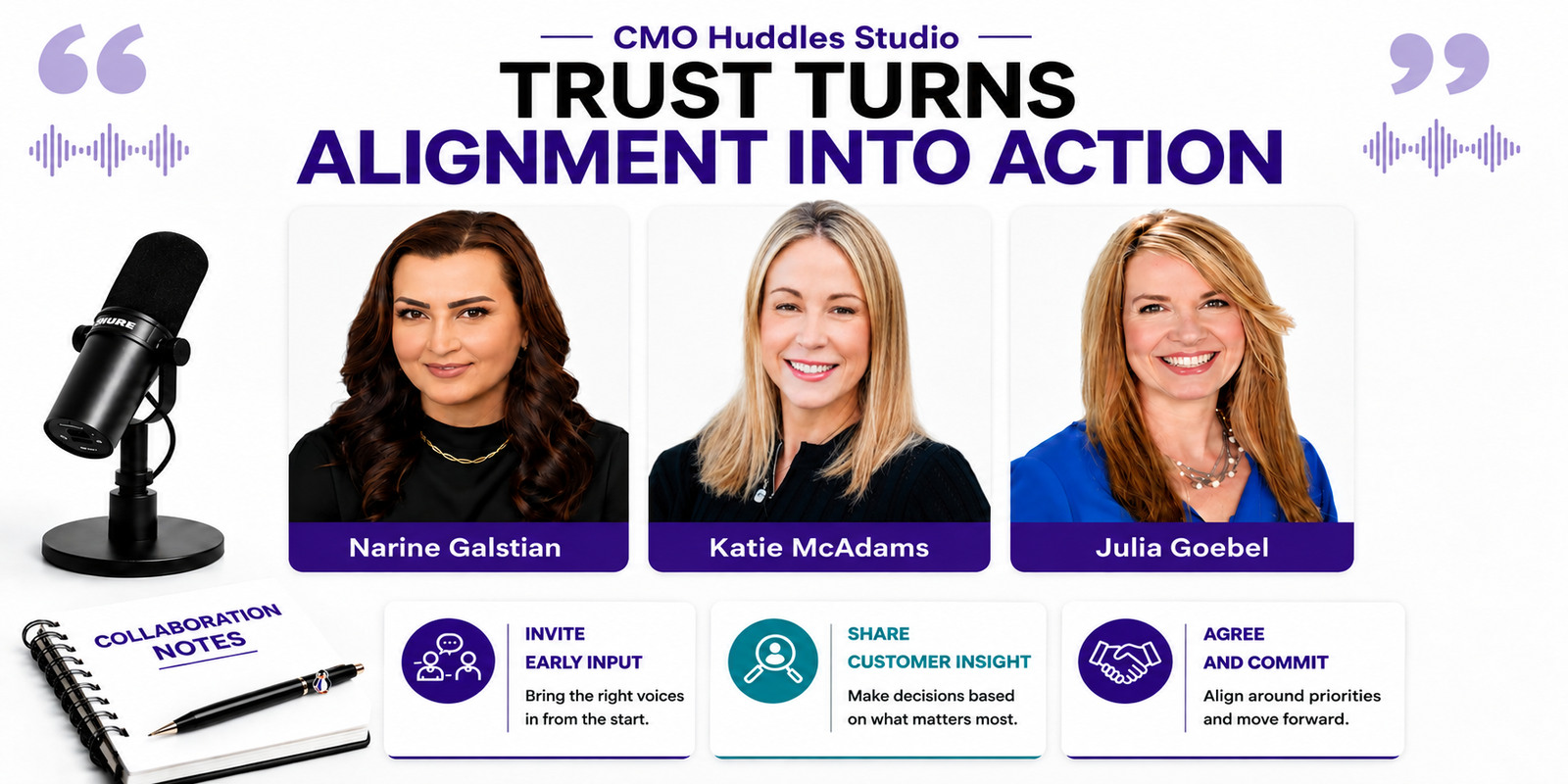
Cross-functional trust can turn the CMO into a company’s chief collaboration officer. Narine Galstian, Katie McAdams, and Julia Goebel explore how customer insight, early stakeholder involvement, healthy debate, and visible leadership alignment connect marketing with sales and product. Their experiences show how relationships and shared outcomes help turn competing priorities into coordinated business momentum together.
Marketing sits at the intersection of customers, product, sales, and company strategy. That position gives the CMO a broad view of the business, but it also creates exposure to competing priorities.
In a CMO Huddles Studio conversation, guest host Narine Galstian, then CMO of SADA, spoke with Katie McAdams, then CMO of Basis Technologies, and Julia Goebel, then CMO of Komodo Health, about the relationships behind organizational alignment.
A go-to-market plan can struggle when the teams expected to execute it were not involved in shaping it. Bringing sales, product, finance, and customer success into the conversation earlier gives each function a chance to surface risks and contribute evidence.
Katie described the mindset that can make those conversations productive:
“Don’t go in with preconceived opinions into these conversations where you’re looking to build alignment.”
Early participation does not require every stakeholder to control the outcome. It allows marketing to understand competing priorities before the final plan reaches execution.
Marketing often carries customer evidence across functional boundaries. Interviews, win-loss findings, NPS feedback, market research, and sales conversations can help teams evaluate priorities through a shared external lens.
Katie described marketing as sitting at the crossroads of product and sales. Customer insight can inform what product develops, how sales frames the value, and which market problems receive attention.
That evidence shifts discussion away from which executive has the strongest opinion and toward what customers appear to need.
Formal processes matter, but alignment can remain fragile when functional leaders have not built trust with one another. Regular communication makes difficult conversations less dependent on a single meeting.
Narine described how she gathers deal-level context:
“Understanding their challenges with each deal and figuring out how to insert marketing tactics to support, progress, and accelerate the process.”
The goal is not for marketing to take over sales execution. The calls provide context about active buyer friction and where marketing support may be useful.
Executive teams will not agree on every decision. Debate can improve a plan when it remains focused on evidence, trade-offs, and shared outcomes.
Julia addressed what happens after the executive debate ends:
“When the leadership team leaves the room, we as leaders have to agree and commit.”
Visible alignment gives teams greater confidence about priorities and reduces the risk of parallel strategies forming beneath the executive level.
Marketing connects customer insight with product, sales, brand, and growth, giving the CMO visibility across several business functions.
Early participation, shared evidence, clear decision rights, and agreement about the intended business outcome can strengthen planning.
Not always. Healthy debate can precede a clear decision, followed by visible commitment from the leadership team.
Regular exposure to sales conversations, customer friction, pipeline context, and shared outcomes can make marketing support more relevant.
Listen to the full conversation with Narine Galstian, Katie McAdams, and Julia Goebel.
CMO Huddles helps B2B marketing leaders win by bringing together peers, fresh perspectives, and opportunities to build stronger personal brands. Want to join the huddle? Learn more about CMO Huddles and apply to join the community.