
Back to Blogs
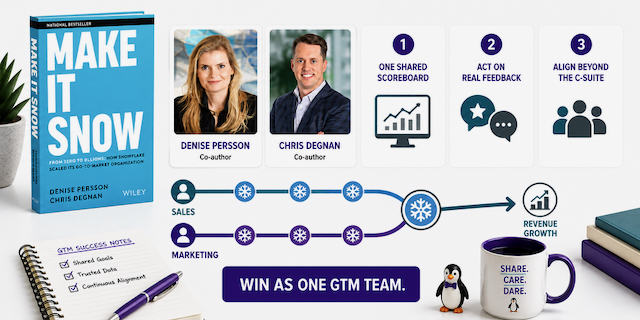
Snowflake’s growth was supported by a CMO-CRO partnership built on shared outcomes, direct feedback, field-level listening, and one integrated view of go-to-market performance. Drawing from Make It Snow, Denise Persson and Chris Degnan explain how marketing earned sales trust, alignment survived four CEOs, and both functions stayed focused on representative productivity, new business, and revenue.
Sales and marketing alignment often fails because each function enters the executive meeting with a separate scoreboard. Marketing presents activity and leads. Sales presents pipeline and revenue. Each team can defend its own performance while the overall go-to-market system struggles.
Snowflake CMO Denise Persson and former Snowflake CRO Chris Degnan built a different operating relationship while helping the company grow from a startup into a multibillion-dollar business.
Their book, Make It Snow, documents the company’s growth and the leadership practices behind it. Their CMO-CRO partnership offers a practical framework: share the outcome, listen at the field level, exchange uncomfortable feedback, act on what is learned, and present one integrated view of the business.
A marketing team can hit its internal targets while sales misses revenue. Celebrating that result weakens trust because it suggests that marketing’s success is independent of the company’s commercial performance.
Chris described how Denise approached board conversations:
“We would go into board meetings, and Denise wouldn’t be like, ‘Yay, look at what we did on the marketing side, but sales stinks.’ She would be like, ‘No, look at what we did, sales and marketing together.’”
The shared presentation did not erase functional accountability. It placed each team’s contribution inside the same commercial story.
Snowflake used an integrated sales and marketing deck rather than assembling separate narratives. The executives could examine marketing activity, representative productivity, new-logo acquisition, and future revenue as parts of one system.
When Denise arrived at Snowflake, Chris did not prescribe a marketing plan. He explained the commercial problem.
Denise then met with SDRs, account executives, and sales managers to understand what was working, where opportunities stalled, and what each territory needed.
Chris had been concerned that a senior marketing executive might arrive with layers of staff and remain distant from the work. Denise instead engaged directly with the field.
That behavior changed the relationship. Marketing did not begin by defending a prebuilt strategy. It began by understanding how sellers experienced the market.
Field listening also gave Denise a more detailed view than an executive dashboard could provide. She could see how positioning, programs, content, and account support affected individual representatives.
Snowflake adopted “no rep left behind” as an early rallying cry.
The company tracked whether representatives could become productive, with new annual contract value serving as a central measure. If representatives could consistently produce, the business had evidence that it could continue hiring and growing.
Marketing investment was therefore evaluated partly through its ability to improve sales productivity. The relevant question was not simply whether a campaign generated activity. It was whether the go-to-market system helped representatives create new business.
This made alignment operational. Territory needs, account-based marketing, pipeline, and representative performance became shared concerns rather than separate departmental metrics.
The model also recognized the cost of failed productivity. Hiring, training, and supporting a representative for a year without creating success imposes a significant cost on the company.
Trust requires more than agreeing publicly. It depends on whether each leader can provide candid feedback and see the other person respond.
Denise explained what happens when uncomfortable input is ignored:
“If you get feedback and you’re like, ‘Nah, this one’s a little bit uncomfortable for me, I’m not really going to do it,’ then Chris isn’t going to give me any feedback again.”
Acting on feedback showed that the exchange was real. It encouraged Chris and the sales organization to continue sharing information marketing needed.
That does not mean marketing executed every request. Feedback still needed to be evaluated against strategy, customer evidence, brand consistency, and resources. The crucial point was that sales could see marketing listening, investigating, and responding rather than dismissing input to protect its existing plan.
A strong personal relationship between the CMO and CRO cannot compensate for disconnected teams.
Snowflake’s model reached SDRs, account executives, sales managers, field marketing, and other go-to-market functions. Denise’s early listening tour signaled that the partnership would operate at the representative and territory level.
Alignment can break down when executives agree but their organizations retain competing definitions, processes, or incentives. The CMO and CRO may speak warmly about partnership while field teams argue about lead quality and ownership.
Extending the operating model requires:
The relationship becomes durable when teams know how collaboration works without requiring executive intervention in every disagreement.
Snowflake grew rapidly and navigated four CEOs during Denise and Chris’s tenure. Growth increased the number of executives, agendas, and organizational boundaries surrounding the relationship.
Chris warned that politics and functional empire-building can damage a company. Leaders may begin protecting their records, budgets, or teams rather than confronting what the business needs.
The CMO-CRO partnership remained credible because neither leader benefited from making the other function look weak. Their shared operating history also gave successive CEOs evidence that the relationship produced results.
This is not a case for presenting artificial harmony. Honest disagreement can strengthen the business. The destructive behavior begins when a leader uses the disagreement to gain status or escape responsibility.
Snowflake’s shift from “data warehouse for the cloud” toward “the data cloud” required more than marketing language.
Customers were already pulling the company toward a broader understanding of its role. Snowflake then validated the positioning with customers, prospects, partners, and the wider market.
The sales team and partner ecosystem needed to describe the company consistently for the change to take hold. If a significant portion of the field retained the old story, marketing could not create the new category perception alone.
The process connected positioning with go-to-market adoption:
Positioning became a shared commercial tool rather than a marketing declaration.
Snowflake generated substantial expansion revenue from existing accounts, but Denise described new business as the company’s lifeblood because it represented revenue expected in future years.
That made new-logo acquisition one of the most integrated parts of sales and marketing planning.
The focus discouraged either function from treating near-term activity as the complete picture. New business required present investment, representative support, category education, and coordinated account engagement before its full revenue appeared.
A shared view of future revenue can help the CMO and CRO navigate tension between immediate pipeline pressure and the work required to create tomorrow’s customer base.
The conversation also addressed the role of SDRs as AI changes go-to-market work.
Denise described the SDR organization as an important talent pipeline. People she met early in Snowflake’s development later became successful sellers and leaders, including a former SDR who advanced into field marketing leadership.
Removing the entire function could create savings now while increasing future costs by eliminating an internal path for developing sales and marketing talent.
The observation reflects the broader CMO-CRO framework. Efficiency decisions need to be evaluated across the shared system. A cost removed from one function may reappear later in hiring, training, leadership development, or customer acquisition.
The Snowflake experience can be translated into a practical set of operating principles:
One commercial narrative
Present marketing and sales performance together rather than competing for credit.
Field-level listening
Understand what SDRs, representatives, managers, customers, and territories need.
Shared productivity measures
Connect marketing activity with representative success, new business, and future revenue.
Direct feedback
Make difficult input safe to give and visibly investigate what it reveals.
Integrated planning
Use common assumptions, priorities, definitions, and review rhythms.
Joint positioning adoption
Validate the story externally and equip the full go-to-market ecosystem to use it.
No public blame
Address problems honestly without using executive forums to protect one function at the expense of the other.
Denise Persson and Chris Degnan worked from shared commercial outcomes, exchanged direct feedback, listened at the field level, and presented an integrated view of sales and marketing performance.
It reflected a focus on helping each sales representative become productive rather than evaluating marketing only through aggregate activity or lead totals.
Denise met directly with SDRs, account executives, and sales managers, acted on useful feedback, and built marketing around the go-to-market problems sales needed to solve.
New customers represented future expansion and revenue. Sales and marketing therefore planned new-business acquisition together rather than assigning it to one function.
Yes. The episode features Make It Snow co-authors Denise Persson and Chris Degnan applying the operating principles and experiences documented in their shared account of Snowflake’s growth.
Listen to the full conversation with Denise Persson and Chris Degnan.
CMO Huddles helps B2B marketing leaders win by bringing together peers, fresh perspectives, and opportunities to build stronger personal brands. Want to join the huddle? Learn more about CMO Huddles and join CMO Huddles Starter.