
Back to Blogs
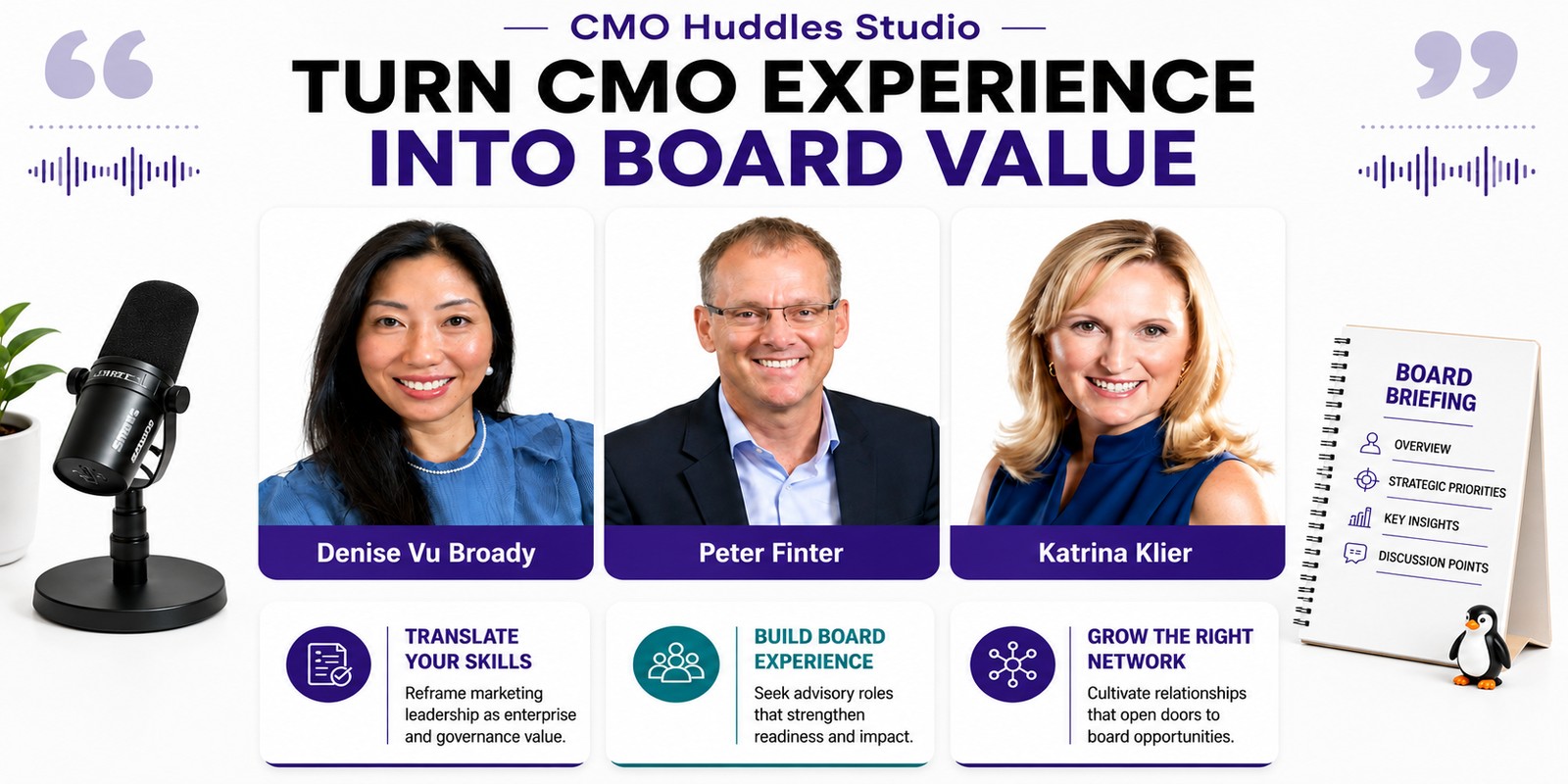
CMO experience can translate into board experience when it is positioned around business strategy, risk, customers, and growth. Denise Vu Broady, Peter Finter, and Katrina Klier explore board preparation, skill translation, networking, advisory roles, and realistic timelines. Their experiences show how marketers can build a credible path toward a private, public, or nonprofit board seat.
CMOs regularly work across strategy, growth, reputation, customers, technology, talent, and organizational change. Those capabilities can be relevant in the boardroom, but they need to be presented as business expertise rather than a list of marketing accomplishments.
In a CMO Huddles Studio conversation, Denise Vu Broady, then CMO of Collibra, Peter Finter, then CMO of KX, and Katrina Klier, CEO of Sage Strategy Group, discussed the path toward board service.
A board is less interested in a candidate’s command of individual channels than in how that leader evaluates growth, risk, customers, competition, and enterprise strategy.
Peter identified one contribution marketing leaders can bring:
“Bringing clarity to mission, purpose, and how we communicate value externally is one of the key superpowers CMOs should be bringing to the table.”
Other transferable strengths may include customer insight, business transformation, reputation management, go-to-market strategy, data interpretation, and executive communication.
The framing changes from “I led a rebrand” to the business problem addressed, the decisions influenced, and the value created.
Denise described the persistence behind her eventual board appointment:
“It could take 3-5 years to get into the spot, but in the interim, get yourself ready.”
Advisory boards and nonprofit boards can provide exposure to governance, group decision-making, and fiduciary conversations. They can also create credible evidence of how the executive contributes outside an operating role.
Board certifications may support education and signal commitment, but credentials alone do not create a seat. Experience, relevance, and relationships remain central.
Boards tend to recruit against a defined gap. They may need experience in cybersecurity, AI, international expansion, regulated markets, customer strategy, or a particular growth stage.
Katrina reframed how board candidates can present their value:
“Think about yourself as a product: Here are my features and functions and how I help you as a board director.”
A board résumé can therefore emphasize strategic situations rather than routine responsibilities. The strongest positioning connects the executive’s experience to problems a board may actually need help governing.
Board openings are less frequent than executive roles and are often filled through trusted networks. Relationships with CEOs, investors, board directors, search firms, and former colleagues can help establish credibility long before a seat becomes available.
The process may include multiple near misses. A narrow role specification can make timing and fit as important as general qualifications.
CMOs may contribute customer insight, growth strategy, reputation management, market perspective, transformation experience, and executive communication.
Yes. Advisory and nonprofit roles can provide governance exposure, relationships, and evidence of contribution beyond an operating position.
Not always. Certification can support education, but experience, fit, reputation, and relationships often carry greater weight.
The process may take several years because openings are limited and boards often recruit for a specific strategic need.
Listen to the full conversation about the CMO’s path to the boardroom.
CMO Huddles helps B2B marketing leaders win by bringing together peers, fresh perspectives, and opportunities to build stronger personal brands. Want to join the huddle? Learn more about CMO Huddles and apply to join the community.