
Back to Blogs
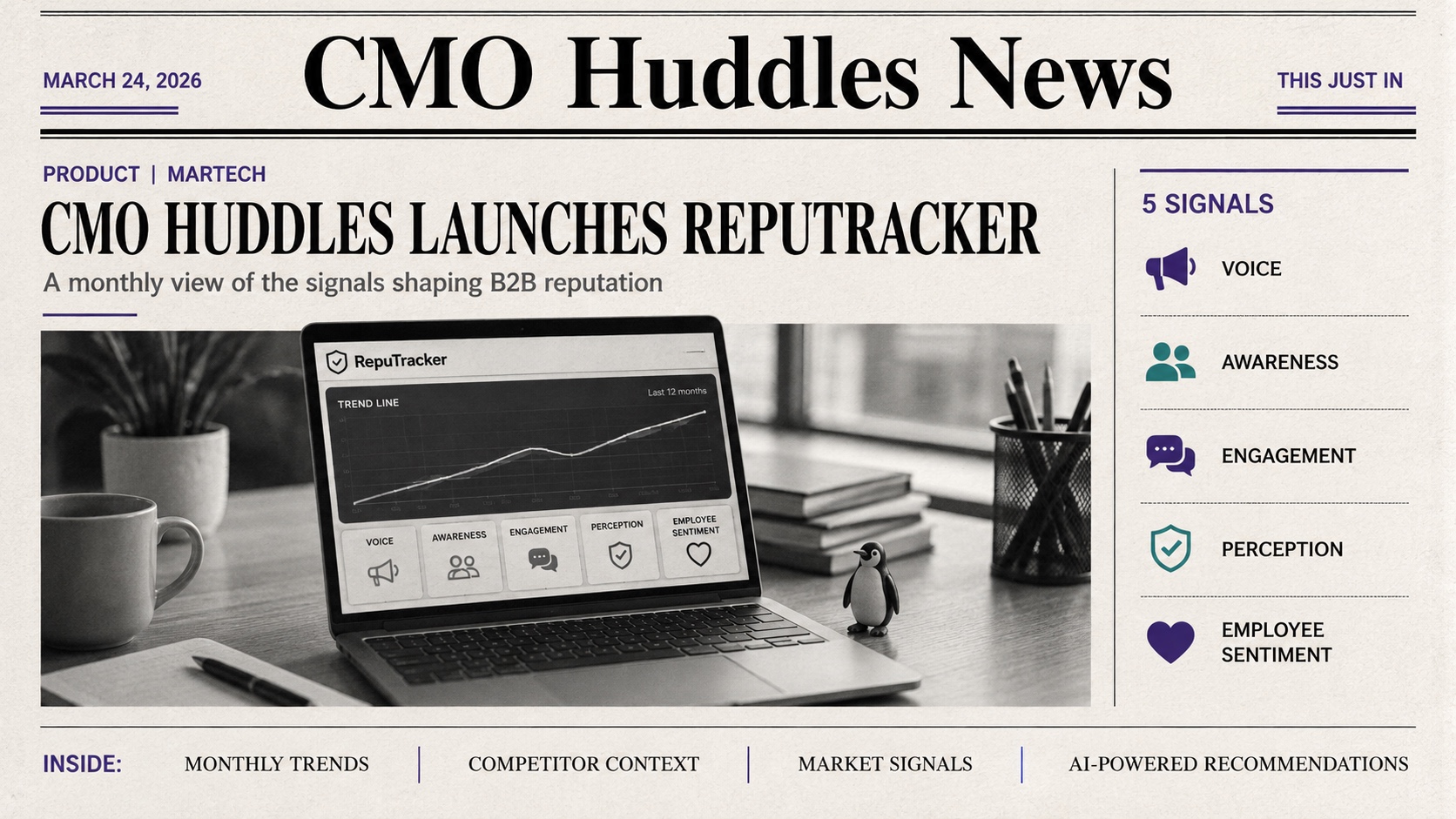
CMO Huddles launched RepuTracker to give B2B marketing leaders a monthly, evidence-based view of brand reputation. Developed with Growth Natives, the beta combines market signals, peer and competitor benchmarks, trend data, and AI-powered recommendations so Leader members can see whether reputation is rising, slipping, or holding steady and understand what may be driving the movement.
B2B marketing leaders are often asked to defend brand investments without affordable, consistent data showing how reputation changes over time.
CMO Huddles developed RepuTracker to address that gap. Created in partnership with Growth Natives, the beta provides CMO Huddles Leader members with a monthly, directional view of their company’s reputation.
The idea emerged from a recurring challenge inside the community. Marketing leaders were making decisions about PR, analyst relations, executive visibility, employee communications, and brand investment without a practical way to see how those choices affected external perception. RepuTracker brings publicly available market signals into one view so members can examine movement over time, compare their company with relevant competitors, and investigate what may be influencing the change.
The product began as a discussion between CMO Huddles and Growth Natives about whether modern data sources could make reputation more visible.
“Brand is king and brand is going to be king for a very long time,” said Taran Nandha, founder and CEO of Growth Natives.
The initial concept required strategic and technical decisions. Reputation is not one metric, and the available platforms expose data in different ways. The development team needed to determine which signals were useful, how much weight each deserved, and how the components could be combined without implying a level of certainty the data could not support. The resulting beta is designed as a directional instrument instead of a final declaration about a company’s brand value.
RepuTracker evaluates five dimensions of B2B reputation:
Each dimension uses several public inputs. Depending on the measure, sources may include Google Trends, Google News, Similarweb, LinkedIn, YouTube, review platforms, and Glassdoor.
The inputs are weighted because every source does not contribute equally to every dimension. Glassdoor, for example, has greater relevance to employee sentiment than a general review platform.
The dimensions contribute to an overall monthly score. Members can also examine the individual components instead of relying only on the combined number.
This detail matters because two companies with similar overall scores may have different strengths and vulnerabilities. One may have strong awareness but weaker perception. Another may be well regarded by customers while receiving limited market attention.
“We are storing data month over month so that you are able to create a trend over time and see how your brand is being built, areas where you need to work on, and how the brand is shifting over time.”
Trend data helps place individual events in context. A sustained change in awareness, perception, or employee sentiment carries more significance than one isolated movement.
It also gives marketing leaders a way to examine whether strategic changes appear in public signals. Increased analyst engagement may influence market visibility. Reduced PR activity may eventually affect awareness. Layoffs may appear in employee sentiment or brand perception.
The tool does not claim that one action caused every movement. It gives leaders a clearer place to begin investigating.
One negative review or sudden spike in mentions may still attract executive attention. A longer trend can help determine whether that event reflects a meaningful change or temporary noise.
An isolated score offers limited meaning. RepuTracker allows Leader members to compare their company with selected competitors and a broader CMO Huddles company cohort.
Category context remains important. A SaaS company with many public reviews will naturally produce different signals from a professional-services firm with fewer review-platform interactions. Direct competitor comparisons and movement within the company’s history may therefore be more useful than comparing absolute scores across unrelated business models.
The comparison view can reveal where a competitor has greater power of voice, stronger awareness, or more positive perception. Marketing leaders can then consider whether the difference reflects strategy, category conditions, or a gap worth addressing.
The product includes AI-powered recommendations based on the signals affecting each dimension. These recommendations are intended as starting points instead of automatic instructions.
A leader can compare them with internal context and decide which actions appear relevant. A drop in awareness may correspond with known traffic data. A perception shift may reflect a product announcement, customer issue, or broader market event.
The recommendations become more useful when the person reviewing them understands what was happening inside the business during the reporting period.
“Our goal is to keep making it better so that we can add a lot of value and validation for all the marketers that are working hard day in and day out.”
The beta designation reflects that continuing work. Feedback from Leader members can improve source configuration, category context, recommendations, and future capabilities.
RepuTracker does not replace internal analytics, customer research, employee surveys, or formal brand tracking. It provides a consistent external view that can sit alongside those sources.
Publicly available data carries limitations. Profiles may be duplicated, one source may represent a particular audience more strongly than another, and competitor information may not be directly comparable with internal data.
As Drew Neisser explained during the product demonstration, reputation data is not like opening a bank account and seeing an exact balance. Its value lies in direction, patterns, and the questions those patterns create.
This limitation is part of the product’s framing. RepuTracker helps marketing leaders investigate changes without presenting the score as infallible.
RepuTracker is currently available in beta to CMO Huddles Leader members. Each monthly view includes:
The product gives marketing leaders a practical way to observe whether reputation is rising, slipping, or remaining steady. The surrounding detail helps them examine what may be contributing to that direction.
RepuTracker is a monthly B2B reputation-tracking product developed by CMO Huddles with Growth Natives.
It evaluates power of voice, awareness, engagement, perception, and employee sentiment.
The beta is currently available to CMO Huddles Leader members.
The product provides monthly updates based on the previous reporting period.
Explore RepuTracker and its current Leader member access.
Listen to the RepuTracker walkthrough with Taran Nandha.
CMO Huddles helps B2B marketing leaders win by bringing together peers, fresh perspectives, and opportunities to build stronger personal brands. Want to join the huddle? Learn more about CMO Huddles and join CMO Huddles Starter.