
Back to Blogs
Drew Neisser is the founder of CMO Huddles and a globally recognized authority on B2B marketing. He’s an AdAge columnist, LinkedIn TopVoice, leading CMO coach, podcast host & friend of penguins everywhere.
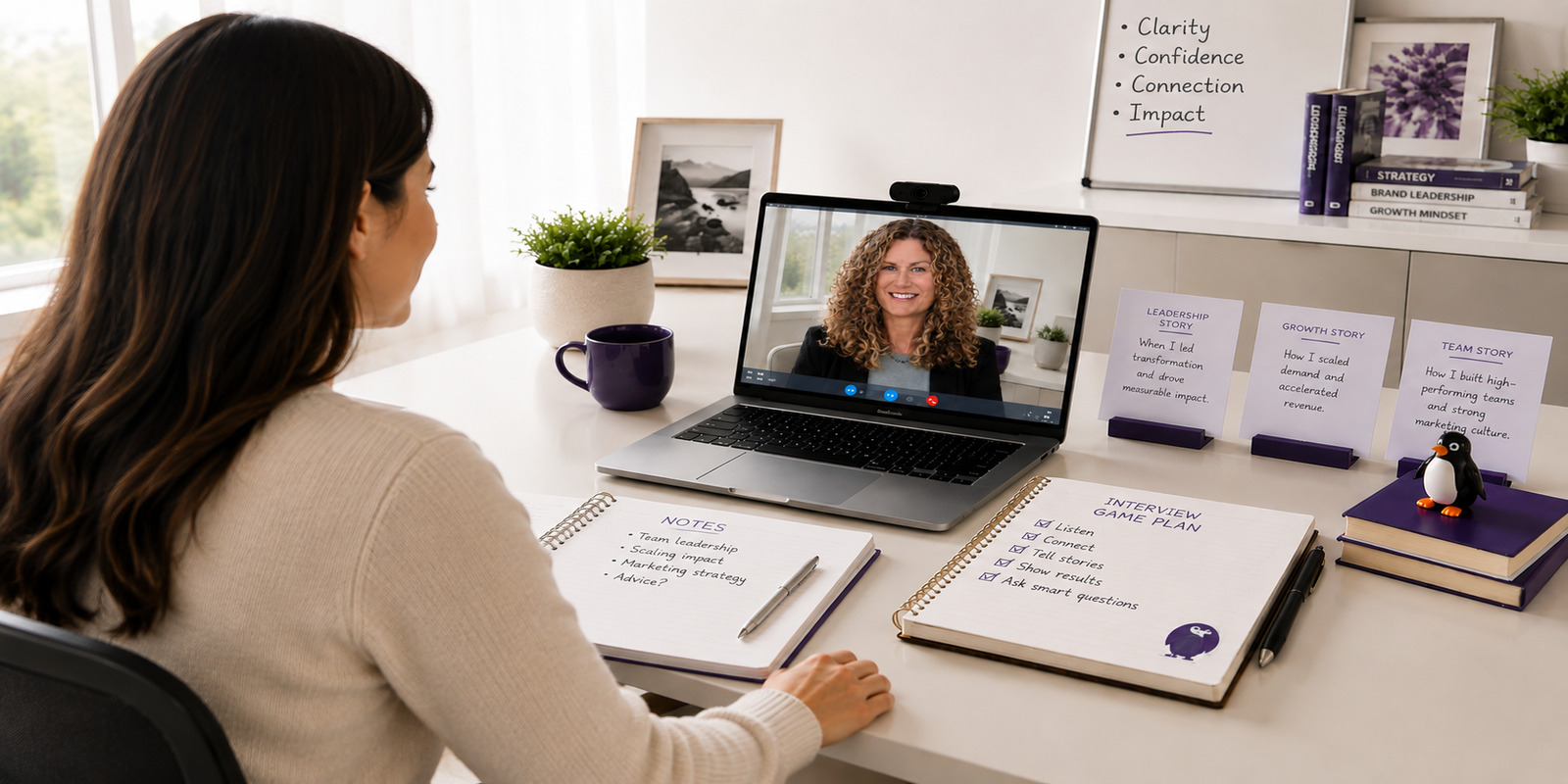
CMOs in transition may have fewer interview “at bats,” which makes every conversation count. In a CMO Huddles Transition Team session, Certified Interview Coach Dalena Bradley explained how senior leaders can avoid vague answers, stop rambling, prepare stronger stories, handle difficult job-loss questions, and interview with more clarity, confidence, and control.
For CMOs looking for their next role, interviews are not just interviews. They're boardroom auditions, leadership tests, chemistry checks, therapy avoidance exercises, and occasionally endurance sports disguised as Zoom calls.
And because senior marketing roles are fewer and further between, CMOs may not get unlimited “at bats.” When an opportunity appears, you need to make the most of it.
That is why we invited Dalena Bradley, an award-winning Certified Interview Coach and LinkedIn Learning Instructor, to join the CMO Huddles Transition Team for a practical session on leadership interview prep.
Dalena has spent 18 years in career services, with the last nine focused entirely on leadership interview preparation. Her background spans corporate communications, executive recruiting, and outplacement, which gives her a rare view from both sides of the table.
Her guidance was direct, useful, and refreshingly human: Senior leaders do not need to become polished robots. They need to tell better stories, answer more succinctly, ask smarter questions, and walk into the conversation as equal participants.
When asked to name the most common interview mistakes she sees executives make, Dalena did not hesitate.
“Number one,” she said, "they’re too general."
Number two: “Rambling.”
Number three: “Being robotic. Not showing up with authenticity and showing who they are as a person.”
There it is: Vague, long-winded, and stiff. The unholy trinity of executive interview trouble.
The good news is that all three are fixable. The less good news is that fixing them requires practice, and not the kind where you quietly read answers to yourself five minutes before the interview while Outlook pings in the background. Yes, that happened during our session. Yes, it became a teaching moment. The universe has timing. [Turns out it was my Apple calendar that was pinging.]
Dalena’s first warning was that executives often answer too broadly. That makes sense. CMOs are trained to think at a high level. They talk strategy, structure, positioning, growth, transformation, and all the other words that sound great until an interviewer thinks, “Fine, but what did you actually do?”
“Because people in leadership roles are big picture people,” Dalena explained, “they don’t often get specific enough.”
The fix is simple but not easy: Move from perspective to proof.
Dalena said candidates often share their approach, perspective, or point of view, but the key phrase is: “For example.”
That is your bridge into a story. Not a wandering autobiography. A specific instance that shows how you tackled the challenge, influenced the organization, made a hard call, changed the trajectory, or learned something useful.
For CMOs, this is especially important because your job is to communicate value clearly. If you cannot translate your own leadership into a memorable story, that is a problem. A brand problem, even. And you are the marketer.
Dalena recommends keeping most behavioral interview answers brief. “A good aim for response time for a behavioral interview question is between two to three minutes,” she said, depending on how layered the question is.
That does not happen by accident. It requires premeditated stories, a structure, practicing out loud, and timing yourself.
Rambling often happens because the stakes are high. Even polished executives get nervous. The temptation is to front-load everything: Every proof point, every message, every caveat, every “one more thing.” Suddenly the answer becomes a 10-minute monologue and the interviewer is quietly aging.
Dalena’s advice is to trust the conversation. You do not have to say everything at once.
And yes, it is completely fine to stop after a concise answer and ask, “Would you like me to expand on any point?”
That move does two useful things. It shows confidence and gives the interviewer control. It also prevents you from filling every silence with more words, which is a crime many of us have committed. Some of us professionally.
Dalena’s third major mistake is showing up as robotic. This risk is increasing as candidates use AI to generate interview answers and then over-rely on notes. “People are generating all their responses with AI these days,” Dalena said. Her caution was not anti-AI. It was anti-reading-your-leadership-off-a-screen.
There is a difference between repetition and memorization. The goal is not to recite a perfect answer. “Know your stories and your examples,” Dalena advised, “and then repeat them out loud over and over again until you’re feeling natural.”
This is especially true for “Tell me about yourself.” Dalena said that answer should be shorter than most behavioral responses: Closer to one to one and a half minutes.
It also needs to be strong. “People are forming their impression of you in seconds,” she said.
If you are interviewing for a CMO role and need to stare at notes to explain who you are, the message is not “prepared.” It may be “not ready to be the face of marketing.” Tiny detail. Large consequence.
One of Dalena’s strongest points was that leadership interviews should not feel like interrogations. “Teaching people how to be more conversational is something that I really focus on,” she said.
That means asking questions midstream, not waiting until the final three minutes when the interviewer says, “What questions do you have for us?” and everyone pretends this is still a two-way conversation.
Dalena recommends asking contextual questions after answering. For example, if you just described your leadership style, you might ask, “What leadership style has worked most effectively with this team?”
That kind of question does three things:
As Dalena put it, “You’re an equal participant in this conversation. You have something they potentially want.”
That mindset matters. You are not begging for a role. You are exploring whether this is a company where you can create impact.
Dalena’s most tactical recommendation may also be one of the most powerful: Ask about the role’s top priority at the beginning of the conversation.
After answering “Tell me about yourself,” she suggests saying something like:
“I’m curious, what is the top priority for this role right now? I want to make sure I fully understand so I can address that at some point during our conversation.”
That question gives you a North Star. It reduces guesswork. It helps you tailor your examples. It also signals that you are not there to perform a generic interview script. You are there to understand the business problem.
For CMOs, that is essential. The role is not “run marketing.” The role is to solve a specific growth, positioning, pipeline, transformation, or leadership challenge at a particular company at a particular moment.
The sooner you uncover that challenge, the better your answers will be.
Many CMOs in transition dread some version of: “Why did you leave?” or “What happened in your last role?”
Dalena’s guidance was both practical and compassionate. First, short tenures are less taboo than they used to be, especially in VC-backed and PE-backed environments. Second, candidates still need to be ready.
Her language recommendation is precise: “My position was eliminated.”
She prefers that to “I was laid off” or “I was let go” because “The more you can distance yourself from the business decision that was made, the better,” Dalena added.
The answer does not need to become a legal deposition, group therapy session, or 20-minute guided tour through executive dysfunction. If the interviewer wants more, they will ask.
Dalena emphasized succinctness, especially when a question has “a little hair on it.” A single sentence may be enough, followed by a pivot to the opportunity ahead.
For example:
“My position was eliminated as part of a broader budget reduction. I’m now focused on finding a role where I can help the company build sustainable revenue growth. Speaking of that, what made this role a priority now?”
That answer is calm, factual, forward-looking, and executive. It does not hide the truth. It also does not hand the interviewer a shovel and invite them to dig through your disappointment.
One audience question sparked a lively discussion: How should CMOs answer “What kind of marketer are you? Demand gen? Product marketing? Brand?”
It is a common question. It can also be a frustrating one, because great CMOs know these categories are interdependent. There is no sustainable demand without brand. Product marketing without go-to-market integration is just lonely positioning. Performance without strategy becomes expensive twitching.
Dalena’s advice was not to pick a box if the truth is bigger. “Don’t be someone you’re not,” she said. “Don’t pick one, if you can do all three, because that is a selling point.”
The right move is to put a stake in the ground, then prove it with a story.
For example:
“I believe the strongest marketing organizations integrate brand, product marketing, and demand generation. In my last role, we connected all three by…”
Then tell the story.
Dalena also encouraged candidates to ask a follow-up if their instincts suggest the question is revealing a concern. “If your spidey senses are up,” she said, “then you absolutely use that time to get them to tell you.”
The order matters: Answer first, then ask. Stay positive. Do not assume the previous CMO failed, even if the question smells faintly of old scar tissue.
Dalena was clear that mindset is as important as message preparation.
For leaders who have been through a painful exit, the first step is the purge. Talk it out with trusted friends, family, coaches, or peers. Write it down. Shred it. Burn it safely. Do whatever helps you process it somewhere other than the interview.
“You’ve got to just get that out of your system,” Dalena said. “Because that is going to subconsciously follow you into the interview.”
She also recommends positive self-talk and visualization. That may sound squishy to some CMOs, but confidence is not a decorative accessory. It changes how you show up.
Dalena suggested simple lines like:
And when the inner critic starts running a second audio track during the interview, Dalena recommends a simple interrupt: “Stop. Not now. Come back.”
That is not woo. That is executive presence maintenance.
Dalena also reminded the group that remote interview presence still matters. A lot.
“Get your setup figured out,” she said.
That means camera quality, lighting, audio, framing, background, posture, and nonverbal presence. If you are interviewing for a CMO role, you are demonstrating whether you can show up as a polished executive communicator on camera.
Dalena cautioned against leaning too far into the camera. In person, leaning in can signal engagement. On camera, it can feel imposing and make you appear smaller.
Her advice: Sit up straight, use the space, center yourself, keep the background uncluttered, and “dress like you care.”
This may sound superficial. It is also real. Executives are expected to be camera-ready now. If your setup looks careless, it can distract from everything else you worked so hard to prepare.
One reason this conversation happened inside the CMO Huddles Transition Team is that CMOs in transition need more than job leads. They need practice, perspective, confidence, and a place to pressure-test the hard questions before the actual interview.
The Transition Team gives CMOs a forum to sharpen their stories, rehearse uncomfortable answers, compare notes with peers, and stay grounded during what can be a lonely and bruising stretch.
Because at the executive level, chances may be fewer. Every interview matters. And it is extremely hard to self-diagnose whether you are being too general, too long-winded, too guarded, too defensive, or too dependent on notes.
As I said during the session, professional golfers still have swing coaches. CMOs deserve the same kind of support when the stakes are high.
Dalena’s work fits that same philosophy. Her interview coaching typically includes a strategy session, messaging work, mindset support, and mock interviews. For CMOs who want dedicated one-on-one help, learn more at DalenaBradley.com.
Interviewing well is not about becoming someone else. It is about showing the best version of your leadership clearly, succinctly, and confidently.
Know your stories. Practice them out loud. Time your answers. Ask smart questions early. Handle hard topics with brevity. Treat the interview like a conversation between executives. And please, for the love of all things flightless and formal, do not read “Tell me about yourself” from your notes.
If you are a B2B CMO in between opportunities, please check out the CMO Huddles Transition Team. The first month is free, and the support can help you make the most of every interview “at bat.”
The most common mistakes are being too general, rambling, and sounding robotic. CMOs need specific stories, concise answers, and enough practice to sound natural rather than scripted.
Most behavioral answers should be about two to three minutes. “Tell me about yourself” should usually be shorter, closer to one to one and a half minutes.
Keep it brief, factual, and business-focused. “My position was eliminated” is often stronger than “I was laid off” because it separates the leader from the business decision.
Yes, but carefully. AI can help organize thinking and generate practice questions, but candidates should not sound scripted or read AI-generated notes. The goal is natural confidence.
It is hard to self-diagnose rambling, weak stories, defensive language, or poor camera presence. Practicing with peers, coaches, or the Transition Team helps CMOs improve before the real interview.