
Back to Blogs
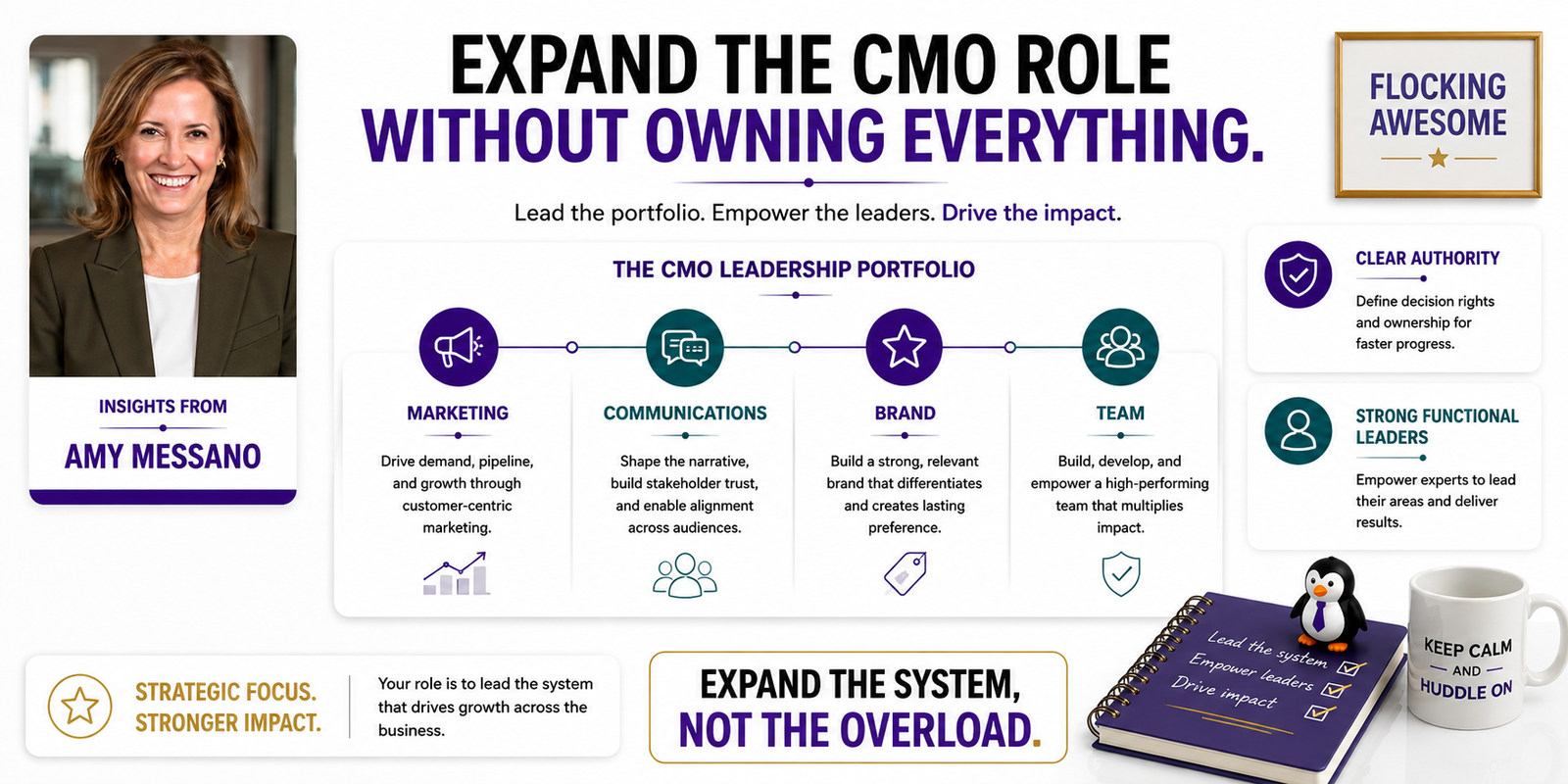
CMO+ leadership expands a marketing executive’s business influence, but scope only creates value when priorities, authority, talent, and operating boundaries expand with it. Amy Messano’s experience leading marketing and communications through brand consolidation, acquisitions, change, and a $10.6 billion sale shows how leadership can strengthen the enterprise without making one executive responsible for every problem.
A CMO+ role combines marketing with another enterprise responsibility, such as communications, customer experience, strategy, growth, or revenue. The title can expand a leader’s influence, but a larger remit is not automatically a better role. The combined functions need a coherent reason to operate together.
Amy Messano held responsibility for both marketing and communications while serving as CMO and Chief Communications Officer of Altair. She had led the two functions together previously and viewed their connection as structural:
“I very much believe that they should be integrated.”
Paid, earned, and owned communication all shape how the company is understood. Bringing them together can reduce conflicting messages, shorten decisions, and connect external storytelling with employee communication. At Altair, that remit included building a centralized marketing team, establishing corporate communications, and moving the company from a house of brands to a branded house.
The role was broader than traditional marketing, but the functions shared a common objective: create one coherent company story for customers, employees, analysts, media, investors, and acquired businesses.
That coherence matters because CMO+ becomes unsustainable when the “plus” is simply every unclaimed problem. A practical role design defines which capabilities belong together, which decisions the leader can make, and what resources accompany the additional accountability.
Broader scope increases the number of people affected by the leader’s decisions. That makes listening more important, particularly when the mandate includes centralization, rebranding, or acquisition integration.
Amy joined a decentralized, engineering-led organization with strong product identities and established local practices. Her previous experience provided useful patterns, but credibility depended on understanding the business before imposing them.
She later reflected:
“It's more emotional than people think, especially through acquisitions. It's people's blood, sweat, and tears, and they want you to understand and respect that.”
A brand consolidation may look like an architecture exercise from the corporate center. For the people who built an acquired product or company, it can feel like a judgment on years of work. Ignoring that emotional reality can produce resistance, lost knowledge, and disengagement.
Listening does not prevent hard decisions. It improves them. Amy’s team maintained Altair as the master brand while preserving RapidMiner as the name of an AI platform because it carried substantial recognition and a large user base. The exception supported the broader architecture instead of undermining it.
This is where CMO+ leadership differs from accumulating tasks. The leader integrates business, brand, culture, and customer implications into one decision rather than treating each function as a separate lane.
A company cannot present a coherent external story if employees do not understand the direction. Internal communications therefore becomes part of change execution, not merely a channel for distributing announcements.
Amy described the people inside the business as central to the brand:
“Your employees are your best ambassadors.”
Employees need context about why the company is changing, how their work contributes, and what remains stable. This becomes especially important during rapid growth, acquisitions, reorganizations, and shifts in positioning.
The communication process can also create a feedback loop. Employees closest to products, customers, and regional markets often see risks that the central team cannot. Giving them meaningful ways to respond improves both the message and the underlying decision.
At Altair, the brand idea “Only Forward” served as a rallying point during the company’s evolution. Its value came from connecting the external brand with the internal direction, rather than functioning as an advertising line detached from the employee experience.
A broader remit does not mean the CMO personally performs more categories of work. Sustainable CMO+ leadership depends on an organizational structure that places expertise and decision-making close to the work.
When asked how she managed the role’s many responsibilities, Amy answered simply: “Teamwork.”
Her organization included roughly 106 people across approximately 37 countries, organized into three broad groups. Solutions teams worked closely with product and development. Integrated Marketing Communications included brand, web, internal communications, social media, media relations, analyst relations, and creative. Field teams included events and several types of partner marketing.
Despite that reach, Amy had four direct reports. The structure allowed her to lead the system without becoming the approval point for every activity.
This distinction is central to avoiding burnout. A CMO+ leader can define priorities, connect functions, make enterprise decisions, and develop leaders beneath them. If the operating model requires the executive to personally reconcile every message, campaign, product request, and regional concern, the role design has failed.
The team’s internal reputation became one measure of progress. Amy said:
“The internal reputation of the team went from order takers to strategic partners, and that just meant the world to me.”
That shift suggests the team had gained context and credibility, not merely additional work. Strategic partners help shape decisions. Order takers receive them after the important choices have already been made.
Marketing and communications can bring different instincts to the same decision. Marketing may see an opportunity to create attention, while communications identifies reputational risk, stakeholder sensitivities, or consequences that cannot be reversed.
Combining the functions does not require one instinct to defeat the other. It gives the leader a complete view of the opportunity.
Amy explained that corporate communications professionals are thoughtful because a poorly prepared executive interview or careless public statement can spread immediately. The risk is not theoretical. The company and its leaders may carry the effect long after the campaign ends.
That caution can strengthen creative work when it enters the process early. Communications can identify the boundaries and evidence required for a bold claim, while marketing can prevent prudent review from becoming automatic avoidance.
The operating solution is shared planning, clear decision rights, and enough trust for both perspectives to influence the outcome. When the functions are integrated only at final approval, marketing experiences communications as a blocker and communications experiences marketing as an unmanaged risk.
Altair completed more than 20 acquisitions during Amy’s tenure before Siemens acquired the company for approximately $10.6 billion. That experience placed marketing and communications at the center of repeated integration work.
Amy observed that acquired teams “want to feel heard” and “want to feel valued and appreciated for what they have brought to the table.” That recognition is not a substitute for integration decisions, but it helps preserve the knowledge and commitment that made the acquired company valuable.
Her team used a consistent brand architecture while allowing acquired capabilities to influence processes and product structure. The approach avoided two extremes: leaving every acquired brand untouched or erasing its identity without examining what the company had purchased.
CMO+ leadership has particular value here because brand, communications, culture, product narrative, and employee experience cannot be separated cleanly. The combined view helps the company decide what to preserve, what to integrate, and how to explain the transition.
A sustainable CMO+ role needs more than personal stamina. It benefits from several explicit conditions:
These boundaries protect the leader and improve the business. When every responsibility is treated as equally urgent, the executive becomes a bottleneck and the team loses clarity. When priorities are explicit, the broader remit can help formerly separate functions act as one system.
Amy’s experience shows that CMO+ can be a platform for enterprise leadership when the added scope creates integration rather than overload. The role becomes more sustainable when the leader builds the architecture, talent, and trust required for others to carry the work.
CMO+ describes a marketing leader whose formal remit includes another significant enterprise function, such as communications, customer experience, strategy, growth, or revenue.
The strongest combinations share decisions, audiences, data, or outcomes. Marketing and communications can be a natural pair because paid, earned, owned, and internal messaging all shape the company’s reputation.
The role benefits from clear priorities, matching authority, strong functional leaders, limited direct reports, explicit decision rights, and agreement about which responsibilities do not belong within the remit.
No. The executive needs enough fluency to ask useful questions, connect implications, and make informed decisions. Deep functional expertise can reside with capable leaders across the organization.
Clear internal communication, visible priorities, meaningful listening, consistent decision principles, and respect for acquired expertise can reduce uncertainty while allowing difficult integration choices to proceed.
Listen to Drew Neisser’s full conversation with Amy Messano.
CMO Huddles helps B2B marketing leaders win by bringing together peers, fresh perspectives, and opportunities to build stronger personal brands. Want to join the huddle? Learn more about CMO Huddles and join CMO Huddles Starter.