
Back to Blogs
Drew Neisser is the founder of CMO Huddles and a globally recognized authority on B2B marketing. He’s an AdAge columnist, LinkedIn TopVoice, leading CMO coach, podcast host & friend of penguins everywhere.
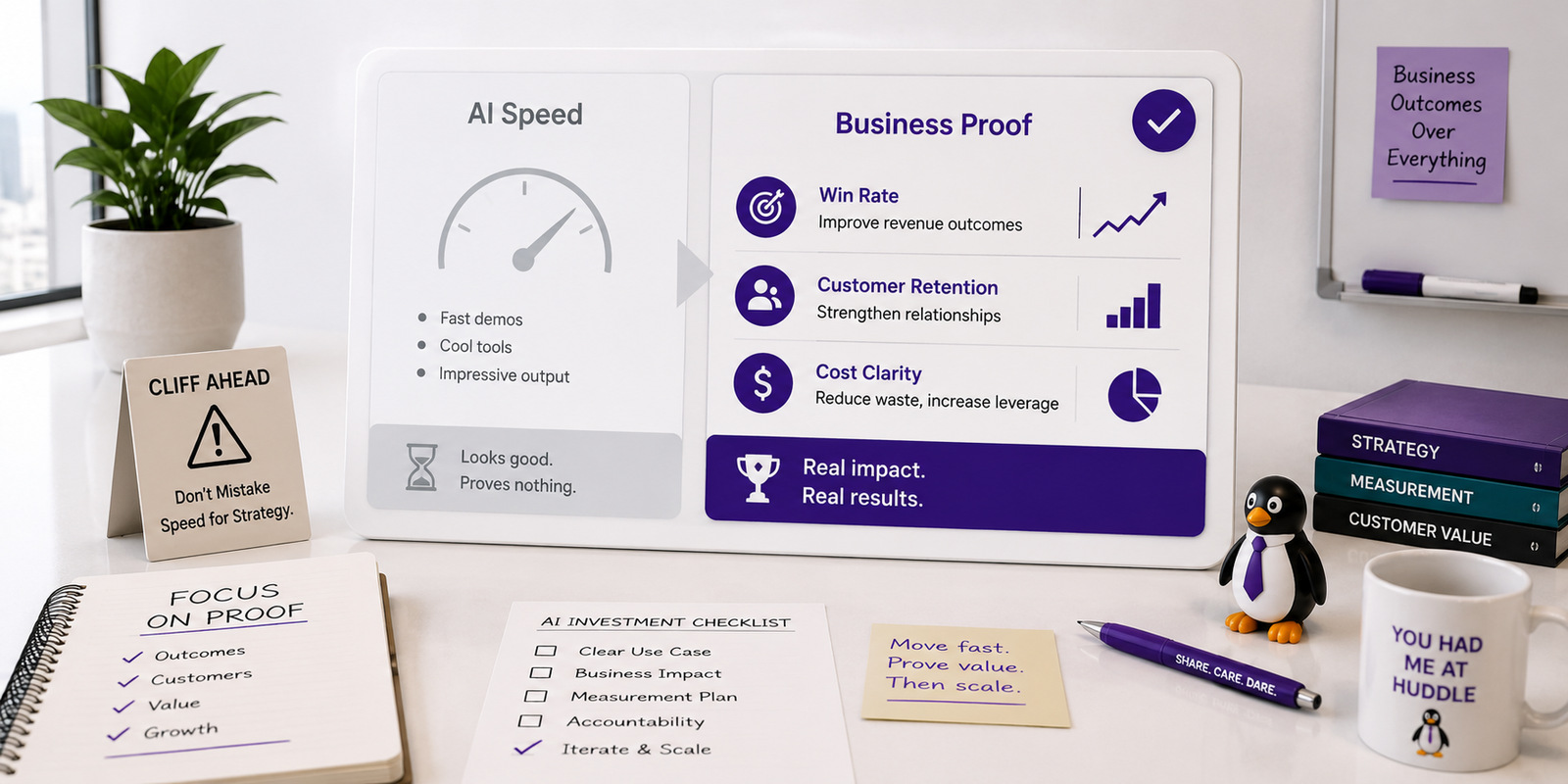
AI can help marketing teams move faster, but speed alone is not strategy. CMOs need to tie AI initiatives to measurable business outcomes, benchmark current performance, expose hidden costs, clean up governance gaps, and push back when executives confuse output, headcount reduction, or revenue-per-employee fantasies with actual growth.
“We’re so AI-forward we’re off the cliff,” shared a CMO at a $300M tech company. She had spent more than three years rebuilding marketing into a real growth engine, only to watch leadership get seduced by the fantasy that AI automatically means fewer people, lower costs, and better outcomes.
Her view was simple: The tools are getting faster, but the proof is not. That line should make every CMO sit up a little straighter, because right now too many executive teams are treating AI enthusiasm as evidence. They see speed, demos, agents, automation, and headcount reduction scenarios, then leap straight to the promised land of higher output and lower cost.
Tiny problem: A faster machine pointed in the wrong direction is still a problem. It is just a more efficient one.
Too many companies are treating AI velocity as strategy. Ship faster, launch faster, produce more, cut heads, declare victory. Except speed only matters if it improves the business.
If campaigns go out faster and conversion stays flat, nothing meaningful happened. If product teams crank out features customers cannot absorb, that is not innovation. That is noise with release notes.
Jenny Coupe put it perfectly in a LinkedIn comment: “Without governance, speed kills.” Samuel Ajiboyede added another useful warning: “Too many confuse speed with progress without the right metrics.”
Exactly. AI can absolutely accelerate marketing. It can help with research, messaging, content operations, sales enablement, campaign development, customer analysis, meeting prep, and workflow redesign.
But “faster” is not the business case.
The business case is better win rates, lower churn, stronger customer satisfaction, shorter sales cycles, improved pipeline quality, reduced cost per opportunity, better retention, or higher share of wallet. If the AI initiative cannot connect to one of those outcomes, CMOs should ask why it exists.
The CMO who sparked this rant was not anti-AI. Quite the opposite. She had real use cases, and one stood out.
Her team analyzed recorded sales calls and found that when sellers mentioned their platform solution, win rates rose by about 1.5 percentage points. That insight led to reinforcement in sales enablement, decks, and messaging.
Now that is useful. That is an AI story a CFO can understand.
It starts with a business problem. It uses AI to find a pattern. It connects the pattern to revenue impact. Then it changes behavior in the field. No confetti cannon required.
Dian Basit summed up the practical standard in a LinkedIn comment: “AI creates value when it improves business results, not simply when teams produce more work.”
Amen. Not “we generated 400 campaign ideas.” Not “we summarized 900 calls.” Not “we created 73 agent prototypes and named three of them.” The question is: What changed because of the insight?
If AI improves a workflow but nothing changes in the market, funnel, sales motion, or customer experience, the win may be smaller than the demo suggests.
The same CMO also replaced a legacy enablement platform with a sales content agent in Slack. Sounds efficient, right? Hopefully.
But once you factor in token costs, engineering support, maintenance, governance, AI ops, workflow redesign, and ongoing quality control, the savings can get fuzzy fast.
This is the chaos tax. It shows up when every team builds agents without shared standards. It shows up when different systems return different answers to basic company facts. It shows up when content libraries are messy, claims are inconsistent, training data is stale, and no one knows who owns the answer.
That is not transformation. That is governance debt with a shiny interface.
Shivansh Chawla pointed to the less glamorous but more valuable work underneath AI adoption: “Sure it is great and has helped me a lot but that’s by focusing on what’s under it. Streamlining data, writing SOPs for processes etc.”
There it is. The boring work is the leverage.
Clean data. Clear claims. Approved messaging. Standard operating procedures. Governance. Ownership. Measurement. Without those, AI does not eliminate chaos. It distributes chaos at scale.
To paraphrase Anne Morriss, CMOs need to slow down to speed up. That does not mean moving slowly. It means getting aligned before sprinting.
Every AI initiative should connect to a major strategic goal: Reducing churn, improving win rates, increasing customer satisfaction, gaining share through differentiated product enhancements, improving sales productivity, or reducing cost per opportunity. Once the goal is clear, the plan gets clearer.
AI can help build that plan. It can help map workflows, identify dependencies, model costs, compare scenarios, and pressure-test assumptions. It can also help estimate the true cost of using AI to achieve a particular strategic goal, including people, platforms, tokens, integrations, governance, and maintenance.
The cost of AI is not just the subscription. The cost is the operating model around it.
Before leaders declare AI victory, CMOs should insist on baselines. Where are we today? What is the current win rate, sales cycle length, conversion rate, cost per opportunity, content cycle time, customer satisfaction score, churn rate, expansion rate, support volume, enablement usage, and message consistency?
If you do not know the starting point, the improvement story will be mostly vibes in business attire.
Benchmarking also applies to knowledge quality. If your AI stack cannot answer basic company questions consistently, stop adding tools. Clean up the content, claims, and governance first.
Otherwise, you are not scaling intelligence. You are scaling confusion.
The real risk with AI is not the technology. It is executive and investor fantasy.
Saying AI can 3x output or reduce headcount by 33% does not make it real. Asking the leadership team to 3x or 4x revenue per employee with the help of AI does not make it a strategy. Those outcomes would be amazing, and some companies may get there. But they will be the companies with clear priorities, disciplined leadership, clean operating models, strong governance, and serious measurement.
AI will not fix a leadership team that cannot focus. It may simply expose that faster.
CMOs have the opportunity to be the adults in the room. Create an inspired strategy. Defend the customer. Resist AI theater. Demand evidence. Name the hidden costs. Benchmark the baseline. Tie AI to business outcomes.
And when the company starts sprinting toward the cliff, say so, preferably before the board deck calls it transformation.
AI theater is visible AI activity that looks impressive but does not improve business outcomes. It often includes flashy demos, agent pilots, output metrics, or headcount assumptions without clear links to revenue, retention, customer experience, or efficiency.
CMOs should start with the business outcome. Ask whether the initiative improves win rates, conversion, pipeline quality, customer satisfaction, retention, sales productivity, cost per opportunity, or another strategic metric. If the outcome is unclear, the initiative needs more work.
Speed only matters if it improves results. Producing campaigns, content, features, or workflows faster can create noise if quality, conversion, customer adoption, or revenue impact do not improve.
Hidden costs include token usage, engineering support, integrations, maintenance, AI ops, governance, content cleanup, legal review, workflow redesign, training, and quality control. These costs can make “cheap” AI use cases more expensive than they look.
Benchmark current performance, clarify strategic goals, clean up data and content, define governance, assign ownership, and identify the specific business outcome each tool is meant to improve.
CMO Huddles helps B2B marketing leaders win by bringing together peers, fresh perspectives, and opportunities to build stronger personal brands. Want to join the huddle? Learn more about CMO Huddles and apply to join the community.