
Back to Blogs
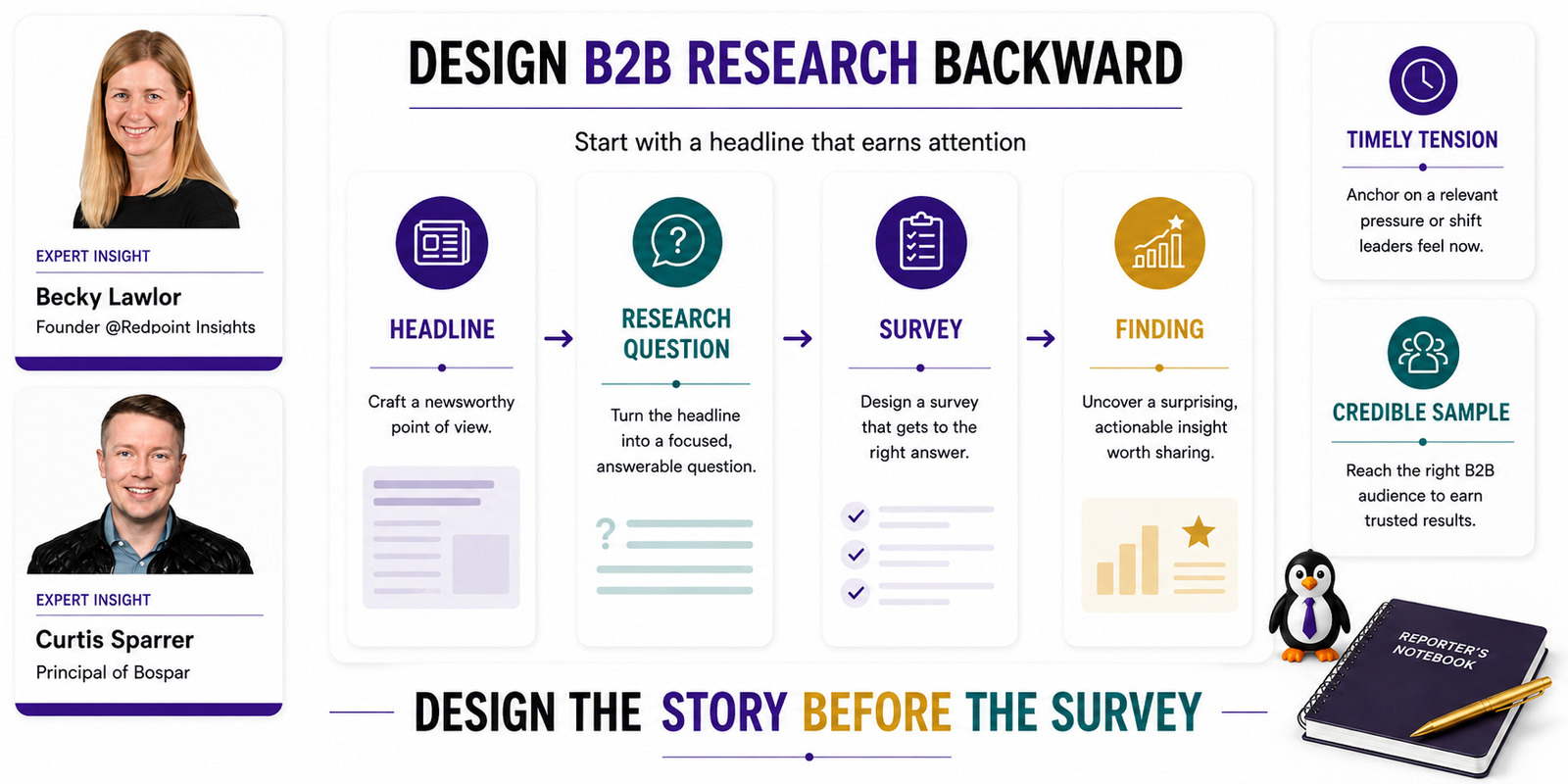
B2B research earns media attention when its design begins with a credible, timely story rather than a self-serving conclusion. Becky Lawlor and Curtis Sparrer explain how CMOs can choose qualified respondents, write stronger surveys, anticipate useful headlines, preserve research integrity, and turn trustworthy findings into press coverage, sales enablement, and enduring thought leadership assets together.
Primary research can earn press, strengthen sales conversations, attract links, generate event content, and give a B2B company something original to say. It can also consume substantial time and money before producing findings that no journalist, buyer, or salesperson wants to use.
The difference often appears before the first response is collected.
In a CMO Huddles expert conversation, Becky Lawlor of Redpoint Content and Curtis Sparrer of Bospar explained how research design and media strategy must work together. Becky approached the subject as a researcher committed to credible methodology. Curtis brought the perspective of a former journalist and public-relations leader responsible for earning attention.
Their advice begins with a deceptively difficult question: What story could this research legitimately uncover?
Research designed for public relations should reflect what relevant journalists already cover or are likely to cover soon. That does not mean copying a familiar story. It means understanding the conversations, events, tensions, and unanswered questions that make a finding timely.
Becky identified a common failure at the start of the process:
“The three biggest mistakes that I’ve seen out there is one, not aligning your research topic with media trends and interests when you’re focused on PR.”
The relevant media environment may be broad or specialized. A B2B company does not always need national consumer coverage. A respected trade publication read by the company’s buyers may deliver more commercial value than a larger outlet with little connection to the category.
CMOs should define the desired audience and publication set before approving the topic. Review recent coverage, recurring editorial themes, industry events, regulatory developments, and predictable seasonal stories. A public-relations partner can help determine whether journalists have exhausted a topic or remain hungry for better evidence.
Research can serve many legitimate purposes. A company may want to understand customer behavior, validate product direction, benchmark a category, or create a story for the press. Those objectives overlap, but they do not produce identical studies.
Curtis drew a distinction between research that makes the company smarter and research designed to interest journalists. A narrowly targeted study of senior executives may be valuable for strategy and sales enablement, while a broader consumer study may support a headline with wider reach.
He explained what many reporters prefer:
“Overwhelmingly, reporters prefer to be able to say ‘Americans are going to do this because of that.’”
That preference does not make specialized B2B research useless. It changes where and how the findings should be pitched. Trade reporters may accept smaller samples when the respondents are difficult to reach and genuinely relevant. Mainstream outlets may expect larger samples that support broader claims.
The research objective should determine the sample, not the other way around.
B2B audience quality is one of the hardest parts of research design. Broad consumer panels may allow respondents to identify themselves as marketers, executives, or technology professionals without verifying that they have the experience required to answer detailed questions.
A respondent who works somewhere in marketing may not be qualified to discuss enterprise software procurement, board reporting, or global demand-generation budgets. Adding company-size, seniority, purchasing-role, and category-use requirements can quickly expose the limits of a general panel.
Screening questions should confirm that respondents fit the intended profile without revealing the answers the sponsor hopes to receive. Researchers may also need quality checks for contradictory responses, suspicious completion times, patterned answers, and duplicate participation.
Bad respondents do not merely weaken a technical appendix. They can invalidate the story.
Poorly written surveys create poor data even when the audience is perfect.
Becky warned:
“If your survey is poorly written, it will result in poor quality or boring data, and it will also probably make it more difficult for you to even get responses in the first place.”
Questions should be clear, neutral, answerable, and varied enough to reveal meaningful differences. A survey composed entirely of one-to-five rating scales may be easy to field but difficult to turn into a persuasive narrative.
The team should also avoid questions that lead respondents toward the sponsor’s preferred conclusion. Journalists may request the questionnaire, methodology, or raw findings. If the wording appears designed to manufacture a result, the credibility of the entire study can collapse.
A research specialist can identify hidden bias, ambiguous language, overlapping answer choices, and questions that demand knowledge respondents are unlikely to possess. That review is especially valuable when internal stakeholders have become attached to a particular outcome.
Thinking about headlines before fielding a study is not the same as manipulating the result. It is a way to test whether the questions could produce a meaningful story.
Curtis recommended beginning with the destination:
“One of the things that I recommend is to reverse engineer and think, what are the headlines that you do want? Because at least you know where you’re going to land.”
The plural matters. A study should not depend on one dream statistic. The team can identify several plausible narratives and include questions capable of exploring each one. If the expected result fails to appear, another credible pattern may provide the stronger story.
Possible headline structures might include an unexpected behavior, a widening gap between leaders and practitioners, a costly contradiction, a change over time, or a difference between what executives believe and what customers experience.
These are hypotheses, not conclusions. The data still gets the final word.
A study becomes difficult to trust when every question seems designed to prove that the company’s category, product, or worldview is indispensable.
Curtis offered an intentionally provocative warning about self-congratulatory research, followed by a cleaner version:
“No one’s going to give you a hug if you’re too busy hugging yourself.”
A cybersecurity company asking respondents whether security is important has not uncovered much. A collaboration platform proving that collaboration improves productivity is equally predictable. The findings may support a sales presentation, but they are unlikely to surprise a serious reporter.
A stronger study investigates a tension the sponsor has permission to explore without requiring the result to glorify the sponsor. The company’s relevance should emerge through its expertise and interpretation, not through a questionnaire that functions as an advertisement.
Research can gain urgency by connecting with stories journalists already expect to cover. Elections, major industry conferences, regulatory deadlines, economic changes, security incidents, holiday behavior, and cultural events can all create relevant openings.
Curtis described research tied to a major technology incident that generated extensive coverage because it entered an active news cycle. He also described connecting remote-work research to Earth Day, giving journalists a timely reason to use the findings.
This requires planning. Annual editorial calendars and predictable events can support a deliberate research schedule. Breaking news may call for a faster pulse survey, but speed should not eliminate respondent verification or careful wording.
Timeliness helps a credible study travel. It cannot rescue a weak one.
A pilot can reveal problems that are expensive to discover after thousands of responses arrive. The research team can examine whether participants understand the questions, whether the response options capture reality, and whether the results contain enough variation to support analysis.
Internal stakeholders should also review the survey before launch. Sales, customer success, product, finance, and communications leaders may identify missing questions or assumptions that do not match the market.
Their involvement needs boundaries. Too many additions can make a survey long, unfocused, and unpleasant to complete. The research owner should protect the primary objective while collecting useful input.
Testing should improve the instrument, not turn it into a catalog of every question anyone in the company has ever wanted answered.
Research does not always confirm the original hypothesis. That is part of its value.
Becky explained that a credible team must be willing to reconsider the story:
“Sometimes the data comes back in surprising ways, and maybe the story is not what you thought, but there usually is a story if you’ve done a good job of asking the questions.”
The first analysis should examine the overall results, differences among meaningful segments, correlations worth exploring, and contradictions between attitudes and behavior. The team should resist ignoring findings simply because they complicate the launch plan.
Unexpected results may be more newsworthy precisely because they challenge the sponsor’s assumptions. Publishing them can strengthen trust and give company experts a more substantive position from which to interpret the market.
Top-tier journalists may ask for the survey, sample details, fielding dates, raw results, sponsor information, or explanation of how respondents were recruited.
Curtis put the expectation plainly:
“They’re gonna look under the hood.”
A methodology statement should be ready before outreach begins. It should explain who participated, how many responses were collected, how respondents qualified, when the survey was fielded, and how the data was analyzed.
The press release and report should also avoid claiming more than the sample supports. A survey of 250 enterprise IT decision-makers does not prove what all Americans believe. Precision makes the finding more credible, not less interesting.
Press coverage may be the initial objective, but strong research can support months of marketing and sales activity. The full program might include a report, executive summary, webinar, conference session, media pitch, sales presentation, customer discussion guide, social series, contributed article, infographic, and follow-up analysis.
Different audiences need different interpretations. A journalist may want the sharpest finding, while a salesperson needs a relevant benchmark and an executive audience may want implications for investment.
Repurposing works only when the core study contains genuine substance. Distribution cannot manufacture depth that the research failed to collect.
Newsworthy research is timely, credible, relevant beyond the sponsor, and capable of revealing a meaningful change, contradiction, or surprising behavior. The strongest studies connect legitimate data to a story journalists and their audiences already care about.
The appropriate sample depends on the audience and publication target. Broad consumer studies commonly require larger samples. Specialized trade publications may accept smaller samples when respondents are senior, difficult to reach, and demonstrably qualified.
Yes, if the headlines are treated as hypotheses and the questions remain neutral. Planning several possible stories helps determine whether the study can produce useful findings. The final narrative must follow the evidence.
It should identify the sample size, respondent qualifications, recruitment approach, fielding period, survey method, relevant weighting, and any limitations that affect how the results should be interpreted.
Listen to the full conversation about creating PR-ready B2B research.
CMO Huddles gives B2B marketing leaders access to peers and experts who can help them pressure-test research, positioning, content, and executive decisions. Learn more about CMO Huddles or join CMO Huddles Starter.