
Back to Blogs
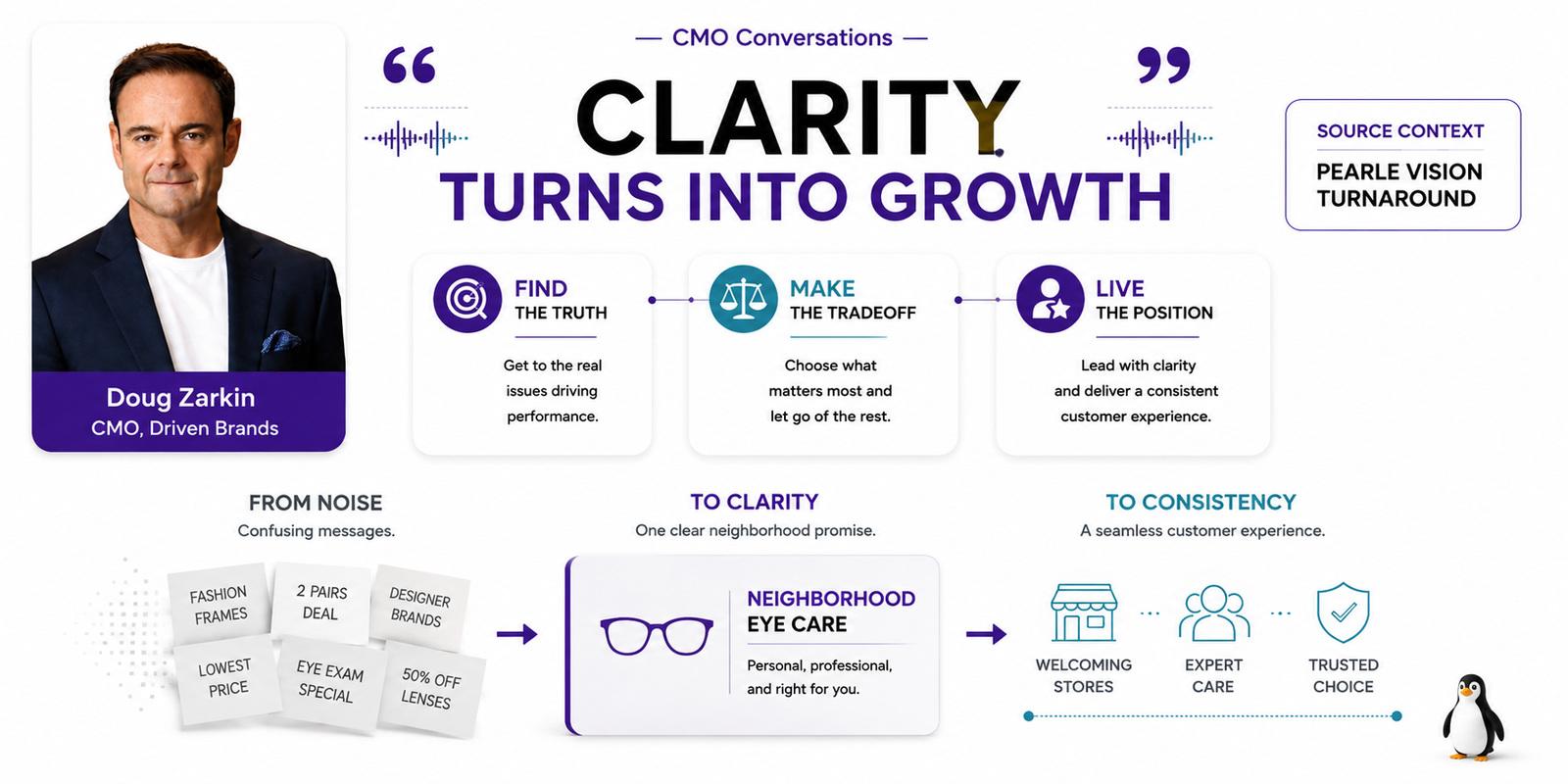
Crystal-clear positioning creates growth when it reflects an authentic strength customers value and shapes decisions across the business. Drawing from Doug Zarkin’s Pearle Vision turnaround, this article explores how field research, disciplined tradeoffs, founder heritage, consistent language, and everyday execution moved the conversation from discounted eyewear toward trusted neighborhood eye care and renewed the brand.
Positioning is a choice about what the company can credibly own, which customers it serves, and what it will emphasize or leave behind. Its value becomes visible when the choice shapes communication, customer experience, operations, and investment.
In a Renegade Thinkers Unite conversation about the transformation of Pearle Vision, Doug Zarkin described how the brand moved away from a discount-oriented retail perception and reconnected with its heritage in professional eye care.
Pearle Vision needed a position that could guide execution across a franchise system. The answer came from examining what the brand had been, what customers valued, and what local teams could deliver credibly.
Doug had approximately six months to establish the brand’s future direction. The work began with visits to Pearle Vision locations and conversations with doctors and franchisees.
“Any marketer worth his salt knows that a positioning that doesn’t make for great execution is just words on paper.”
The fieldwork revealed how the brand operated in practice. It exposed the gap between Pearle Vision’s intended identity and the promotional retail perception that had developed over time.
It also surfaced a credible advantage. Pearle Vision had been founded by Dr. Stanley Pearle in 1961 and could build from an authentic history of professional eye care.
The insight did not come from selecting an appealing phrase in a conference room. It emerged from examining the experience customers received, the value franchisees could deliver, and the history the company could legitimately claim.
Pearle Vision landed on “genuine eye care from your neighborhood doctor.”
Every part of the idea contributed to the strategy. “Genuine” emphasized authenticity. “Eye care” moved the conversation beyond discounted glasses. “Neighborhood” reflected the local nature of the franchise system. “Doctor” placed professional expertise near the center of the experience.
Doug described the reasoning behind the choice.
“We had a heritage that we could stand for: Eye care. We needed to do it in a way that was authentic.”
The positioning connected the brand’s origin with a current customer need. People still valued trusted professional care, and Pearle Vision could support that promise through its doctors and local locations.
This made the heritage useful rather than decorative. The founder story provided evidence for the position and helped distinguish it from a newly invented advertising claim.
The transformation extended into the language used throughout the organization:
These changes encouraged employees and customers to understand the experience differently. “Patient” suggests an ongoing care relationship. “Customer” can suggest a retail transaction. “Eye care center” places professional service ahead of merchandise.
Language could not transform the brand by itself. The terms clarified what the organization was trying to deliver and created a consistent vocabulary for reinforcing it.
The effect became stronger when the operational experience supported the words. Doctors, franchisees, employees, digital channels, and advertising all contributed to whether the new language felt credible.
Doug also addressed what the positioning meant for decisions beyond the statement itself.
“It most importantly means the art of sacrifice. There’s a lot of things we couldn’t do.”
A positioning statement broad enough to accommodate every promotion, partnership, and message provides little strategic direction. Clear positioning rules some possibilities in and others out.
For Pearle Vision, a relentless emphasis on discounts could undermine the effort to establish professional eye care and trusted neighborhood relationships. Promotional activity still had a role, but it could no longer define the brand.
Those tradeoffs gave teams a practical decision tool. A proposed campaign, partnership, experience, or message could be evaluated according to whether it strengthened the position.
Sacrifice can create short-term tension because it limits flexibility. It also makes the brand easier for customers and employees to understand.
Pearle Vision also had decades of company history available to draw from.
“A founder brand has inherently an authenticity to it.”
Doug did not attempt to recreate the company as it existed in 1961. The work translated Dr. Pearle’s emphasis on professional care into a modern retail and healthcare environment.
Heritage creates value when it connects with something customers care about now. Age alone is not differentiation. A credible origin can become a strategic asset when the organization continues to embody the principle behind it. For Pearle Vision, that meant allowing the founder’s vision to inform present-day service, communication, and customer experience.
Positioning reaches its potential when teams beyond marketing can use it. In a franchise business, local operators and employees play a significant role in whether customers experience the promise.
The Pearle Vision position could influence:
The organization did not need every execution to look identical. It needed each experience to reinforce the same central idea.
This is where positioning becomes an operating choice. Marketing may articulate the promise, but the broader business determines whether customers believe it.
Customers encounter a brand through a sequence of details. The welcome at the location, the quality of the exam, the explanation of options, the response to a question, and the follow-up all contribute to the perception.
Doug captured that accumulation in one sentence:
“Trust is really built in a series of small moments.”
A campaign can introduce the position, but everyday execution establishes its credibility. Each interaction either supports the neighborhood eye-care promise or creates distance from it.
The same principle applies to B2B brands. Positioning may appear in a headline, but buyers evaluate it through sales conversations, product experiences, customer support, implementation, and follow-through.
Doug described social media as a conversation rather than a one-way communication channel. That perspective matters because positioning continues to evolve through contact with the market.
Customer reactions can reveal which parts of the position resonate, where execution falls short, and how the language is being interpreted. Local employees and franchisees can provide equally valuable feedback about what customers ask and experience.
The feedback does not mean changing the position whenever someone reacts negatively. It gives the organization evidence for improving how the promise is delivered. A durable position can remain consistent while the execution becomes more responsive and effective.
A useful position can be evaluated through five questions:
An idea that passes those tests can do more than improve messaging. It can organize decisions across customer experience, sales, operations, product, and demand generation.
Clear positioning identifies a relevant customer, meaningful need, credible advantage, competitive context, and set of strategic tradeoffs.
Tradeoffs prevent the position from becoming so broad that it can approve almost anything and guide nothing.
Yes. Heritage becomes useful when it authentically supports a current customer need and the company can still deliver the promise.
It can improve recognition, message consistency, employee alignment, customer experience, and the effectiveness of sales and demand programs.
Listen to the full conversation about Pearle Vision’s transformation.
CMO Huddles helps B2B marketing leaders win by bringing together peers, fresh perspectives, and opportunities to build stronger personal brands. Want to join the huddle? Learn more about CMO Huddles and join CMO Huddles Starter.