
Back to Blogs
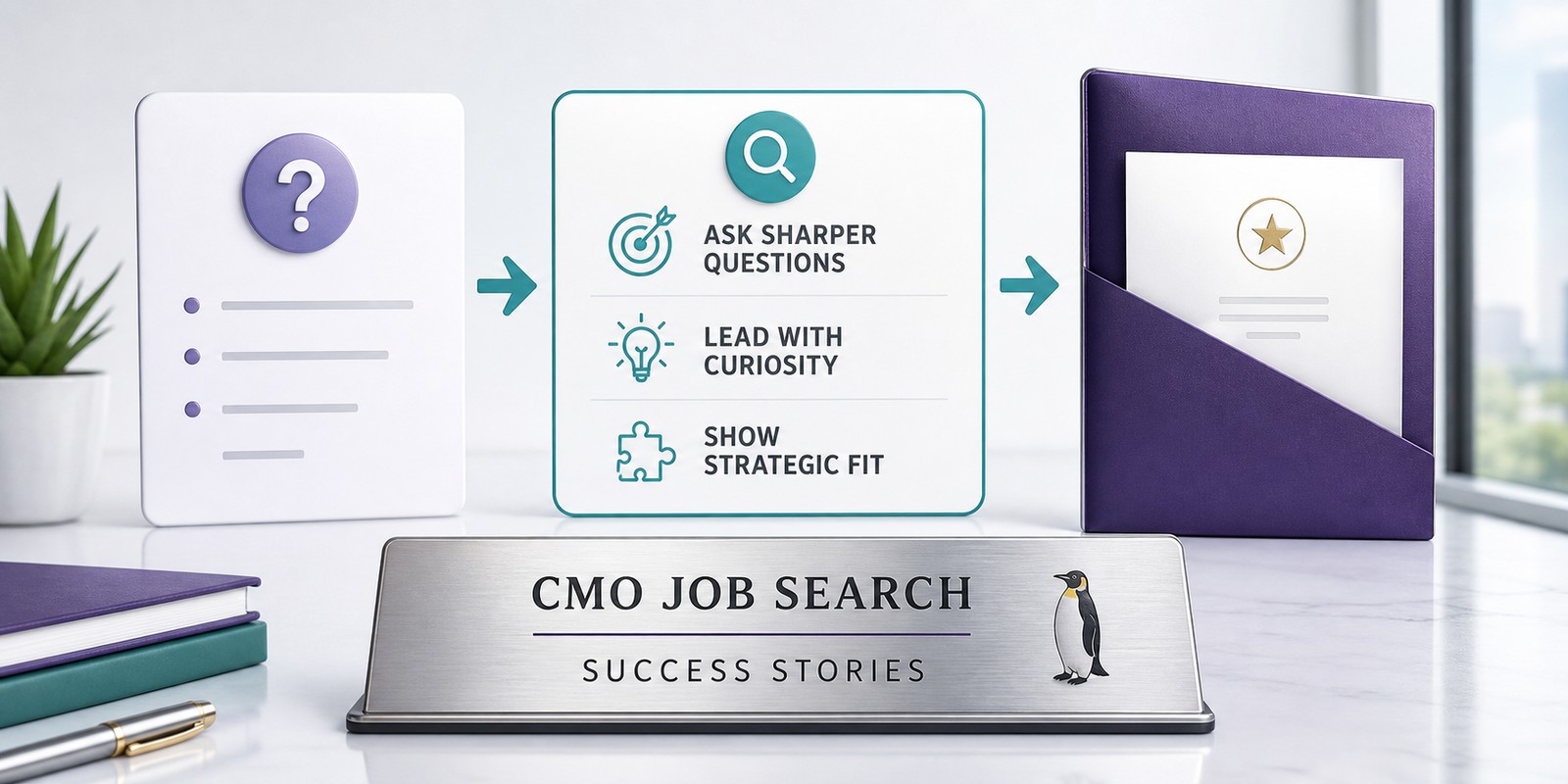
After four months of searching, one Huddler landed a CMO role at a midsize software company by leading with curiosity instead of a prescribed playbook. Deep research, responsive recruiter relationships, thoughtful questions, and a hypothesis-based 30-60-90 day plan helped the Huddler overcome industry-experience concerns and demonstrate strategic judgment throughout an unpredictable interview process with confidence.
The Huddler entered the process with two visible objections.
They had not worked in the company’s industry, and the hiring team questioned whether experience in larger organizations would translate to a smaller environment.
Trying to answer every question with a polished claim could have reinforced those concerns. Instead, the Huddler concentrated on understanding the business.
During the first substantive interview, approximately 70% of the conversation consisted of the Huddler asking questions about the company, category, and opportunity.
“The single best thing that I did early on was... we spent probably 70% of the time with me asking questions about their space and the company, everything else. And he loved that.”
The interview ran out of time before the Huddler’s background could be covered, so the company scheduled another conversation.
Curiosity had created momentum.
The winning opportunity came through a recruiter who had previously contacted the Huddler about other roles.
Those earlier opportunities did not work because of timing, but the recruiter kept the relationship active. The Huddler’s responsiveness and friendly communication made the relationship more than a series of transactions.
That history mattered when a better-fitting role appeared.
The experience also exposed a lesson the Huddler planned to carry forward: Recruiter relationships are easier to maintain while employed than to rebuild suddenly during a transition.
The Huddler used ChatGPT, Gemini, recruiter insight, public CEO content, and company research to prepare for each conversation.
The goal was not to produce generic questions. It was to understand:
Research revealed that the company had completed nine acquisitions in ten years. That gave the Huddler a clearer view of the integration and growth questions likely to matter.
It also enabled questions that demonstrated business understanding without pretending to know the organization from the inside.
The recruiter identified two likely concerns:
The Huddler did not wait for those objections to disappear. Each conversation reinforced a consistent response.
Product experience demonstrated an ability to learn complex offerings. Previous experience helping a business grow from approximately $200 million to $500 million showed relevant scale and growth capability.
Repeating the same clear evidence across interviews helped the hiring team build confidence over time.
The process included:
The panel expanded from an expected two or three people to six, with the participant list arriving that morning.
The Huddler also learned that informal check-ins were still evaluative. Another opportunity had been lost after a last-minute presentation request caught the Huddler underprepared.
The lesson was not to treat every interaction with suspicion. It was to remain ready to explain the business perspective and value proposition whenever the process shifted.
The company requested a 30-60-90 day plan after another candidate submitted one proactively.
The Huddler avoided presenting a detailed strategy based on incomplete information. The plan focused on hypotheses, questions, and potential “needle movers,” including midmarket expansion, international growth, and digital-marketing efficiency.
That restraint became a differentiator.
“The CEO told me afterwards he liked that I didn’t have a prescribed playbook that I would walk in because he was worried I didn’t know enough about the business to even go there.”
The plan demonstrated structure without pretending the diagnosis was complete.
Several opportunities appeared early and then disappeared. The repeated rejection and ghosting affected the Huddler’s confidence.
The response included:
Two late-stage processes eventually overlapped. That competition created urgency for the company that made the offer and may have strengthened the Huddler’s negotiating position.
The Huddler connected transferable product and scale experience to the company’s priorities while using well-researched questions to demonstrate an ability to learn the new market.
The questions showed curiosity, business judgment, and preparation. They also allowed the interviewer to discuss the company’s challenges before the Huddler proposed answers.
The plan presented hypotheses, areas to investigate, and potential business priorities instead of claiming to know the right strategy before joining.
The overall search lasted four months. The successful opportunity moved from first contact to offer in approximately six to eight weeks.
CMO Huddles has a dedicated Transition Team for experienced B2B marketing executives navigating what comes next.