
Back to Blogs
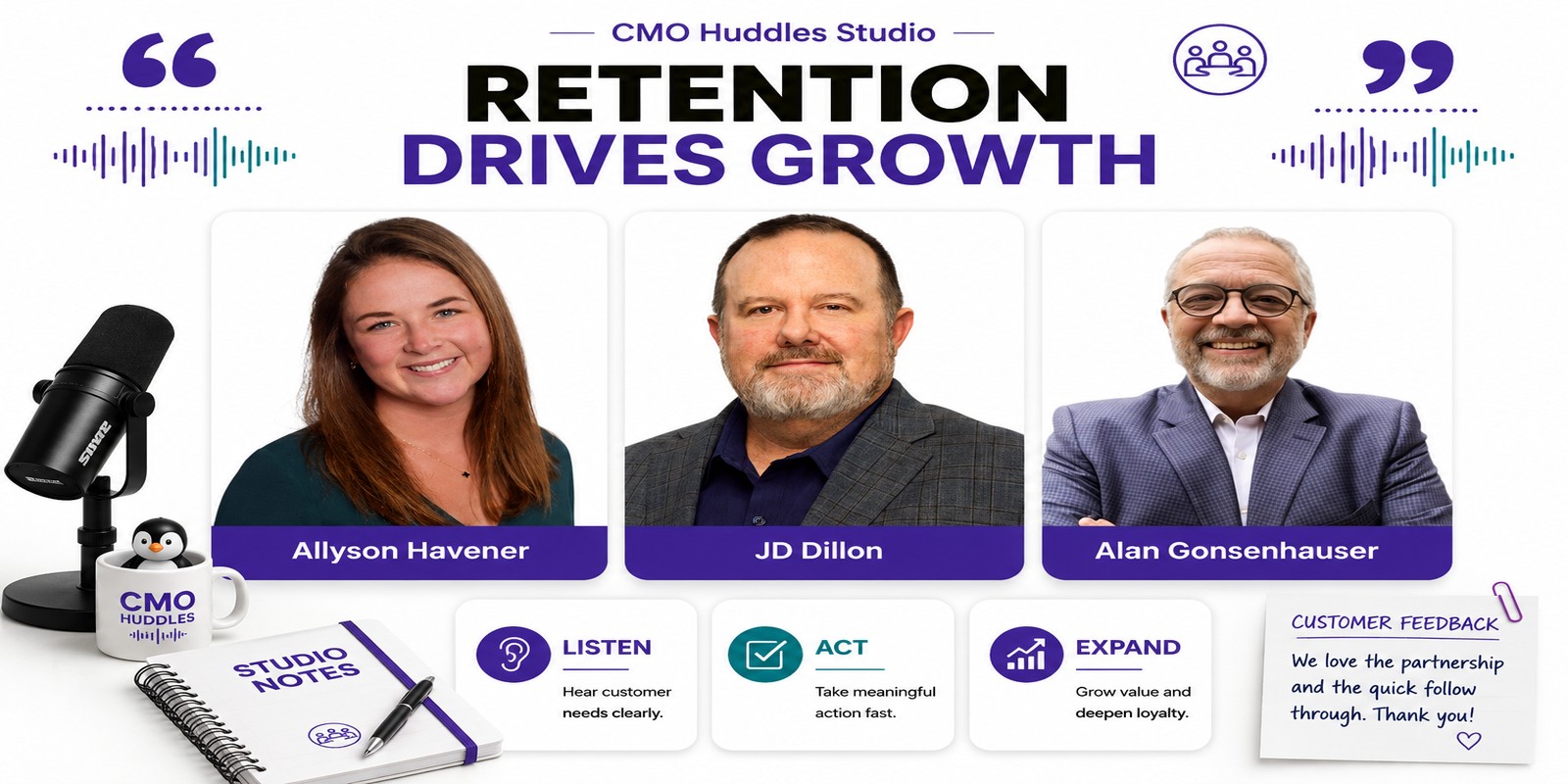
Retention becomes a stronger growth engine when marketing connects customer feedback, adoption, advocacy, expansion, and churn to shared revenue outcomes. Allyson Havener, JD Dillon, and Alan Gonsenhauser show how customer voice can shape product decisions, executive conversations, and measurable growth without treating the post-sale experience as another department’s responsibility or a secondary marketing concern today.
Customer-led growth turns the post-sale experience into a source of insight, advocacy, retention, and expansion. It also makes customer value a shared business outcome rather than the responsibility of customer success alone.
In this CMO Huddles Studio conversation, three marketing leaders explore what that model looks like in practice: Allyson Havener, who was CMO of TrustRadius at the time of the conversation; JD Dillon, Chief Marketing and Customer Experience Officer at Tigo Energy; and Alan Gonsenhauser, founder and CEO of Demand Revenue.
Customer listening becomes valuable when it changes what the organization does.
JD described how customer evidence enters executive discussions:
“I lead with a customer quote and try to intersperse good and bad. Getting the customer voice quite literally into meetings and discussions is invaluable.”
At Tigo Energy, that listening extends into the field. Conversations with solar installers influence product development, support services, case studies, and customer programs.
The company’s Green Glove Program combines installation checks, direct support, and a seal of quality. It gives installers practical help while making service part of the product experience.
Alan connected the customer conversation to financial performance:
“Your future growth and your future profitability is dependent on the customer experience you engender.”
That framing changes the metrics available to marketing. In addition to acquisition and pipeline, customer-led growth can include:
These measures can help connect customer experience to revenue, profitability, and company value.
Collecting a score is not the same as responding to customers.
Alan described a cross-functional approach that categorized customer comments, assigned teams to act on the feedback, and communicated what had changed. The value came from the operating loop: LIsten, interpret, act, and report back.
JD discovered a similar need when strong growth obscured underlying customer loss. His team reframed a weekly churn meeting as a retention meeting, preserving the underlying analysis while giving the work a more constructive orientation.
Customer-led growth does not require an immediate company-wide transformation.
Allyson offered a practical entry point for building momentum:
“Don’t try to boil the ocean. Just start with one simple thing. One campaign that’s fun and exciting and that everyone can rally around and then build from there.”
That first motion might be a review program, customer spotlight series, retention council, churn analysis, or recurring voice-of-customer segment in executive meetings.
The useful question is whether the effort creates a repeatable connection between customer evidence and business action.
Customer-led growth uses customer feedback, experience, advocacy, retention, and expansion to guide decisions and support sustainable revenue.
Marketing can bring customer insight into strategy, strengthen adoption and advocacy, support expansion, and connect retention signals to the broader growth story.
Useful measures can include net revenue retention, gross revenue retention, churn, adoption, customer lifetime value, expansion, and advocacy.
Listen to the full conversation about retention as a revenue engine.
CMO Huddles helps B2B marketing leaders win by bringing together peers, fresh perspectives, and opportunities to build stronger personal brands. Want to join the huddle? Learn more about CMO Huddles and apply to join the community.