
Back to Blogs
Drew Neisser is the founder of CMO Huddles and a globally recognized authority on B2B marketing. He’s an AdAge columnist, LinkedIn TopVoice, leading CMO coach, podcast host & friend of penguins everywhere.
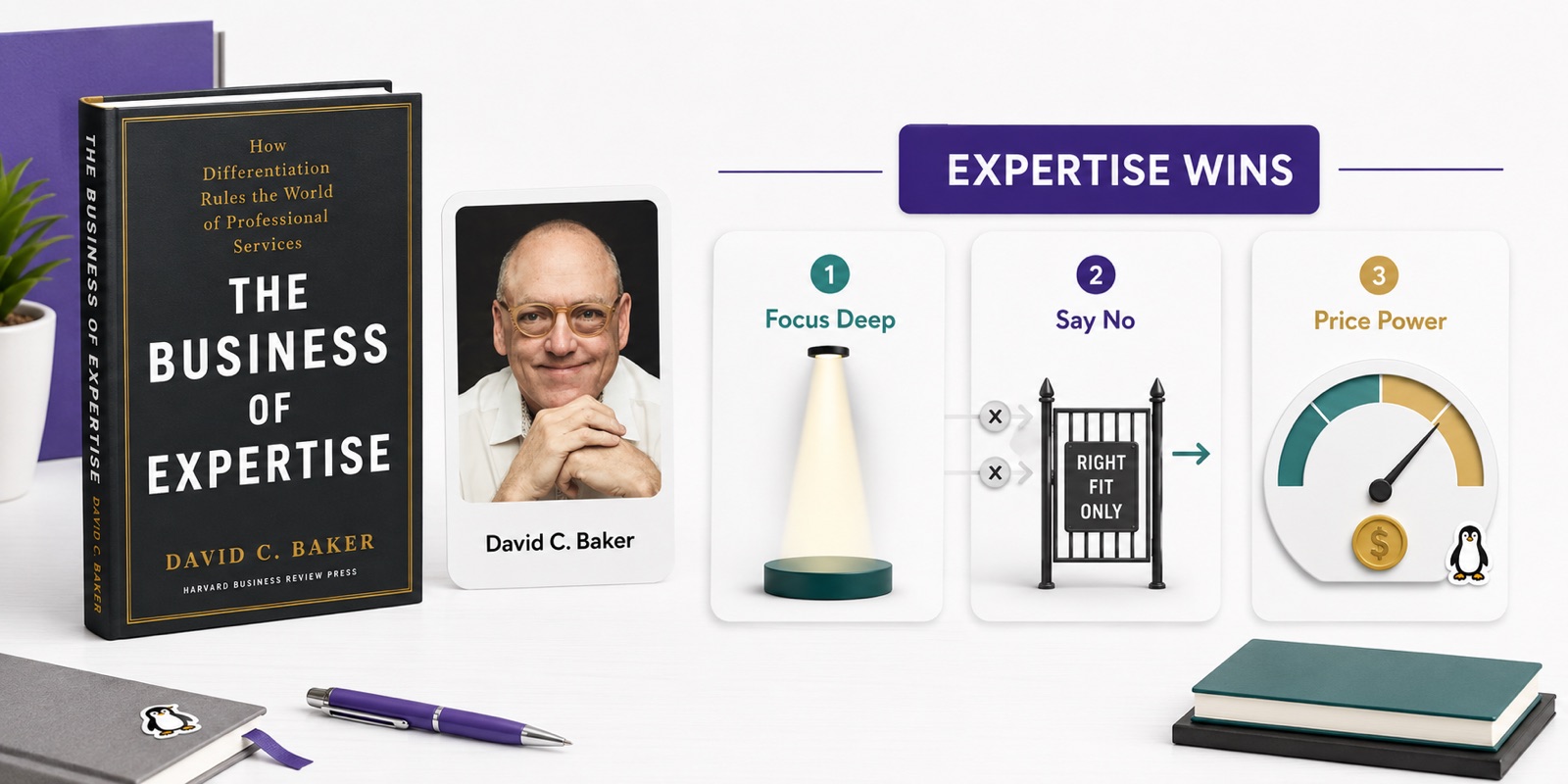
David C. Baker’s The Business of Expertise is essential reading for anyone building a services company, whether solo or wildly ambitious. It is also deeply relevant to B2B CMOs who want to be seen as strategic experts inside their companies. The lesson is simple but uncomfortable: Expertise requires focus, courage, discipline, and the willingness to say no.
Drew is an unabashed David C. Baker fanboy. He's read and listened to The Business of Expertise a combined four times and recommended it to more than ten budding entrepreneurs. If someone is thinking about starting a services business, whether as a solo consultant or as the founder of a firm with big ambitions, this book is close to mandatory.
But here’s the twist: Baker's ideas aren't just for entrepreneurs. They're also vital for B2B CMOs who want to be seen as strategic advisors rather than the keepers of campaigns, colors, and conference swag.
In a CMO Huddles Expert Huddle, Baker framed the first mistake of expertise-based businesses clearly: “To be poorly positioned as a generalist.” That problem shows up just as often inside companies as it does in consulting firms.
A CMO who tries to be everything to everyone risks becoming the internal vendor of everything and the strategic owner of nothing. That's where Baker’s expertise lens becomes useful. Trusted advisors do not simply accept every request. They diagnose the business problem, prescribe the right work, and explain the tradeoffs.
Baker's advice on focus runs against the instinct of many ambitious leaders. Early on, saying yes can feel like survival. Later, it becomes the thing that keeps the function from maturing.
“Getting to the next level is not about saying yes, it’s about saying no and deepening your expertise.”
This is not an argument for being precious or unhelpful. It is an argument for protecting marketing’s ability to create business value. If every internal request receives equal urgency, nothing is strategic. If every stakeholder can redirect the team, marketing becomes reactive by design.
One of Baker sharpest points is that marketing is not just about demand generation. It is about creating optionality.
“A marketing plan gives you the freedom to say no.”
For consultants, that means having more opportunity than capacity.
For CMOs, it means building enough credibility, clarity, and internal demand for marketing’s strategic counsel that the team is not trapped reacting to every random request.
Baker described the gap between capacity and opportunity as the source of freedom. If there is not enough demand for your expertise, you take what comes. If there is more demand than capacity, you can choose the work that matters most.
Inside a company, that means CMOs need an internal marketing plan for the marketing function itself. Not a glossy deck about brand purpose. A real campaign to help the organization understand what marketing knows, where it creates value, and why its judgment should shape business decisions earlier.
Baker also connects pricing to positioning. In his words, “Price is not just about how much money you make, it’s also a positioning thing.”
Inside a company, CMOs may not set a consulting fee, but they do establish terms. What gets prioritized? What gets resourced? What gets declined?
The equivalent of pricing power is executive attention. Is the CMO brought in early, when strategy is being shaped? Or late, when someone needs a launch plan by Friday?
Baker’s warning also applies cleanly to internal leadership: “Don’t be afraid of the truth.”
If marketing is being treated like an execution shop, find out. If the CEO does not believe marketing can influence revenue, find out. If sales does not trust the pipeline story, find out. The sooner the truth is visible, the sooner the CMO can decide what to fix, where to educate, and what to stop pretending is working.
Baker is refreshingly unsentimental about growth. He does not worship it. He interrogates it.
“Unless you’re growing, you’re dying. And it’s just not true at all.”
This is a useful provocation for CMOs. Bigger teams, bigger budgets, and bigger tech stacks are not automatically better. Growth changes the job. Baker put it plainly: As firms grow, leaders move further from the work and closer to managing people.
That tradeoff matters. Some CMOs are brilliant builders of teams and systems. Others are strongest as strategic thinkers, category shapers, or executive advisors. The mistake is assuming that more always means better.
The better question is: What kind of marketing organization does the business actually need now?
Perhaps the most relevant part of the interview for sitting CMOs came when Baker compared vendors and experts.
“They don’t take orders from you. They listen very carefully, and then they prescribe what you need.”
That is the difference between a vendor and a strategic advisor. Vendors respond. Experts diagnose. Vendors ask what color the button should be. Experts ask whether the button should exist.
Baker was especially pointed about in-house marketing teams:
“You’re not there to take orders. You’re not there to save them money. You’re there to guide them as an expert.”
This is the CMO challenge in one sentence. Too many marketing teams are treated as internal service bureaus because they have allowed request volume to substitute for strategic value. That does not mean CMOs should become arrogant or unhelpful. Baker made that distinction too:
“Customer service is not the center of it. It’s the wrapping around great expertise.”
In other words, be easy to work with. But do not confuse being helpful with being subordinate to every request.
Of course, no modern conversation about expertise can avoid AI for long. David’s view was both optimistic and unsentimental.
“What it’s done is it’s exposed the people who weren’t really good at what they did.”
That may be the most cheerful brutalism you will read today.
His larger point is that AI threatens execution more than expertise. The routine stuff gets compressed. The shallow stuff gets exposed. The generic stuff gets cheaper. But the hard advisory work remains.
“Now you can come to me as the advisor for the really tough things.”
For CMOs, this is the opportunity and the warning. If marketing is mostly execution, AI will pressure it. If marketing is strategic expertise applied to specific business context, AI can amplify it.
Bakers two-room model captures this neatly: Expertise is the smaller first room; execution is the larger second room. AI changes both, but not equally. It is a bigger threat to execution and a powerful tool for sharpening expertise.
The Business of Expertise gives CMOs a useful operating challenge: stop confusing helpfulness with strategic authority.
The practical moves are clear:
The real lesson is not that every CMO should act like a consultant. It is that every CMO needs the courage to lead from expertise.
Because CMOs are in the expertise business too. They need to define where marketing has authority, show how that expertise improves business outcomes, and resist being reduced to an internal production team.
Focus creates authority. A CMO who tries to support every request equally will struggle to be seen as strategic. A CMO who clarifies priorities, says no thoughtfully, and builds deep business expertise earns more trust.
Expertise gives CMOs the confidence to diagnose instead of simply respond. When marketing understands the company, customers, category, and revenue model deeply, it can guide decisions rather than just execute them.
AI makes shallow execution easier to replace and deep expertise more important. CMOs should use AI aggressively, but they should also move marketing’s value toward judgment, context, strategy, and business-specific insight.
Anyone considering a services business should read it: Consultants, fractional CMOs, agency founders, solo operators, and entrepreneurs with bigger ambitions. It is especially useful before you pick a positioning, set pricing, or say yes to the wrong first clients.
Want to hear more? Listen to the full conversation on Renegade Marketers Unite.
CMO Huddles helps B2B marketing leaders win by bringing together peers, fresh perspectives, and opportunities to build stronger personal brands. Want to join the huddle? Learn more about CMO Huddles and apply to join the community.