
Back to Blogs
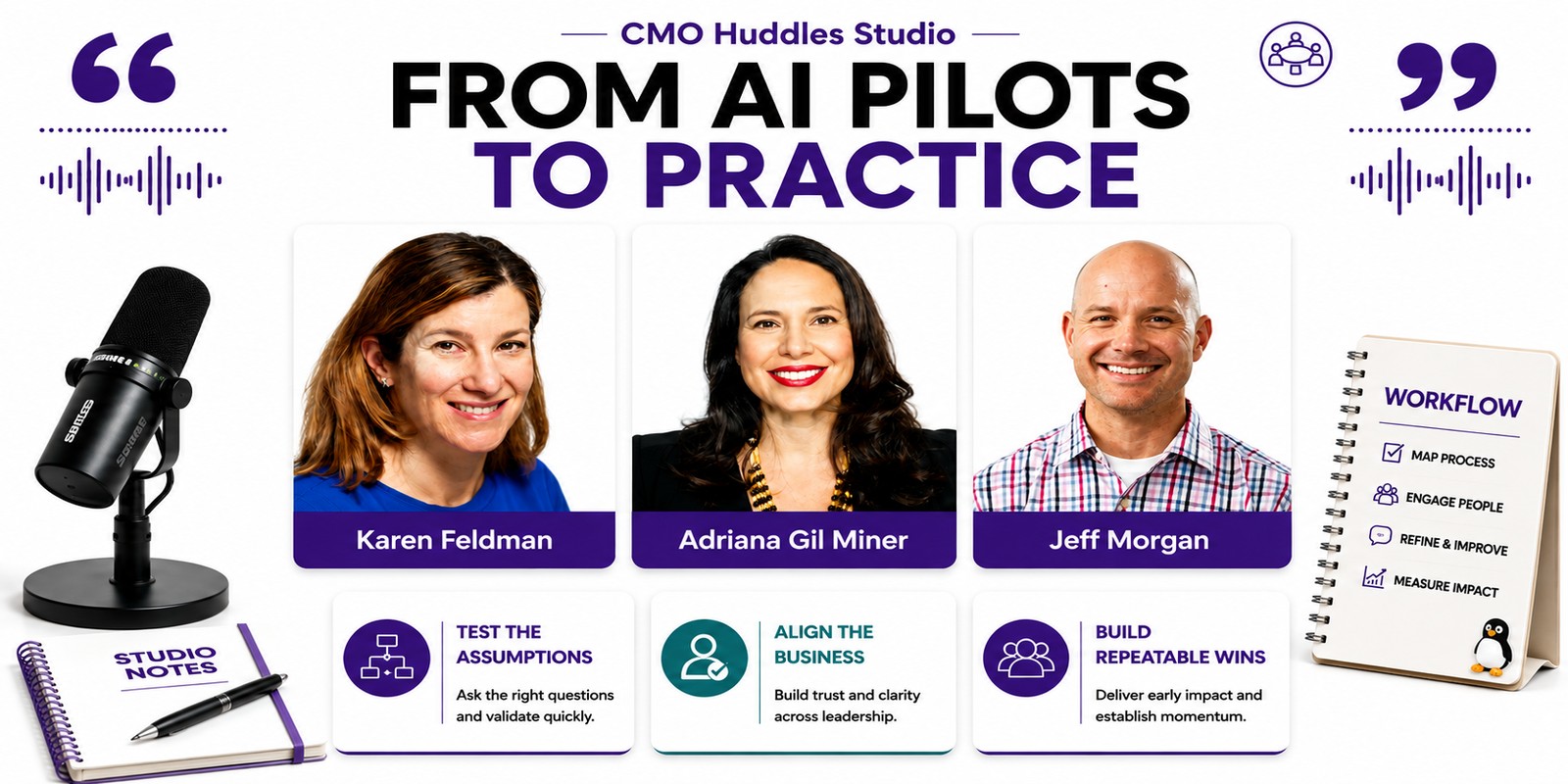
Moving GenAI from experimentation into marketing practice depends on useful workflows, strong inputs, human judgment, and brand standards. Karen Feldman, Adriana Gil Miner, and Jeff Morgan share how their teams applied GenAI to content, campaigns, customer journeys, and operations. Their experiences show how disciplined adoption can improve capacity without replacing the expertise behind distinctive marketing.
GenAI becomes operational when it is attached to a real workflow, supported by useful context, and reviewed by people who understand the audience and brand.
In a CMO Huddles Studio conversation, Karen Feldman, now SVP and CMO of Iron Mountain, Adriana Gil Miner, then Chief Marketing and Strategy Officer at Iterable, and Jeff Morgan, then Chief Revenue Officer at Elements, shared how their teams were incorporating GenAI into daily work.
A broad instruction to “use AI” gives teams little guidance about where the technology can create value. A defined workflow creates a more practical experiment.
The speakers described applications across:
A workflow can be evaluated through quality, time, cost, consistency, adoption, or business impact. That makes the experiment easier to learn from than general tool usage.
Karen emphasized that efficiency is not the only goal:
“I don’t think generative AI should ever be used by pushing a button.”
Human review helps protect accuracy, brand voice, strategic relevance, and originality. It also creates space to question whether the generated output is useful rather than merely complete.
The relationship works best when AI expands capacity while experienced marketers remain responsible for judgment and final quality.
Jeff compared prompting to briefing a capable intern:
“If I can give them instructions that include the expertise that I have, then the output they produce is a lot better.”
That expertise may include audience context, brand guidance, examples, constraints, source material, and a clear definition of the intended result.
Reusable briefs and documented prompts can help teams improve quality without treating prompting as a mysterious individual skill.
As more teams gain access to similar models, generic output becomes easier to produce. Distinctive marketing still depends on customer understanding, positioning, taste, and editorial choices.
“One of the big things GenAI is doing to all of us is pushing every marketer to be a brand marketer.”
Brand standards become operational inputs rather than documents consulted only during major campaigns. Teams need enough shared context to recognize when an output sounds plausible but does not sound like the company.
Successful experimentation can remain isolated when teams do not document or discuss what they learn. A recurring forum can help employees share workflows, prompts, failures, review standards, and useful tools.
The operating model may also clarify:
This turns isolated pilots into a body of organizational practice.
A pilot tests a possibility. A practice connects the technology to a repeatable workflow with ownership, standards, and measurement.
Common areas include research, content, personalization, enablement, campaign planning, and workflow documentation.
People remain responsible for accuracy, judgment, differentiation, customer relevance, and brand consistency.
Documented workflows, governance, shared learning, reusable inputs, and clear quality standards can make adoption more consistent.
Listen to the full conversation with Karen Feldman, Adriana Gil Miner, and Jeff Morgan.
CMO Huddles helps B2B marketing leaders win by bringing together peers, fresh perspectives, and opportunities to build stronger personal brands. Want to join the huddle? Learn more about CMO Huddles and apply to join the community.