
Back to Blogs
Drew Neisser is the founder of CMO Huddles and a globally recognized authority on B2B marketing. He’s an AdAge columnist, LinkedIn TopVoice, leading CMO coach, podcast host & friend of penguins everywhere.
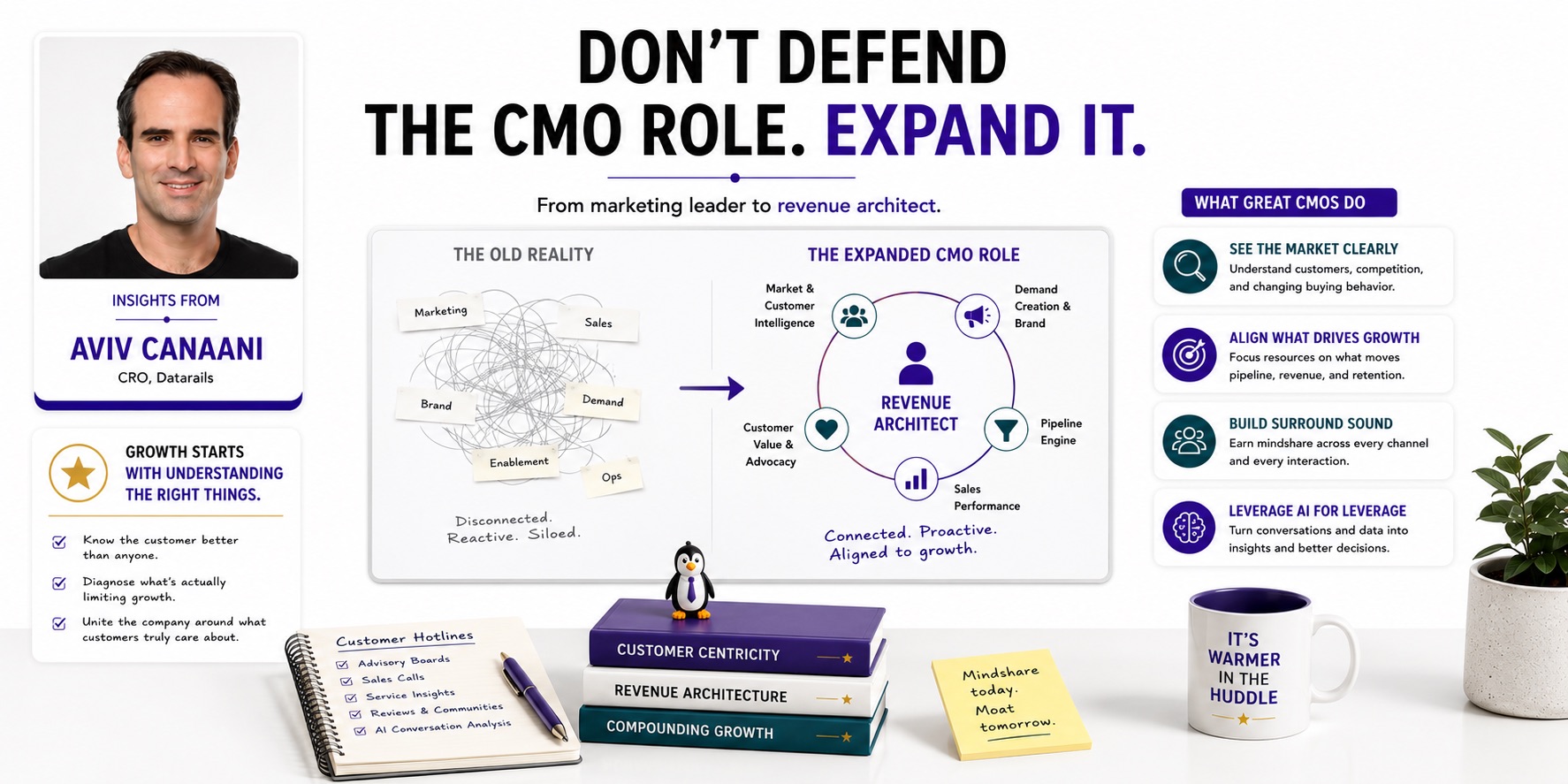
There’s a lively debate underway about the future of the CMO. Some predict the role will disappear. Others want to rename it Chief Market Officer. Still others seem comfortable putting marketing under a CRO. I’m not.
After two recent conversations with Aviv Canaani, CRO of Datarails, I found myself asking a more useful question: How much bigger could the CMO role become?
Aviv didn’t rise through the sales ranks. He never carried a bag. He came up through marketing, became CMO of Datarails, and then added Sales and the rest of the revenue organization to his remit. “I never thought I’ll turn up as a CRO,” he told me, which is precisely what makes his story so interesting.
What fascinates me is not simply that a CMO became a CRO. It is how Aviv thinks about the job now that he has it. He calls it revenue architecture.
When Aviv joined Datarails, the company was heavily dependent on outbound. Over the next several years, that flipped. “We used to be 90% outbound,” he told me. “Now we’re 90% inbound.”
Then the founders asked Aviv to take over Sales. You might assume that meant learning how to become the company’s best salesperson, but Aviv sees the role differently. “I don’t think I’m the best salesperson,” he said, noting that his job is to hire people who are better than he is at their individual disciplines and make sure the entire system works.
That phrase, revenue architecture, stuck with me because it starts with the company’s growth objective and works backward. How many deals do we need? How many opportunities will produce those deals? How many meetings produce those opportunities? What’s our conversion rate? What’s our sales capacity?
Aviv takes this all the way down to the economics of an individual sales meeting. Without sharing Datarails’ actual numbers, imagine that arranging a meeting costs a few thousand dollars. Now imagine that same amount sitting in a stack on the table next to the salesperson. That’s how Aviv wants his team to think about every opportunity Marketing puts on the calendar.
Once you see the system this way, the traditional line between Sales and Marketing starts looking a little arbitrary. Aviv controls one sales and marketing budget, which means he can decide whether the next marginal dollar is better spent generating another opportunity, hiring another AE, improving enablement, or making some other investment that increases revenue. As Aviv explained, “It’s up to me to decide where I want to spend the next dollar.”
I’ve long argued that CMOs should strive to create a predictable marketing engine. But predictability shouldn’t mean generating the same number of MQLs every quarter. The first question should be: What is actually preventing us from growing faster?
That requires Marketing and Sales to diagnose the pipeline together. Do we need to win more because conversion is weak? Win faster because deals are getting stuck? Win bigger because we aren’t reaching the right accounts or articulating enough value? Or do we simply need more qualified opportunities?
Those are very different problems requiring very different marketing responses. Too many marketing plans still start with the assumption that the answer is always “more leads.” Revenue architecture begins when Marketing understands enough about the entire commercial system to help diagnose the actual constraint.
You don’t need Sales reporting to you to do that. You need enough command of the business to ask better questions and enough credibility with Sales to solve the answers together.
This is where I start to get nervous. Most CROs rose through Sales, often because they were terrific salespeople. Great sellers understand human beings in the moment. They build trust, uncover objections, create urgency, and get transactions across the finish line.
But the job can also create a particular field of vision. What can we close this quarter? What’s in the pipeline? Which rep needs help? How much “revenue is in the room”?
A great CMO should see something bigger. The customer isn’t merely a revenue opportunity. The customer is a human being to understand, serve, and ideally delight enough that they help create the next customer.
Did we acquire the right customer? Will they become an advocate? Can their story become a testimonial? Will they refer three peers? What are they telling us that could improve the product, increase expansion, or reduce churn? Is customer service reinforcing our promise or undermining it?
That’s the market in marketing. Customer centricity remains the CMO’s superpower.
In the age of AI, CMOs should raise the bar considerably. The CMO should aspire to know the customer better than anyone else in the organization, combining direct conversations with the ability to listen to thousands more indirectly.
The direct hotlines are familiar: customer advisory boards, executive sponsor programs, customer awards, events, customer visits, and joining sales calls. Heck, run a few sales calls yourself. And when you’re talking to customers, go beyond the obligatory NPS question. Marketing leadership expert Thomas Barta recommends asking something far more useful: “What’s one thing we could do better?”
Then there are indirect hotlines that didn’t exist at today’s scale even a few years ago. Use AI to analyze thousands of Gong conversations. Mine customer service calls for recurring problems and language. Monitor review sites, community discussions, surveys, and other feedback for changes in questions, objections, priorities, and sentiment.
The goal is to combine intimacy with scale so the CMO can walk into an executive meeting knowing not just what the numbers say, but what customers are actually saying.
Aviv is already doing some of this in a fascinating way. Datarails looks at attribution software, asks prospects how they heard about the company, has SDRs ask again, and then examines Gong conversations to see what buyers actually said during the sales process.
Those answers aren’t always the same. A buyer might give a respectable B2B answer when asked directly and then casually reveal during a recorded conversation that they’ve been seeing Datarails on TikTok.
Yes, TikTok. For a company selling financial software to CFOs.
Aviv told me that TikTok regularly shows up in Gong conversations and that Datarails has seen deals influenced by Instagram as well. “People will say, ‘I saw you on TikTok,’” he explained, even when the formal attribution system tells a different story.
I love this example because it illustrates something attribution systems have struggled with forever. Buyers don’t experience your brand in neat channels. They see a video, read an article, hear about you from a colleague, encounter your CEO on LinkedIn, find you in search, and increasingly encounter your company in an AI-generated answer.
Then six months later a salesperson calls and hears some version of, “Oh, I’ve seen you guys.” That’s surround sound. And the salesperson gets to harvest trust that was created long before the call.
Marketing is an epic battle for mindshare. The strongest brands are differentiated on multiple dimensions and have achieved enough mindshare that buyers know something about them before they’re ready to buy.
Sales teams can’t create that at scale. Salespeople come and go, individual campaigns come and go, and channels come and go. Mindshare compounds through the totality of paid, earned, and owned communications, the product experience, customer service, advocacy, and what customers say about you when you’re not in the room.
Increasingly, all of those signals also contribute to whether your company becomes visible and credible in LLM-powered discovery. That makes surround sound more important, not less. This is the moat.
Here’s the danger of becoming too good at revenue architecture: you can optimize the current revenue machine at the expense of creating future demand.
Aviv understands this tension better than many CROs might. At Datarails, Growth and Brand are separate functions, and the VP of Brand is the one leader in his organization who isn’t directly measured on revenue. If Brand were held to the same standard, Aviv told me, “you would never be able to do really creative stuff. It’s going to be too transactional.”
That’s a remarkable statement coming from a CRO. It also suggests that becoming a revenue architect doesn’t require abandoning the longer time horizon that marketers should bring to the executive table.
There’s another reason this conversation is happening now. AI gives CMOs extraordinary leverage to expand their field of vision across both the market and the revenue engine.
On the customer side, CMOs can suddenly listen at scale. Thousands of sales and service conversations can become searchable market intelligence rather than recordings sitting in a repository. On the revenue side, AI can help identify patterns behind wins and losses, surface objections, automate routine work, and expose constraints in the commercial system faster.
Aviv is pushing hard in this direction. His goal is to remove as much administrative work as possible from his account executives so they can concentrate on what humans still do particularly well: selling.
He goes further, questioning how much of the traditional BDR role will survive and whether AI could eventually handle portions of SMB and midmarket selling. Whether his timetable proves right almost doesn’t matter for this discussion because the direction is clear: as execution gets automated, architecture becomes more important.
So do judgment and customer understanding. Those should be comfortable territories for CMOs.
Kate Bullis, Latané Conant, and others have argued that Chief Marketing Officer should evolve into Chief Market Officer. I understand the appeal because “marketing” can sound like a department while “market” sounds like a business responsibility.
The Chief Market Officer should understand the customer, competition, category, changing buying behavior, differentiation, and demand. They should be able to translate those insights into decisions that help the company grow. Is that a revenue architect? Maybe.
I’m less interested in settling the title than expanding the mandate. If marketing simply reports to a traditional sales-trained CRO, there’s a structural risk that the urgent overwhelms the important. This quarter’s pipeline will always scream louder than next year’s mindshare, and the deal in front of you will always feel more tangible than the thousands of future buyers who don’t know you exist yet.
Someone needs to protect both. If the CRO is a former CMO like Aviv who understands how demand and brands are built, maybe that works beautifully. If not, I’d much rather see the CMO standing alongside the CRO helping architect growth than reporting underneath one.
So where does all of this leave the CMO who isn’t looking for a new title tomorrow? I’d start with three questions, not because they provide all the answers but because answering them honestly should reveal where your greatest opportunity to lead lies.
Not just the persona and not just the dashboard. Know the actual humans, their changing priorities, and the language they use when nobody from Marketing is in the room.
Don’t settle for “more pipeline.” Determine whether the business needs to win more, win faster, win bigger, retain more, expand more, or create more opportunities, and then help solve that problem.
That’s where purpose, differentiation, customer experience, and brand come together. That’s how you build a moat, not just a more efficient funnel.
Aviv’s path from CMO to CRO isn’t proof that every marketer should follow him, and I’m not even sure it’s the right aspiration for most. What it does demonstrate is that the boundary around marketing leadership can be pushed much further than many organizations, and perhaps many marketers, assume.
CMOs have spent decades fighting for a seat at the table. AI, customer intelligence, and increasingly interconnected revenue systems create an opportunity to stop fighting over the chair and start expanding what the person sitting in it can contribute.
The future CMO may become a CRO. They may become a Chief Market Officer. They may remain a Chief Marketing Officer with a dramatically expanded mandate. What matters more than the title is whether they understand the market, the customer, and the revenue system well enough to help lead the whole business.
Don’t defend the CMO role. Expand it.
CMO Huddles helps B2B marketing leaders win by bringing together peers, fresh perspectives, and opportunities to build stronger personal brands. Want to join the huddle? Learn more about CMO Huddles and apply to join the community.
No. Aviv’s path is instructive because it shows how far the CMO mandate can expand, not because every marketer should chase the CRO title. The real opportunity is to understand the full revenue system while still protecting the customer and market perspective.
Revenue architecture means designing the commercial system around growth objectives, budget choices, conversion rates, sales capacity, demand creation, and customer economics. It forces marketing and sales to diagnose the actual constraint instead of assuming the answer is always more leads.
AI can help CMOs listen at scale, but the advantage comes from combining that scale with real customer understanding. The CMO who knows what customers actually say, value, fear, and repeat can make better strategic choices across brand, demand, product, and revenue.
It depends on the CRO. If the CRO understands brand, demand creation, customer insight, and future market development, the structure can work. If the role is focused mainly on near-term sales execution, marketing risks losing the longer-term perspective that creates future demand.
Start by diagnosing the growth constraint with Sales, building direct and indirect customer listening systems, and clarifying how brand, demand, sales, advocacy, and AI signals work together. The goal is not to defend the old CMO role. The goal is to expand its business impact.