
Back to Blogs
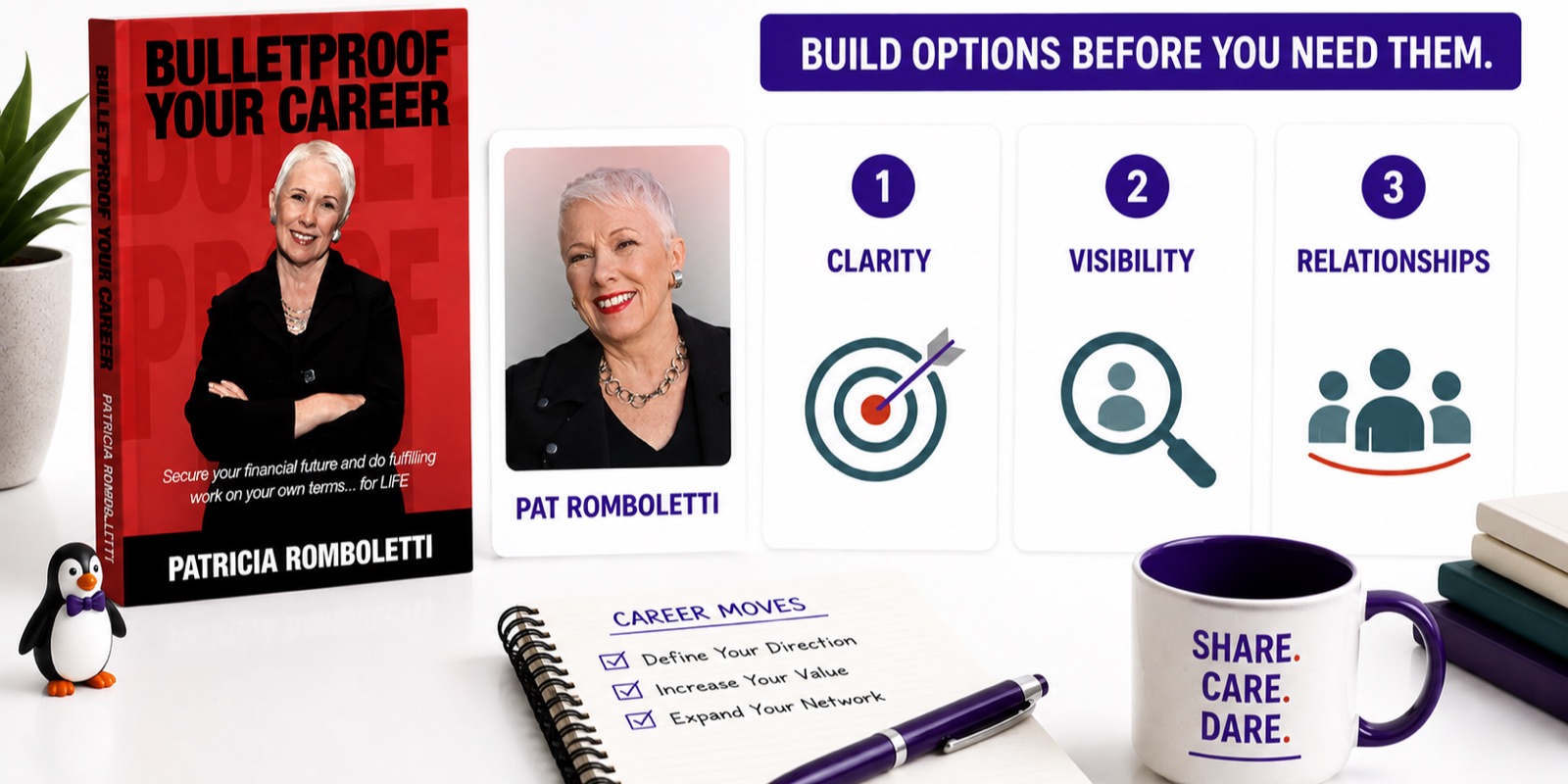
A resilient CMO career is built before the next transition begins. Bulletproof Your Career author Pat Romboletti explains how clarity, visible expertise, intentional networking, goodwill, and a practical career blueprint expand options. These habits help marketing leaders maintain relationships, strengthen their reputations, and develop the self-knowledge needed to navigate an unpredictable executive career with confidence.
CMO turnover makes career uncertainty difficult to avoid. The timing of a leadership change may remain outside an executive’s control, but career preparation does not need to begin after the role ends.
In a Book Huddle conversation about bulletproofing a CMO career, Pat Romboletti, author, career coach, and founder of Bulletproof Your Career, explored what executives can do while employed to strengthen their position for whatever comes next.
Her framework centers on clarity, visible expertise, relationships, mindset, and a career blueprint. Each element helps create professional options before an unexpected transition makes those options urgent.
Senior leaders often spend years building the brands they serve while giving much less attention to their own professional positioning. That can become limiting when they want to change industries, pursue a board seat, or move into a different kind of leadership role.
Pat described thought leadership as an “underleveraged, reasonably inexpensive tool that everybody has.” LinkedIn, speaking opportunities, industry events, and other forms of participation can make expertise visible before a transition begins.
She also connects that visibility with future direction. Leaders hoping to enter another field can begin following its thinkers, developing relationships there, and demonstrating that their interests extend beyond their current category.
Personal visibility can complement the company rather than compete with it. Pat cautioned against becoming either a relentlessly self-promotional executive or simply a mouthpiece for corporate content. A more balanced presence may include company news, industry ideas, leadership topics, and the executive’s own perspective.
Consistency matters more than engineering a perfect ratio. Over time, those contributions give people a clearer sense of what the leader knows, how they think, and where they could add value next.
“It’s a matter of curating your network continuously, and you cultivate the network continuously. And especially curating if you’re in a job.”
Waiting until a transition to begin networking changes the dynamic of every conversation. An executive who reaches out while employed can begin with common interests, shared experience, or curiosity instead of an immediate need for help.
That preparation becomes particularly valuable for leaders hoping to change industries. Hiring executives may view an unfamiliar category as additional risk, even when the candidate’s underlying skills transfer well.
Relationships inside the desired industry can provide credibility that a résumé alone may not create. Pat described those connections as the “tip of the spear.” Someone who already knows the executive can provide context, make an introduction, or give a hiring leader a reason to consider a less obvious candidate.
The relationship carries weight because it existed before the job opening. It reflects familiarity with the person’s thinking and work rather than an endorsement created for one application.
Networking does not require meeting everyone in the room. At physical events, Pat encourages executives to work with their natural style instead of forcing themselves into an exhausting version of professional schmoozing.
For introverts, that might mean arriving before the room becomes crowded, asking the registration team who could be useful to meet, or focusing on a few deeper conversations instead of collecting dozens of names.
Pat connects that approach with what she calls the rule of 250: Each meaningful relationship potentially opens access to that person’s wider network. “Networking in a way that works for you is going to make it work every time,” she said.
Two substantive conversations can be more useful than working the entire room, particularly when the executive follows up and continues those relationships afterward. The measure of a successful event becomes the quality of the connections made, not the number of business cards collected.
The tone of an outreach message can reveal whether someone wants to build a relationship or extract an immediate favor.
Pat calls the alternative making deposits in the “goodwill bank.” She described the principle simply: “You pay it forward, then it pays you back.”
She illustrated the difference with two executives contacting a CEO. One essentially led with his need for a job. The other began by recognizing the company’s success and offering help through her own network without asking for anything in return.
The second approach creates a different relationship. It does not make the recipient responsible for solving the sender’s problem. Instead, the conversation begins with relevance and generosity.
Introductions, useful information, congratulations, and other small acts can build professional goodwill over time. Those deposits matter because they create a genuine relationship before either person needs to draw on it.
Career resilience also depends on how executives respond to circumstances they cannot control. Budget cuts, reorganizations, layoffs, and shifting expectations can quickly become personal when a leader treats every difficult outcome as evidence about their ability.
Pat uses a simple visual with her clients: Imagine nearly an entire circle representing what is outside your control and a small slice representing what remains within it. Much of the mental strain comes from trying to change the larger portion.
“The biggest mistake about mindset is thinking it’s a one and done. It’s not like you check your oil every 5,000 miles. It’s every day.”
Daily maintenance can mean redirecting attention toward the decisions that remain available: How to lead the team, which relationships to strengthen, what to learn, and how to prepare for future possibilities.
This does not require denying the difficulty of the situation. It creates enough perspective to separate a business decision from a verdict on the leader’s entire career.
“I’m going to do the best job I can. I’m gonna do a great job where I am and I’m going to recognize that that doesn’t guarantee anything.”
Traditional career planning can assume that strong performance will naturally lead to the next opportunity. Pat’s career blueprint starts from a less predictable reality.
The blueprint includes both Plan A and Plan B. It maps possible next directions, existing relationships, industry changes, emerging companies, and areas where new opportunities could develop.
That does not mean treating a current role as temporary or constantly searching for an exit. It means paying attention inside and outside the company at the same time.
A career blueprint can evolve as the market, the leader’s interests, and available opportunities change. Its value comes from giving executives a reason to keep investing in their careers while things are going well.
No amount of networking, thought leadership, or planning can guarantee that an executive will avoid a layoff or unexpected transition. Strong performance cannot provide that certainty either.
Pat’s framework creates more places to turn when circumstances change. Visible expertise helps people understand what the leader can contribute. Relationships create access to information and introductions. A career blueprint keeps possible directions visible. Regular attention to mindset helps the executive use those assets without allowing one difficult moment to define the larger career.
For CMOs, bulletproofing is ongoing career maintenance. The relationships and reputation built while employed can become the foundation for the next move long before anyone knows when that move will be necessary.
It means continually developing the relationships, reputation, clarity, and career options that can support an executive when circumstances change.
While employed, when conversations can begin around shared interests and mutual value instead of an immediate request for a job.
No. Thoughtful industry participation, useful content, speaking, comments, and interviews can establish expertise without constant posting.
It is an evolving plan covering the current role and possible future directions, including the relationships, market changes, and experiences that could support another move.
Listen to the full conversation with Pat Romboletti.
CMO Huddles helps B2B marketing leaders win by bringing together peers, fresh perspectives, and opportunities to build stronger personal brands. Want to join the huddle? Learn more about CMO Huddles and join CMO Huddles Starter.