
Back to Blogs
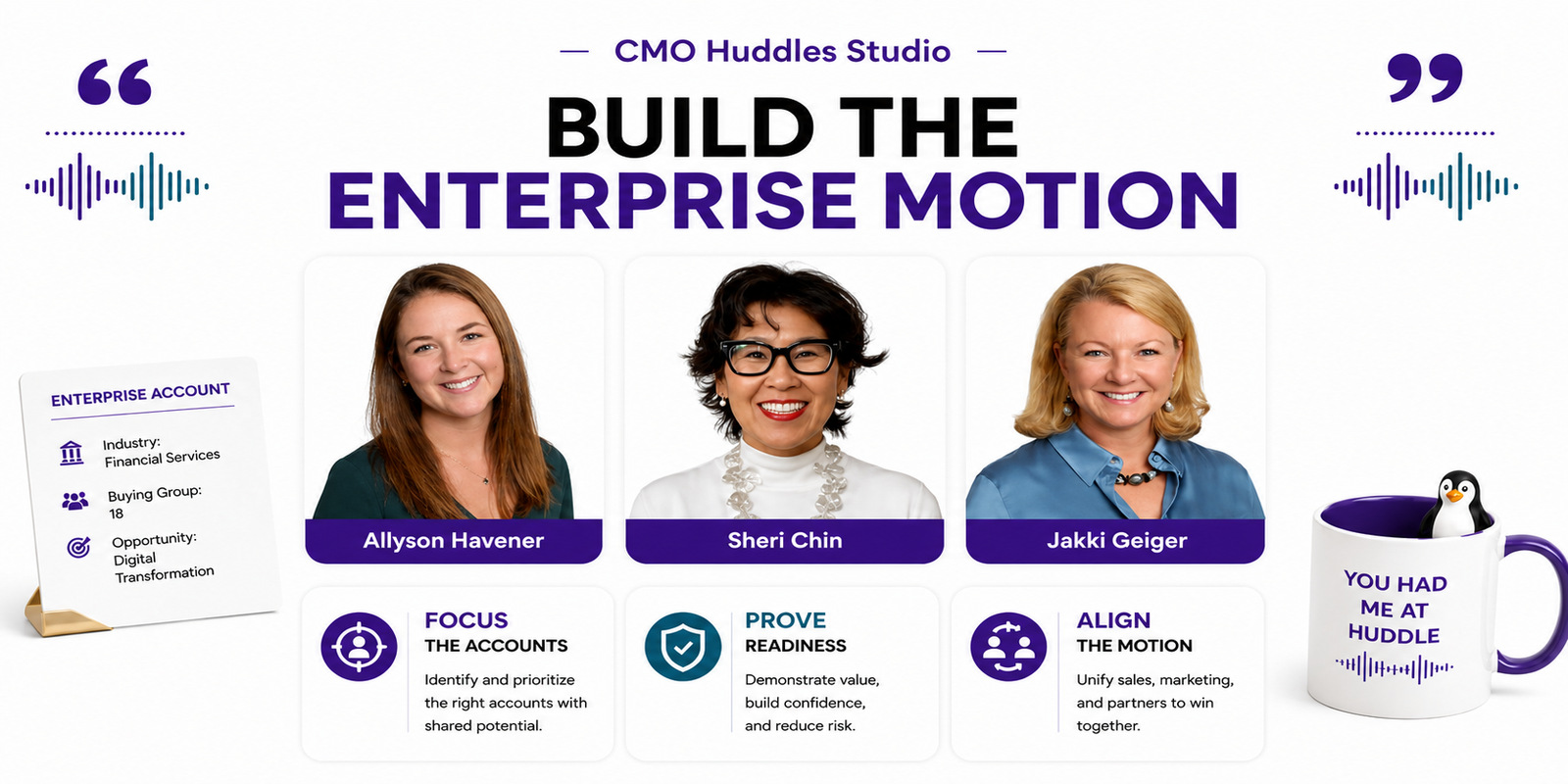
Moving up market requires more than larger target accounts and higher contract values. Allyson Havener, Sheri Chin, and Jakki Geiger explain how enterprise growth changes sales skills, buying cycles, marketing timelines, proof requirements, partnerships, product expectations, and customer success. The strongest motion expands enterprise capabilities without neglecting the customers and revenue supporting the existing business.
Enterprise buyers are not simply larger versions of small and midsize customers. They bring longer buying cycles, more participants, greater perceived risk, formal procurement, and higher expectations for proof and support.
A CMO Huddles Studio conversation about moving up market featured Allyson Havener, Sheri L. Chin, and Jakki Glivicky Geiger.
Their experiences show why an enterprise motion affects the full go-to-market system. Targeting larger accounts without changing the company’s capabilities can create expensive opportunities that never progress.
“Don’t underestimate sales training. Selling into enterprise is a completely different sales sensibility skill set than SMB early-stage sales.”
Sheri’s distinction reflects the complexity of enterprise buying. Sellers may need to navigate larger committees, formal procurement, security requirements, legal review, and several competing definitions of value.
A strong relationship with one enthusiastic contact may not be enough. The buying champion often needs help building agreement across technical, financial, operational, and executive stakeholders.
Marketing can support that work with role-specific content, account insight, competitive context, customer evidence, and materials champions can use internally.
The operating cadence changes as well. Marketing and sales need a shared view of target accounts, buying-group engagement, opportunity progression, and the evidence still missing from the conversation.
Jakki also connected the enterprise motion with annual planning and resource allocation.
“That’s something not everybody thinks about as they’re planning to go into enterprise. You actually need to move the planning and budgeting process forward since those sales cycles are longer.”
Jakki’s observation has implications for annual planning and quarterly expectations. An enterprise campaign launched against the current quarter may not produce revenue within that quarter. Awareness, relationships, internal consensus, and procurement can take months to develop.
This changes how the organization evaluates events, executive programs, ABM, partnerships, and content. Leading indicators may include account access, buying-group engagement, executive meetings, reference activity, and progression through known decision steps.
Longer cycles also increase the cost of inconsistency. If the strategy changes every quarter, the company may withdraw support before the enterprise motion has had enough time to mature.
Large buyers want evidence that a company can perform in a comparable environment. A general testimonial may not address concerns about implementation scale, integrations, security, governance, or global support.
Enterprise customer stories can explain the complexity of the original problem, the implementation process, stakeholder management, and the business outcome. References may carry even greater value when buyers can speak privately with a peer.
Proof can also include security documentation, implementation plans, service models, relevant certifications, product roadmaps, and executive sponsorship. Each item answers a different form of perceived risk.
The strongest evidence reflects the buyer’s actual concern. Praise without operational detail may increase awareness while doing little to advance the decision.
Allyson noted that partnering with a company that already serves enterprise customers “is a fast-track way to start breaking into the enterprise.” The relationship can provide access, credibility, complementary capabilities, and greater implementation confidence when the buyer already trusts the partner’s expertise.
The relationship needs a clear role in the enterprise motion. A logo exchange will not create the same value as coordinated account planning, joint solutions, shared proof, or a credible implementation path.
Marketing can help identify the story connecting the partners, develop joint customer evidence, and create opportunities for the market to understand how the combined value works.
Sales and partner teams still need aligned incentives and ownership. Without that operational support, the partnership story may remain stronger than the customer experience.
Moving up market can expose capability gaps that smaller customers did not encounter. Enterprise buyers may expect advanced permissions, reporting, integrations, security controls, service agreements, and change-management support.
Marketing can connect market demand with product decisions, but it cannot credibly promise capabilities that do not exist. Close coordination with product, legal, security, implementation, and customer success keeps the enterprise story grounded.
“The best way to make sure that you keep your enterprise customers is to make them successful.”
Allyson’s point places customer success inside the growth motion. Retention, expansion, references, and reputation depend on whether the company delivers the value promised during the sale.
An enterprise deal that requires unsustainable customization may create impressive initial revenue while weakening margins and customer experience. Readiness includes the ability to serve the account repeatedly, not merely close it once.
Enterprise ABM can become expensive when the target list is too large or selection is based only on company size.
A more focused model can consider fit, need, timing, relationship access, technical compatibility, strategic value, and the company’s ability to create a credible advantage. The resulting account set may be smaller, but each account receives a more intentional motion.
Different tiers can receive different levels of personalization and executive involvement. The purpose of tiering is to align effort with opportunity, not to apply an enterprise label to every desirable logo.
Sales and marketing agreement on the account set matters because the motion depends on coordinated attention over a longer period. A target account that sales does not intend to pursue is unlikely to justify sustained marketing investment.
An enterprise strategy can absorb executive attention, product capacity, and marketing investment. Existing customers may begin to feel that the company has moved on without them.
That creates risk when the current base still supplies most of the revenue, advocacy, and product insight. The organization may weaken a healthy business while waiting for a new motion to mature.
Segmentation can clarify which experiences need to differ and which strengths remain shared. The company may create enterprise-specific sales and service capabilities while continuing to invest in self-service, product-led growth, or partner motions for smaller customers.
Product decisions also need scrutiny. Features requested by a small number of enterprise prospects may create complexity for every customer. The strategic value of the segment needs to be considered alongside the operational consequences.
Moving up market works best as an expansion of capability. The current customer base remains part of the growth system.
It usually involves more stakeholders, longer cycles, formal procurement, greater perceived risk, and higher expectations for proof and support.
Marketing can support account selection, buying-group insight, executive engagement, enterprise proof, partnerships, ABM, and sales enablement.
They demonstrate that the company can deliver in a comparable environment and address concerns about implementation and scale.
It can segment the motion, preserve investment in the current base, and avoid forcing enterprise requirements onto every customer experience.
Listen to the full moving-up-market conversation.
CMO Huddles helps B2B marketing leaders win by bringing together peers, fresh perspectives, and opportunities to build stronger personal brands. Want to join the huddle? Learn more about CMO Huddles and join CMO Huddles Starter.