
Back to Blogs
Drew Neisser is the founder of CMO Huddles and a globally recognized authority on B2B marketing. He’s an AdAge columnist, LinkedIn TopVoice, leading CMO coach, podcast host & friend of penguins everywhere.
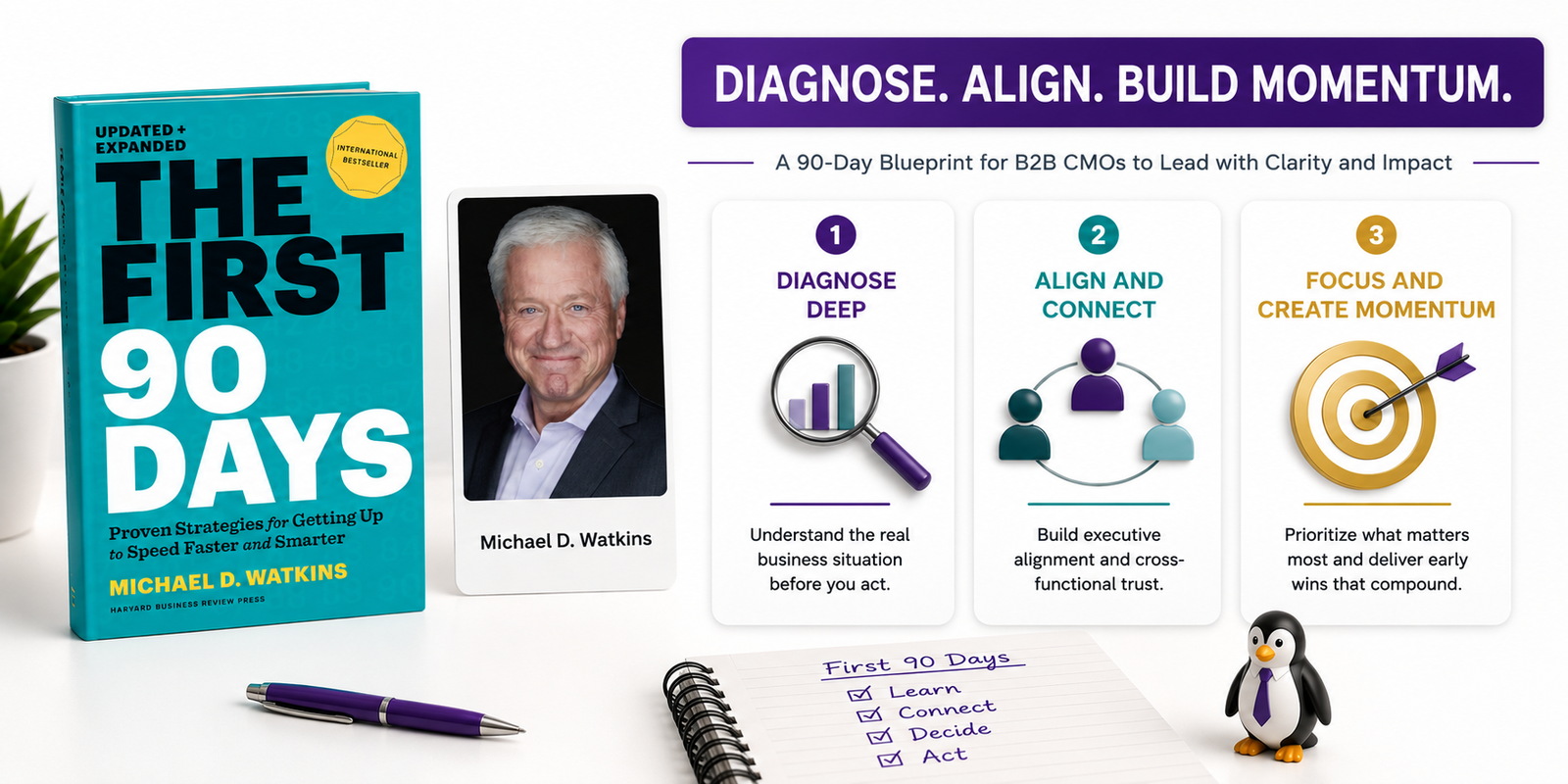
Michael Watkins’ First 90 Days framework remains deeply useful for CMOs because marketing transitions are rarely just onboarding. New CMOs inherit expectations, politics, team realities, and growth pressure. The smartest first move is not immediate action. It is fast diagnosis, CEO alignment, focused priorities, and a 90-day operating rhythm that builds trust.
A new CMO does not walk into a neutral situation.
They inherit expectations, politics, team dynamics, budget assumptions, sales relationships, board pressure, customer realities, and a company story that may or may not match the market. That is why Michael Watkins’ The First 90 Days framework remains so relevant for marketing leaders.
In a CMO Huddles Expert Huddle, Watkins focused on transition as a leadership discipline. “The core of leadership is about mobilizing and focusing and sustaining the energy of the organization,” he said.
For CMOs, that means the first 90 days cannot be limited to marketing diagnostics. The work is to understand where the business needs energy, where that energy is scattered, and how marketing can help focus it.
Many new CMOs are tempted by the action imperative: Fix the dashboard, change the org, relaunch the website, rewrite the positioning, repair the sales relationship, or announce a new strategy. Some of those moves may be needed. But if they happen before the CMO understands the business situation, they can become activity without leverage.
One of the most useful ideas from the Expert Huddle is that leaders often default to the problems they know how to solve. Watkins calls attention to the risk of relying too heavily on what made a leader successful in the past.
"There is a tendency to come into organizations and see the problems you want to see, because you know how to solve them,” Watkins said.
For CMOs, that trap is easy to understand. A brand builder may see a positioning problem. A demand leader may see a pipeline problem. A product marketer may see a narrative problem. A comms leader may see an awareness problem. Each may be partly right. But the new CMO’s job is not to apply their favorite playbook. It's to diagnose the situation the company is actually in.
A CMO should spend the early transition period asking what the business truly needs. Some possibilities:
The diagnosis determines the plan.
Watkins’ transition advice is especially useful when translated into a CMO operating sequence: Learn, connect, decide, act.
Learning means understanding the business model, customers, market position, team capability, sales motion, product strategy, financial expectations, and current marketing system. It also means listening across functions, not just inside marketing.
Connecting means building the relationships that will determine whether the CMO can actually lead. That includes the CEO, CFO, CRO, product, customer success, board members where appropriate, agency partners, and the marketing team itself. Marketing’s work is cross-functional, so the CMO’s influence has to be cross-functional too.
Deciding means turning the diagnosis into priorities. The CMO cannot take on every inherited complaint. They need to decide what matters most, what can wait, and where marketing can create business leverage.
Acting means moving with enough focus that the organization sees progress. The goal is not a giant strategy deck. The goal is a focused set of decisions and initiatives that build confidence.
The CEO relationship is one of the most important parts of the first 90 days. Watkins’ transition work emphasizes the importance of negotiating success. For CMOs, that means clarifying what the CEO actually expects from marketing and where those expectations may need to be refined.
A CEO might say they want more pipeline, but the underlying issue may be positioning, sales follow-up, product readiness, pricing, category confusion, retention, or lack of proof. A CEO might say they want a brand, but be unwilling to fund the time horizon required. A CEO might expect marketing to solve a problem that actually requires product, sales, or customer success.
Watkins offered a useful reminder for moments when a CMO needs to challenge assumptions without becoming isolated: “You never want to be the one that’s the sole source of discomfort. You want to syndicate.”
Useful CEO alignment questions include:
This conversation is not political housekeeping. It is the foundation for the CMO’s ability to lead.
One of the strongest parts of the Watkins Expert Huddle is the discussion of 90-day cycles beyond onboarding. Watkins emphasized that a 90-day plan should not be a performative answer sheet. It should define how the leader will engage, make decisions, create focus, and build alignment.
“When you're putting together those hypothetical 90-day plans, they should focus on the process of engagement, decision making, focus, and alignment you're going to pursue going forward,” Watkins said.
That is highly relevant for CMOs. B2B sales cycles may be long, but marketing operating cycles cannot wait a year to learn. A campaign launched today may influence revenue months later, but the team can still make progress in 90-day increments: Sharpen positioning, improve conversion, test message resonance, strengthen sales enablement, improve customer proof, simplify reporting, or pilot an AI workflow.
The point is not to finish everything in 90 days. The point is to create a rhythm of learning, focus, and adjustment.
The first 90 days can go wrong when a CMO confuses motion with momentum. Common mistakes include:
The better move is to build credibility through judgment: Learn fast, connect intentionally, align clearly, decide selectively, and act with focus.
A new CMO should diagnose the business situation, listen across functions, understand CEO expectations, and identify the biggest gaps between marketing activity and business need.
The framework helps CMOs avoid premature action, accelerate learning, align stakeholders, secure early wins, and turn transition into a structured operating process.
One common mistake is applying the playbook that worked in a previous company before understanding the new company’s actual situation, culture, constraints, and growth needs.
CMOs can use 90-day cycles to set objectives, assign owners, review progress, adapt to market changes, and keep marketing focused without relying on stale annual plans.
The CMO should clarify the business problem they were hired to solve, define success metrics, discuss tradeoffs, and identify which outcomes marketing can own versus where cross-functional alignment is required.
Want to hear more? Listen to the full conversation on Renegade Marketers Unite.
CMO Huddles helps B2B marketing leaders win by bringing together peers, fresh perspectives, and opportunities to build stronger personal brands. Want to join the huddle? Learn more about CMO Huddles and apply to join the community.