
Back to Blogs
Drew Neisser is the founder of CMO Huddles and a globally recognized authority on B2B marketing. He’s an AdAge columnist, LinkedIn TopVoice, leading CMO coach, podcast host & friend of penguins everywhere.
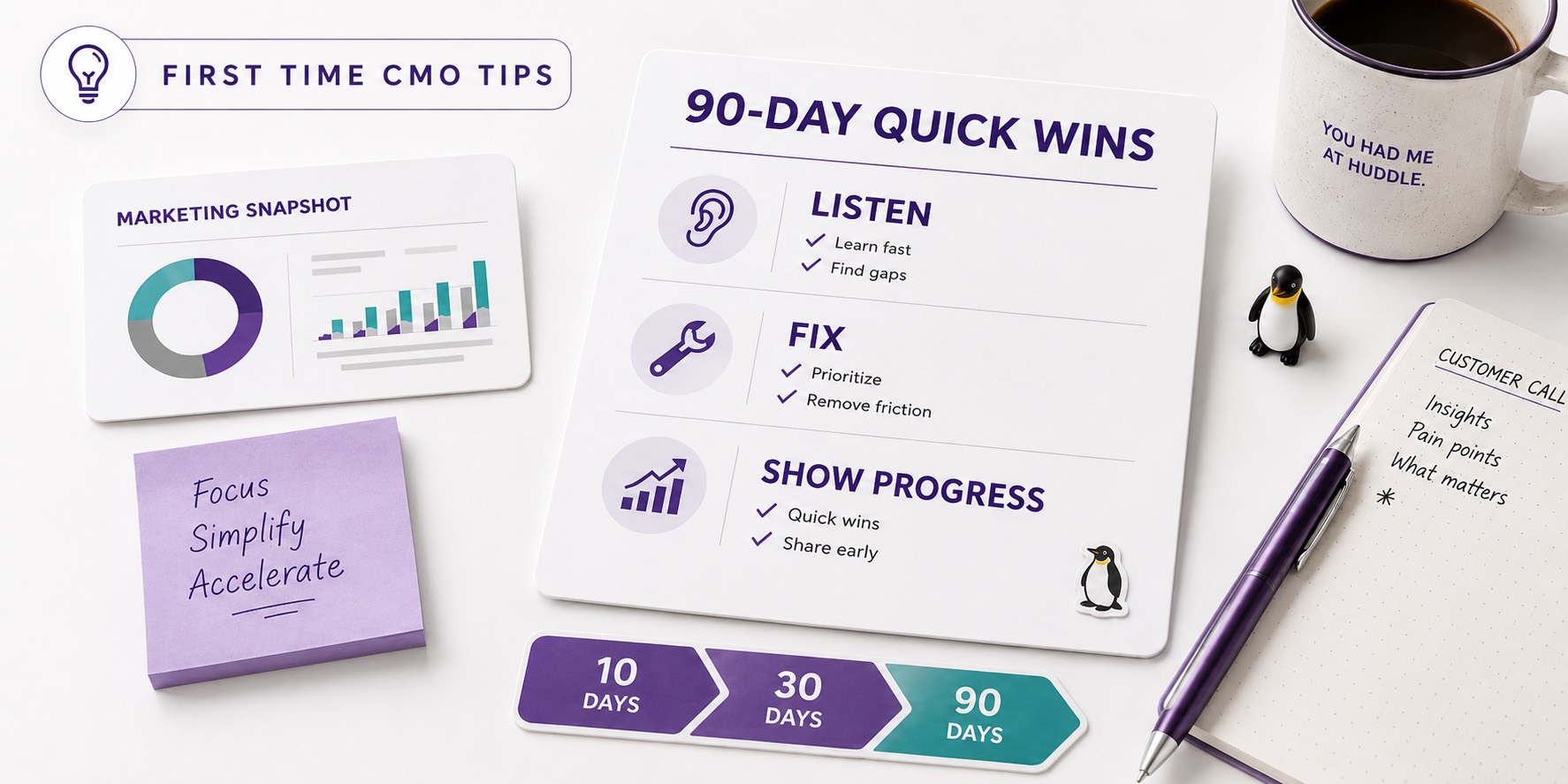
A practical LLM-era checklist for newly hired B2B CMOs to create early wins, uncover fast insights, and build cross-functional credibility. Learn where to focus during your first 90 days, from customer listening and pipeline improvements to AI visibility, Sales alignment, and quick experiments that build momentum for bigger strategic moves ahead.
Download the First 90 Days Quick Wins Checklist PDF for a printable version to use during your first 90 days.
This is not a comprehensive first-90-days plan. For that, Michael Watkins' The First 90 Days remains the broader primer. You can also revisit Drew Neisser's interview with Michael Watkins.
Think of this as the quick-wins companion for the LLM era: get close to the evidence fast, fix what is obviously broken, and use your new-CMO currency to create visible momentum while the organization is still ready to listen.
This checklist is for newly hired B2B CMOs. Many will be first-time CMOs, but not first-time B2B marketers. The assumption is that they understand B2B fundamentals: long buying cycles, complex buying groups, Sales dependency, pipeline pressure, and the need to earn trust across the C-suite.
Do not try to do everything. Pick the items most likely to create insight, credibility, savings, revenue, or visible improvement quickly. AI should not be treated as a separate initiative here; it is a force multiplier across discovery, listening, synthesis, competitive intelligence, and conversion work.
□ Ask AI what it thinks of your company. Test ChatGPT, Claude, Gemini, and Perplexity: What do you do? Who is your ideal customer? When should buyers consider you? Who are your competitors? Where are you strong or weak? Note the surprises.
□ Run a free GEO/AEO test. Establish a baseline for how visible your company is in LLM-driven discovery. Then run the same test on 3-5 competitors. Treat the score as a starting point, not gospel. Webflow's AEO test is one of the best.
□ Test the buyer questions that matter. Ask unbranded questions such as "What are the best solutions for [problem]?" "What companies help [ICP] accomplish [job]?" and "What are the alternatives to [competitor]?" Are you mentioned, recommended, accurately represented, or cited?
□ Mystery-shop your own company. Search. Visit the website. Read the content. Fill out a form. Request a demo. Try it on mobile. Find the friction.
□ Find the website layups. Check speed, mobile experience, conversion paths, forms, top landing pages, outdated claims, broken links, unnecessary gates, and dead ends. Fix what can be fixed now.
□ Get into the customer conversation. Listen to sales calls, demos, onboarding calls, and service calls. Do not rely only on summaries. Hear the words customers and prospects actually use.
□ Give an approved LLM your homework. Feed it call transcripts, win/loss notes, customer interviews, reviews, support tickets, existing research, and other available evidence. Ask it to surface recurring pains, objections, buying triggers, language, and contradictions.
□ Know the numbers. Get a baseline on pipeline, conversion, CAC, retention, marketing spend, major programs, and the metrics the CEO, CRO, and CFO care about most.
□ Ask the CEO one important question: "At the end of my first 90 days, what would make you say, 'We absolutely hired the right CMO'?"
□ Start your CRO alliance immediately. Agree that Marketing and Sales win or lose together. Identify one shared problem you can attack right away.
□ Secure an EA. If you do not have an assistant, that makes you the assistant. Push for executive support, or hire a virtual assistant for a few focused hours a day yourself. Even with an LLM chief-of-staff, too many unessential tasks still need competent delegation.
□ Field a fast employee survey. Learn whether employees can explain what the company does, believe the positioning, understand its purpose, and are proud of the brand. Use AI to synthesize open-ended responses.
□ Talk to customers yourself. Interview at least 3-5 customers. Ask why they bought, what almost stopped them, what surprised them, what value they actually get, and how they would describe you to a peer. And borrow Thomas Barta's deceptively simple question: "What's one thing our company or product could do better?" Listen carefully. The answer may hand you a quick win.
□ Build a Voice-of-Customer snapshot. Combine customer interviews, calls, reviews, survey responses, win/loss data, and support conversations. Use AI to find the patterns, but preserve the actual language customers use.
□ Find the perception gaps. Compare: Company says → Customers say → Sales says → AI says. Big differences can reveal fast positioning and messaging opportunities.
□ Run an AI-assisted competitive sprint. Analyze competitors' positioning, websites, reviews, content, announcements, strengths, weaknesses, and LLM visibility. Find one place you can differentiate immediately.
□ Pick one conversion experiment. Ungate a high-performing asset. Simplify a form. Rewrite a key landing page. Fix a CTA. Improve demo flow. Choose something measurable that can produce evidence quickly.
□ Find one pipeline leak with Sales. Look for a stage where prospects consistently stall, disappear, or lose interest. Attack it together.
□ Fix one thing Sales hates about Marketing. Ask. You will probably get an answer.
□ Create a shared scorecard with your CRO. Favor business outcomes and shared pipeline metrics over marketing vanity metrics. Establish one source of truth.
□ Build CFO credibility early. Learn how Finance evaluates marketing spend. Reconcile the budget, understand the financial model, and identify one place to save money or demonstrate better return.
□ Kill something. Find a legacy campaign, tool, report, meeting, metric, piece of content, or process that everyone knows is not delivering. Stop doing it.
□ Show the receipts. Quantify and communicate the quick wins: conversion improvement, wasted spend eliminated, pipeline recovered, customer insight uncovered, GEO visibility improved, process simplified, or time saved.
□ Retest your LLM visibility. Repeat your GEO/AEO baseline. What changed? Where are competitors still winning? Turn the findings into the next set of experiments.
□ Turn customer language into marketing language. Fix obvious gaps in homepage copy, positioning, sales messaging, FAQs, proof points, and high-value content.
□ Answer the questions AI and buyers need answered. Identify the highest-value questions prospects ask and make sure authoritative, useful answers exist on your site and in the places buyers look for information.
□ Scale one thing that worked. Take the strongest early experiment and expand it. One proven win is worth more than ten unfinished pilots.
□ Create one visible Sales + Marketing win. Make sure the organization sees evidence that the CMO and CRO are solving business problems together.
□ Give the CFO a reason to trust you. Show where you have saved, stopped, shifted, or improved marketing investment and what you have learned.
□ Close the employee feedback loop. Tell employees what you heard, what you are changing, and what you are not changing yet.
□ Identify your AI leverage opportunities. Find the 3-5 marketing workflows where AI could materially improve speed, quality, insight, or cost. Do not launch 25 AI experiments. Pick the ones that matter.
□ Spend your new-CMO currency. You now know enough to spot the bigger opportunities. Put 1-3 consequential changes on the table while you still have permission to challenge "how we have always done it."
□ Tell the organization what is next. Summarize what you learned, what you fixed, what you stopped, what worked, and the bigger priorities you will tackle next.
Use this proven survey in the first 30 days to understand whether employees can explain the company, believe the vision, feel proud of the brand, and spot improvement opportunities. Keep it anonymous when possible and close the loop by sharing what you learned and what you will act on.
Recommended format: 8-10 minutes, anonymous, with drop-down, multiple-choice, scale, and open-ended questions.
Questions four to ten use the following answer options: Strongly disagree; Disagree; Neutral/Neither agree nor disagree; Agree; Strongly agree.
Use these only if you want more marketing-specific signal without making the survey too long.
No. Michael Watkins' The First 90 Days is still the broader primer for executive transitions. This checklist is narrower: it focuses on fast, high-leverage moves a new B2B CMO can use to create momentum, insight, and credibility in the first 90 days.
No. It is for newly hired B2B CMOs, including first-time CMOs with prior B2B experience. First-time CMOs may find it especially useful because it emphasizes cross-functional trust, CEO/CRO/CFO alignment, and visible progress.
Quick wins buy time. They help the organization see that Marketing is listening, learning, fixing, and contributing. That credibility gives the CMO more room to tackle bigger strategic issues such as positioning, demand strategy, team design, budget allocation, brand, and AI transformation.
Buyers are increasingly using LLMs and AI search experiences to discover, compare, and evaluate vendors. A new CMO needs to know whether the company is visible, accurately represented, and recommended in those environments.
No. AI should accelerate listening and synthesis, not replace judgment. The best use of AI in the first 90 days is to compress tedious analysis, reveal patterns, and generate better questions for human conversations.
Avoid trying to solve everything, launching too many AI experiments, making big claims before understanding the evidence, or letting the checklist become a substitute for strategy. The goal is to earn trust quickly so the bigger work can begin from a stronger position.
CMO Huddles helps B2B marketing leaders win by bringing together peers, fresh perspectives, and opportunities to build stronger personal brands. Want to join the huddle? Learn more about CMO Huddles and apply to join the community.