
Back to Blogs
Drew Neisser is the founder of CMO Huddles and a globally recognized authority on B2B marketing. He’s an AdAge columnist, LinkedIn TopVoice, leading CMO coach, podcast host & friend of penguins everywhere.
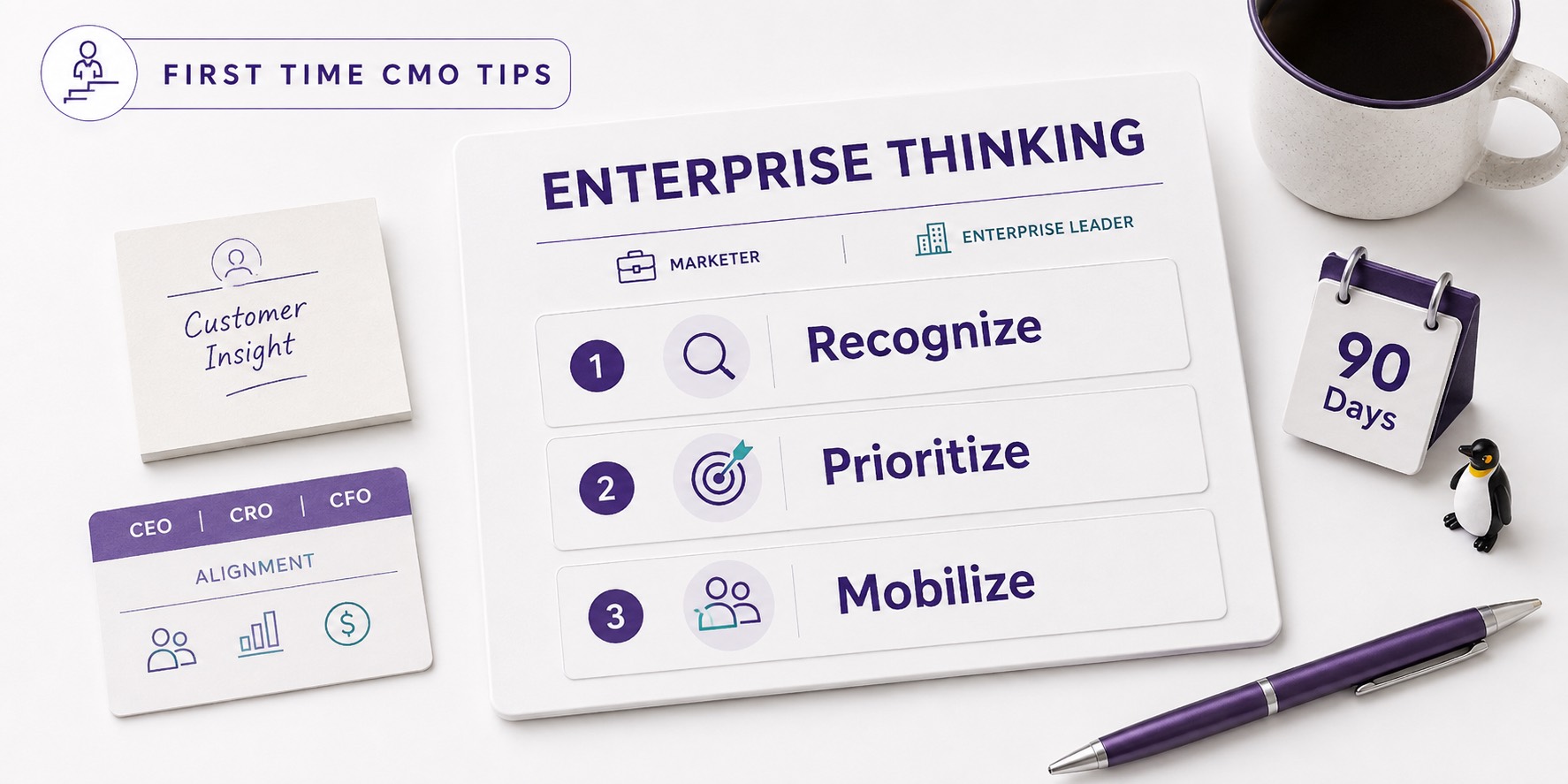
First-time CMOs do not earn enterprise credibility by defending marketing harder. Drawing from Michael Watkins’ The First 90 Days and The Six Disciplines of Strategic Thinking, this post shows how new CMOs can diagnose before acting, wear both hats, recognize emerging threats, prioritize wisely, and mobilize the business around better decisions.
Becoming a first-time CMO is not just a promotion. It is a category change.
One day you are the senior marketer with strong opinions about positioning, pipeline, brand, demand, events, content, and the website everyone privately hates. The next day you are expected to sit at the executive table and help shape the future of the business.
That is where Michael Watkins’ work becomes especially useful. His classic book, The First 90 Days, is essential reading for leaders entering a new role. His newer book, The Six Disciplines of Strategic Thinking, goes a level deeper into what leaders must do once they are expected to think beyond their function.
For first-time CMOs, the combination is powerful: onboard with discipline, then lead with strategic range.
Watkins told us that one of the biggest mistakes leaders make is “expecting that what has made you successful in previous roles is going to make you successful in your new role.” For a first-time CMO, that warning should arrive with flashing purple lights.
What got you to the CMO seat may not be enough to help you keep it.
Watkins describes one of the biggest transitions for senior leaders as moving from specialist to enterprise leader. For CMOs, this shift can be sneaky because marketing already touches so much of the business.
You may feel enterprise-wide because your team owns brand, demand, customer insight, market intelligence, positioning, events, content, partner marketing, lifecycle, and half the things Sales forgot to do before Friday.
But at the executive table, the job is bigger than representing marketing.
Watkins calls this the “two hats” problem: showing up both as the leader of your function and as a leader of the enterprise. “The real criticality,” he said, is moving beyond “focusing on your own part of the business” and becoming “a true enterprise leader.”
That means the first-time CMO must ask questions that are not merely marketing questions.
What is changing in the market? Where is the business most exposed? Which customer signals matter most? What must the company stop doing? Where are Sales, Product, Finance, Customer Success, and Marketing misaligned? What will happen if the company stays on its current path for another six months?
The fastest way to get labeled “just the marketing person” is to talk only about marketing.
First-time CMOs often feel pressure to prove they can fix marketing. That is understandable. It is also dangerous if it narrows the frame too quickly.
Watkins’ advice from The First 90 Days is to avoid the trap of reaching conclusions too quickly. He warned that new leaders often shift too fast “from the learning and connecting to the deciding and acting process.”
That warning hits home for CMOs because many enter roles where the diagnosis has already been handed to them. The brand is broken. Pipeline is soft. The website is stale. Sales needs better leads. The board wants category leadership. The CEO wants a new narrative by Tuesday and preferably one that also fixes retention.
Maybe those are the right problems.
Maybe they are symptoms.
Watkins used the classic warning: “To a person with a hammer, everything looks like a nail.” Then he added the practical caveat: “If it really is a nail, hammer away. But just be sure it’s a nail and not because you hope it’s a nail.”
That is the first-time CMO’s discipline: do not solve the familiar problem before you understand the real one.
New CMOs often feel the action imperative: the urge to move fast so everyone knows the company made the right hire. Watkins understands the pressure, but he cautions leaders to examine where the urgency is coming from.
“There are reasons why you have to make early calls and take early decisions,” he said, “but you need to make sure that you’re not generating the impulse within you to do that because you feel like you need to prove yourself.”
For first-time CMOs, that line is worth underlining twice.
Your first 90 days should not be a performance of decisiveness. They should be a disciplined process of learning, connecting, diagnosing, aligning, and then acting where action will create credibility without creating avoidable damage.
That does not mean sitting quietly in the corner with a notebook while the pipeline catches fire. It means separating true urgency from executive insecurity.
There is a difference between an early win and a premature strategy.
In The Six Disciplines of Strategic Thinking, Watkins defines strategic thinking as “the process of recognizing emerging threats and opportunities, establishing the right priorities and mobilizing your organization to do something about it.”
He simplifies the cycle into three words:
Conveniently, the initials spell RPM. Also conveniently, CMOs like frameworks they can put on a slide without requiring a decoder ring.
This framework is tailor-made for first-time CMOs because it turns “be more strategic” into a practical leadership rhythm.
Recognize means sensing what is changing before the obvious metrics scream. Prioritize means deciding what matters most when everything appears urgent. Mobilize means aligning people, resources, and decisions so the organization actually moves.
Most struggling marketing organizations are weak in at least one of these areas. Some do not recognize market shifts quickly enough. Some recognize everything and prioritize nothing. Some prioritize correctly but cannot mobilize Sales, Product, Finance, and Customer Success around the same plan.
That last one is where many first-time CMOs discover that strategy is not a deck.
It is a contact sport with meeting notes.
Watkins argued that organizations need better “sensory systems” to detect what is happening in the external world. That language should make every CMO sit up a little straighter.
Marketing should be one of the company’s most valuable sensory systems.
CMOs can bring customer data, market signals, website behavior, win-loss themes, community conversations, analyst feedback, competitive moves, sales-call insights, search behavior, event conversations, and advisory-board input into the executive conversation.
But Watkins offered an important caution. Customer data is powerful, but the CMO must connect it beyond the marketing silo. “That information is a source of power,” he said, but the move is to fuse it with other information so the leadership team gets “a picture of really what’s happening in the organization.”
Translation: do not show up saying, “The customer data proves marketing is right.”
Show up saying, “Here is what customers are telling us. Here are three possible explanations. Here is what it may mean for product, sales, customer success, pricing, and investment. Here is what we should test next.”
That is how customer insight becomes enterprise strategy.
Watkins described strategic thinkers as “hypothesis generators and testers.” That may be one of the most useful habits for a first-time CMO to adopt immediately.
When pipeline softens, it could be a demand problem. It could be a positioning problem. It could be pricing. It could be sales capacity. It could be the product roadmap. It could be buyer risk tolerance. It could be that the ICP changed while everyone was polishing the old deck.
The strategic CMO does not rush in with one confident explanation and a new campaign theme.
The strategic CMO says: here are the plausible explanations, here is what the data suggests, here is what we do not know yet, and here is how we should test our way toward the truth.
As Watkins put it, “It could be this… but let’s consider the possibility that it’s that, and let’s at least do a little testing.”
That sentence is not flashy. It is executive gold.
It lowers defensiveness. It invites cross-functional thinking. It keeps the team from jumping to simplistic fixes. It makes the CMO look less like a functional advocate and more like a business leader.
Watkins’ second big warning in the strategic-thinking conversation was that leaders fail when they do not build strategic thinking capability in their teams.
He pushed back against the idea that the CMO has to be “the primary strategic thinker” for marketing. Instead, he argued for shared leadership and embedding strategic dialogue into operating rhythms.
Not a once-a-year offsite.
Not a strategic planning workshop with pastry, post-its, and the faint smell of performative alignment.
Daily and weekly operating rhythms.
For first-time CMOs, this matters because your impact will be capped if your team waits for you to do all the strategic thinking. Your direct reports need to recognize market shifts, frame problems, identify tradeoffs, test hypotheses, and mobilize their teams. Otherwise, you become the bottleneck with a better title.
That means using staff meetings differently. It means asking better questions in business reviews. It means making leaders explain what they are seeing, what they believe is changing, what they recommend, what tradeoffs they see, and what evidence would change their minds.
Strategic thinking is a muscle.
No one builds it by watching the CMO lift all the weights.
Watkins also emphasized process leadership, especially in the context of 30-60-90 plans. His advice is that these plans should focus less on pretending to know the answers and more on showing the process you will use to learn, align, decide, and act.
“What they should be providing is a process of engagement,” he said. “Here’s who I’m going to talk to, here’s how I’m going to accelerate my learning process, here’s how I’m going to build alliances.”
This is especially useful for first-time CMOs who are asked, before they even start, to present their plan for fixing everything from brand to pipeline to sales-marketing alignment.
The mature answer is not a fake certainty festival.
The mature answer is a disciplined process: who you will meet, what you will test, how you will assess the team, where you will look for quick wins, how you will align with the CEO, and when you will bring recommendations back.
Process leadership says, “I may not know the answer yet, but I know how to get us to a better answer.”
For a first-time CMO, that may be the most confidence-building signal of all.
The first-time CMO job is not to become the loudest marketing advocate in the room. It is to become one of the clearest enterprise thinkers at the table.
That starts in the first 90 days with disciplined diagnosis, careful alliance-building, and CEO alignment. It expands through strategic thinking: recognizing emerging threats and opportunities, prioritizing the right work, and mobilizing the organization to act.
Do not let your functional expertise become a trap. Use it as a source of insight, then connect it to the broader business system.
Represent marketing well.
Represent the enterprise better.
That is how a first-time CMO becomes a real C-suite leader.
First-time CMOs should focus on learning, connecting, diagnosing, aligning with the CEO, and building cross-functional trust. Early wins matter, but they should support credibility and momentum rather than lock the company into a premature strategy.
First-time CMOs earn enterprise credibility by connecting marketing insight to broader business issues. They should bring customer and market signals to the table, then explain what those signals may mean for product, sales, finance, customer success, and growth strategy.
Watkins defines strategic thinking as recognizing emerging threats and opportunities, establishing the right priorities, and mobilizing the organization to act. For CMOs, this provides a practical rhythm for moving from market insight to enterprise action.
Hypothesis thinking prevents premature conclusions. Instead of declaring that a problem is caused by brand, demand, pricing, product, or sales, the CMO can identify several plausible explanations and help the leadership team test toward the truth.
CMOs can build strategic thinking by embedding it into regular operating rhythms. Ask team leaders what they are seeing, what is changing, what tradeoffs matter, what evidence supports their view, and what would cause them to rethink the plan.
CMO Huddles helps B2B marketing leaders win by bringing together peers, fresh perspectives, and opportunities to build stronger personal brands. Want to join the huddle? Learn more about CMO Huddles and apply to join the community.