
Back to Blogs
Drew Neisser is the founder of CMO Huddles and a globally recognized authority on B2B marketing. He’s an AdAge columnist, LinkedIn TopVoice, leading CMO coach, podcast host & friend of penguins everywhere.
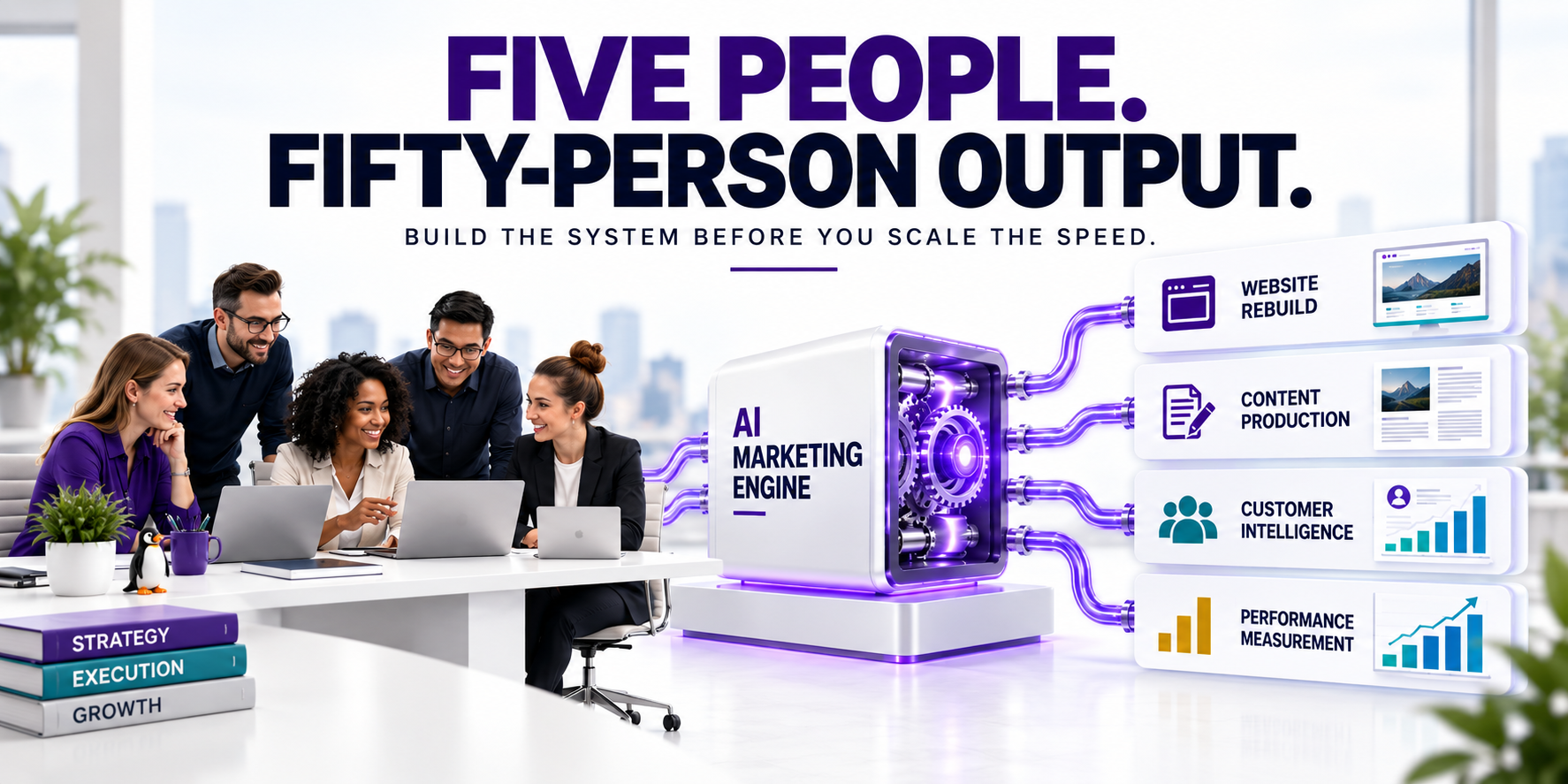
PointFive CMO Dave Anderson is building an AI-native marketing engine that helped a five-person team rebuild a website in four days, create 250 pages, and drive measurable growth. His bigger lesson for B2B CMOs: AI does not replace strategy, creativity, or customer intimacy. It removes execution drag so better marketers can move faster with confidence.
When Dave Anderson told me his five-person marketing team at PointFive rebuilt the company’s brand and website in four days, I did the only reasonable thing a marketer can do in 2026: I asked for the math. Dave explained that “it’s just the two of us building 250 new pages, all with new positioning, all with all the brand guidelines built in,” including demo flows and the surrounding infrastructure.
In the old world, Dave estimated that kind of effort would have taken six people across product marketing, design, development, infrastructure, and executive oversight. His rough comparison was 660 person-days of conventional effort versus 16 person-days with an AI-native operating model, or as he put it, “41 times less effort.”
That is the kind of number that makes CMOs sit up straighter and CFOs stop pretending not to listen.
The important part is not that Dave used Claude. Lots of marketers are using AI tools. PointFive is doing something more interesting: building an AI-native marketing engine that combines a shared intelligence layer, repeatable workflows, creative judgment, and enough governance to keep it from turning into a very expensive spaghetti factory.
Dave thought he had built a handful of agents. Then he checked. “I run 130 agents at last check, which I didn’t realize,” he told me, adding that he originally thought he was only running six.
Some of those agents, apparently, had recruited other agents. “Thirty of the agents recruited themselves from other agents,” Dave said, which is funny until you realize this is exactly how agent sprawl sneaks into the enterprise wearing a productivity badge.
The lesson was painfully practical. Instructions matter. Dave put it bluntly: if you tell agents, “I don’t care what it takes, just get it done,” and fail to add guardrails like “don’t recruit anyone else,” you may get the task done and inherit a small digital village in the process.
Naturally, Dave built an org chart for them. “I built an org chart for them too,” he said, “so I could work out what they were doing.”
Funny quickly becomes governance when the agents start multiplying.
Dave is clear that the tools only work because PointFive built what he calls an intelligence layer. “I can only do that because we built an intelligence layer,” he said, describing a shared system that includes current information about opportunities, value propositions, solution briefs, sales calls, customer details, and deal status.
This is the part many AI adoption stories skip. PointFive has “built a lake that’s super intelligent,” Dave explained, and that allows him to query it whenever he needs context. Without that layer, AI becomes a faster way to generate plausible mush.
PointFive also has an internal agent called Shulem (Dave calls it “Shoey”) available in a public Slack channel. Employees can ask questions, and others can see the answers, corrections, and follow-up threads. Dave called it “one of the most important knowledge bases that we have in the company,” which is a very different use case than one marketer privately asking ChatGPT for ten subject lines and hoping nobody notices.
In one example, Dave asked the system for customer examples related to GPU optimization. It returned technical details, customer value, savings, and time-to-value, after which the product manager added more context. Suddenly, the team had raw material for a blog post, a product story, and a sales conversation.
When the company’s knowledge becomes easier to access, marketing gets smarter before it gets faster.
Every CMO knows the feeling. Product ships something, engineering is excited, and someone drops a list of features into Slack expecting marketing to turn it into a market moment by Tuesday. Dave’s response is wonderfully direct: “So what? So what? Who cares?”
That question may be the most important product marketing tool ever invented.
At PointFive, engineers can publish detailed updates directly. Dave said, “You had to enable the engineers to be the marketers,” with product teams posting feature and function updates publicly instead of burying everything in internal systems. Marketing then watches for clusters that deserve a bigger story.
Dave described the motion this way: “I would see the update. And I would go, ‘Hang on a sec, that’s like 6 or 7 really big pieces that have just gone. I need to bundle them, and I’m gonna do that as a release.’” The smarter move, he added, is embedding product marketing earlier in planning so the team can ask whether something is “groundbreaking,” a “catch-up” feature, or part of the company’s point of difference.
One release involved BigQuery optimization. Engineering could explain the technical configuration capabilities, but Dave pushed for proof of customer value. The system surfaced a customer example: “One particular customer cut their storage costs by 82%, which generated $330,000 in five days.”
Dave’s response was immediate: “There’s the headline of your release.”
A feature becomes a story when it has a customer, a number, and a reason to care.
PointFive’s numbers are eye-catching. Dave reported 96 blog posts, 36 overview pages, 41 guides, and 76 other website sections, along with gains in unique visitors, search impressions, website sessions, page views, event registrations, form submissions, and demo requests.
He also made sure to separate productivity from impact. “I can measure the productivity,” Dave said, “I can then also measure the improvement in results as a result.”
That distinction matters because AI makes it dangerously easy to confuse volume with value. A marketing team can now produce more pages, more posts, more campaigns, more decks, and more emails than ever before. The question is whether any of it improves pipeline, conversion, win rates, retention, or strategic position.
Otherwise, congratulations. You built a faster treadmill.
Dave’s team has seen meaningful demand creation. PointFive went from having no measurement infrastructure to hitting its sourced-pipeline target in the quarter, with Dave noting, “Previously we had no metrics in place to even measure it, no systems. We built all of the systems for the first time.”
Then AI exposed the next bottleneck: sales capacity. “The issue now is not the pipeline creation,” Dave said. “The issue now is closing the pipeline.” In other words, AI-native marketing can create more demand than the rest of the organization is ready to process.
That is a good problem only if you are prepared to solve it.
Dave offered one prediction that should be handled with care, especially in larger companies. He believes many traditional marketing organizations will struggle to become AI-native fast enough because the resistance is as much cultural as technical.
“They will create a shadow marketing organization that is AI native,” Dave said, “and it will eat the other organizations.”
Spicy? Yes. Worth considering? Also yes.
Dave was speculating about how larger companies may handle the transition when existing teams, processes, and approval structures cannot move fast enough. The pattern is familiar: a new capability starts outside the core organization, proves it can move faster, and eventually becomes the new operating model.
For CMOs, the lesson is to lead the redesign before someone else does. That means mapping workflows, building shared intelligence, clarifying ownership, governing agents, retraining teams, and measuring business outcomes instead of AI activity.
If there is going to be a shadow marketing organization, better that the CMO turns on the lights.
One reassuring part of my conversation with Dave was his view of creativity. He sees AI as removing the execution drag that used to trap good ideas in the swamp.
“I’m like the creative person that wants to do wild, crazy ideas and thinks out of the box,” Dave said, explaining that the old problem was having too many ideas and not enough execution capacity. “What I used to have an issue with was I’d have so many ideas I never finished anything.”
Now, he said, “I have an agent that can get the things done that I need to do.” That does not mean every idea is worth pursuing. Dave uses AI to challenge his thinking before he wanders too far down a rabbit hole, especially when an idea does not fit the company’s value proposition or strategic differentiation.
This is a powerful shift. The human role becomes less about wrestling every asset into existence and more about improving the idea, sharpening the hook, checking the strategy, and deciding what deserves attention. As Dave put it, “You get to do the bigger creative hook things that are gonna make it memorable.”
That is where great marketers should want to spend more time.
Dave is skeptical that answer-engine optimization will remain a durable advantage for long. He sees many of today’s AEO tactics as familiar SEO plays in a new outfit: “Spam the internet with blogs and articles about why you’re so great, the top five this, the top ten that.”
His warning is simple: “If you’re just spewing out content, it won’t work.”
Everyone will learn the tactics. Everyone will publish more. Everyone will chase citations. The advantage will come from differentiated ideas, trust, customer empathy, community, and the ability to communicate something useful to a specific audience.
Dave believes the real contest comes back to communication. “It’s going to come down to creative, and it’s going to come down to social,” he said. “It’s going to come down to how well you are able to communicate to that audience, to get them to listen, to build trust, to have empathy to solve their problems.”
In a world full of AI-generated sameness, distinct thinking becomes louder.
For all the speed, agents, workflows, and efficiency, Dave kept coming back to customers. He sees customer intimacy as the durable advantage for CMOs in an AI-native world, saying, “The customers are your most important asset. Getting stories from them and having them as advocates and treating them really well is so, so important.”
AI can summarize a sales call. It can surface a pattern. It can generate a draft. But it cannot replace the trust built when a CMO understands the customer’s work, language, frustrations, ambitions, and identity.
Dave loves products that map directly to a customer’s job. “The most fun is when you are marketing a product and the product is its person’s job,” he said. That is where community, advocacy, and identity start to form.
In an AI-native marketing engine, customer intimacy becomes more important because everything else gets faster. If your team can create almost anything quickly, the competitive question becomes whether you know what is worth creating.
Speed without customer truth is just expensive blur.
First, build the intelligence layer before you build the content machine. If your data, positioning, customer proof, sales calls, product information, and value propositions are scattered, AI will accelerate confusion.
Second, redesign workflows around business outcomes, not tools. Ask where work gets stuck, where handoffs slow progress, where human review matters, and where AI can remove friction without removing judgment.
Third, govern agents early. If Dave can accidentally discover 130 agents in a five-person team, larger organizations need ownership, documentation, cost controls, and review rhythms before the pile becomes archaeology.
Fourth, measure both productivity and business impact. Faster publishing is useful only if it improves the metrics that matter.
Finally, keep customers close. The more AI changes execution, the more CMOs need to protect the market insight, empathy, creativity, and trust that make marketing worth doing in the first place.
Dave Anderson will be keynoting at the CMO Super Huddle on October 22-23, 2026, where we will dig deeper into what AI-native marketing really looks like when the demos end and the operating model begins.
Bring your curiosity. And maybe an org chart for your agents.
It is an operating model in which trusted company knowledge, reusable workflows, human judgment, and governed AI agents work together. The goal is not simply faster content production. It is a marketing system that can learn, execute, and measure outcomes with far less friction.
No. Agent count is an activity metric, not a business result. Start with a small number of high-value workflows, assign an owner to each one, document the inputs and guardrails, and expand only when the agent produces reliable value.
Agents are only as useful as the context they can access. A shared intelligence layer gives them current positioning, product facts, customer evidence, sales conversations, and performance data, reducing contradictory answers and making human review more productive.
It may change team size and roles, but the more immediate effect is a different allocation of work. CMOs should decide which tasks to automate, where specialists add leverage, and which decisions still require customer empathy, strategic judgment, and accountability.
Humans still decide which problems matter, what the brand should stand for, when evidence is credible, and which ideas deserve investment. AI can accelerate execution and expose patterns, but leadership, taste, trust, and customer understanding remain executive responsibilities.