
Back to Blogs
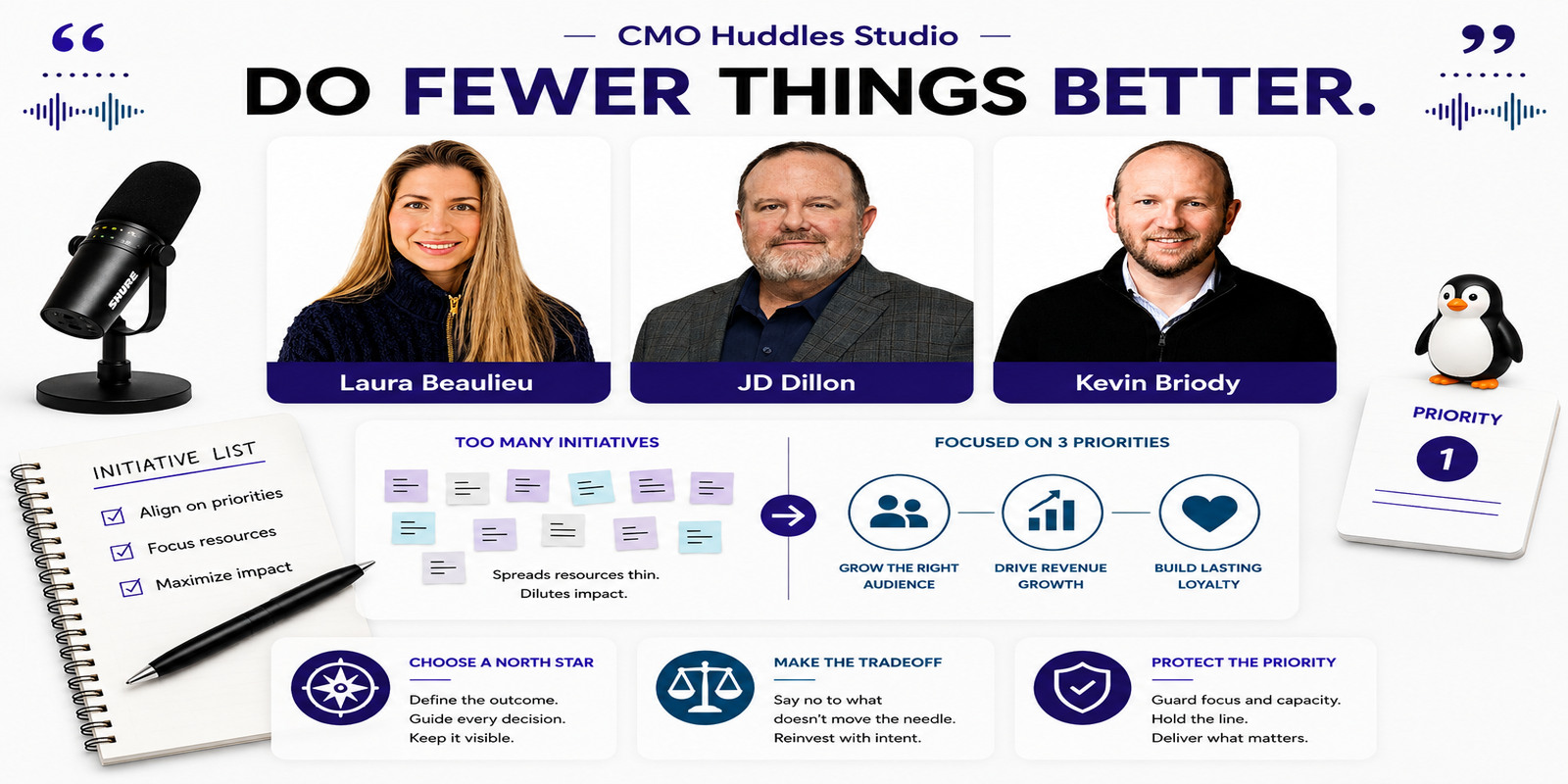
Focus becomes a growth strategy when marketing concentrates resources on a few valuable outcomes and creates room for stronger execution. JD Dillon, Laura Beaulieu, and Kevin Briody show how a branded service, customer-powered webinars, and website consolidation helped their organizations reduce complexity, build internal commitment, and turn deliberate tradeoffs into customer and business impact today.
Marketing teams rarely suffer from a shortage of ideas. The harder problem is deciding which ideas deserve people, budget, leadership attention, and time.
In a CMO Huddles Studio conversation, JD Dillon of Tigo Energy, Laura Beaulieu of Holistiplan, and Kevin Briody, then of Edmentum, shared three different expressions of focus. Their examples included a branded customer-service program, an advocate-powered webinar motion, and the consolidation of multiple websites.
Each initiative required more than choosing a priority. It required protecting that priority from the steady return of everything else.
Tigo Energy’s Green Glove Service began with customer problems that received extra attention. Customers noticed the difference, and the company recognized an opportunity to make exceptional support more deliberate and repeatable.
JD turned the familiar idea of white-glove service into something Tigo could own. Green connected the program to the company’s brand and renewable-energy category, while glove made the service promise easy to understand.
He described the program’s origin:
“What we did was we ran into a couple of issues. We gave extra special service to the customer, and they said, ‘Wow, this is special and different,’ and sort of organically we said, well, let’s do more of it.”
Branding the service changed how people interacted with it. Customers began asking about Green Glove at events. Employees tracked how many installations they had supported. The company discussed the program during all-hands meetings, and the phrase became a standard against which service could be judged.
The brand also created accountability. JD recalled an installer using the phrase “this is not Green Glove Service” when the company fell short. The complaint was uncomfortable, but it showed that the promise had become meaningful enough for customers to invoke.
A focused idea becomes powerful when it helps the organization decide what good looks like.
Green Glove did not begin as an expensive, fully developed transformation. It grew from real customer interactions that produced evidence of value.
JD connected that approach to ROI:
“ROI has a numerator and a denominator. You can increase the ROI by either decreasing the ‘I’ or increasing the ‘R.’ Do experiments. Get a good ROI by doing a little bit of investment and getting a modest amount of return.”
Small experiments can help a CMO establish whether customers care, whether employees can deliver the experience, and whether the initiative deserves additional investment. The goal is not to keep the program permanently small. It is to earn the right to scale it.
This makes focus easier to defend. Leaders are not asking the organization to accept a grand theory without evidence. They are narrowing attention around something customers have already begun to validate.
Laura joined Holistiplan with a 30-60-90-day plan she had already discussed with the leadership team. The plan gave her a starting structure, but she did not treat interview-stage assumptions as settled answers.
She began by speaking with leaders, salespeople, customer-facing employees, and customers. The interviews helped her identify repeated themes and compare them with available performance data.
Laura described the leadership task behind that work:
“A big part of being a good leader is being able to take in all the information from multiple sources, organize it, systemize it, and really simplify it for your team.”
Two signals stood out. Webinars were contributing to growth, and customer referrals were unusually influential. Instead of treating them as unrelated channels, Laura combined them into a more focused motion: invite enthusiastic customers to share how they used the product and help prospective customers learn from credible peers.
The result connected acquisition, customer recognition, education, and advocacy. One program could create value across several stages of the customer journey without fragmenting the team’s effort.
Laura reviewed Net Promoter Score responses to identify customers who rated the company highly and appeared enthusiastic about participating. She then interviewed potential advocates and invited selected customers to lead practical webinars.
The customer speakers had credibility the brand could not reproduce on its own. They could explain how they adopted the product, what changed in their work, and what another advisor would need to know before beginning.
The webinars also created a feedback mechanism. Questions and comments revealed which topics mattered, where prospective customers remained uncertain, and what existing users had learned.
Focus does not require a leader to make every decision alone. It requires a method for determining which evidence deserves attention.
A successful program often attracts additions. Stakeholders see momentum and propose adjacent campaigns, new formats, extra audiences, or unrelated requests. Each idea may sound reasonable on its own while collectively weakening the original motion.
Laura’s team used quarterly objectives and key results to narrow its work to a small number of priorities. The exercise forced people to distinguish between tasks they could perform and outcomes most likely to move the business.
She described the calibration:
“If you hit 100% of your goals, you set them too low. If you hit 60%, you set them too high. You’re going for that 80%, can I hit 80% of my goals, and will this drive the business forward?”
The percentage is less important than the discipline. Goals should create meaningful ambition without becoming a list so expansive that the team cannot tell what matters most.
Kevin used a simple North Star with his teams: do fewer things exceptionally well to create greater impact. The principle was not primarily about reducing workload. It was about protecting the conditions required for strategic and creative thinking.
He explained the leadership responsibility:
“It’s the CMO’s job to intentionally create the headspace for your team to be creative and strategic. Part of that is going through that focusing exercise and cutting out what doesn’t add value.”
When teams spend most of their time responding to urgent requests, they lose the capacity to solve larger problems. Activity remains high, but the work becomes increasingly reactive.
Focus gives people time to understand the problem, explore options, challenge assumptions, and produce something stronger than the first available response. That space is a business resource, even though it does not appear on a project plan.
At Edmentum, multiple websites served different audiences and created substantial complexity. Maintaining them consumed time that could have supported experimentation and improvement.
Kevin’s team decided to consolidate the sites, rebuild the course catalog, and create a simpler platform. The work required a deliberate reduction in routine content production while the team invested in the larger change.
That temporary slowdown could have looked like reduced productivity if leaders measured marketing only by output. Kevin framed it as an investment in future capability. One site would be easier to manage, easier for customers to navigate, and easier for marketers to improve.
The project also challenged the assumption that a valuable website must contain as much content as possible. A smaller number of useful, accessible assets may serve customers better than a large archive built around internal demands.
Content counts, campaign counts, and page counts are easy to report. They are also weak indicators of whether marketing helped the business.
A focused operating model asks different questions:
These questions shift attention from how busy the team appeared to what changed because of its work.
Focus should not make a team unable to respond to new evidence. Markets change, customers reveal new needs, and urgent business conditions sometimes deserve immediate attention.
The discipline is to distinguish a strategic adjustment from routine distraction. Leaders can ask whether the new request materially affects a current priority, whether something else will stop, and what evidence justifies the change.
If every new request becomes an additional priority, the strategy has not adapted. It has dissolved.
Marketing serves many stakeholders and has access to a wide range of channels, tools, and tactics. Most proposed activities have some potential value, making it difficult to reject them unless the team has agreed on a smaller set of business outcomes.
Review work against strategic relevance, customer value, business impact, ongoing cost, and opportunity cost. Low-impact activities should be paused, reduced, automated, or eliminated so the team can protect higher-value priorities.
Yes. Small experiments can test a strategic hypothesis without requiring a large initial commitment. The important distinction is whether the experiment supports an agreed priority or merely introduces another disconnected activity.
Connect the reduction to the capability or business result being built. Explain what the team is pausing, why the larger investment matters, how progress will be measured, and when the organization should expect benefits.
Listen to the full conversation about focus as a growth strategy.
CMO Huddles helps B2B marketing leaders compare operating approaches, pressure-test priorities, and make difficult tradeoffs with greater confidence. Learn more about CMO Huddles or join CMO Huddles Starter.