
Back to Blogs
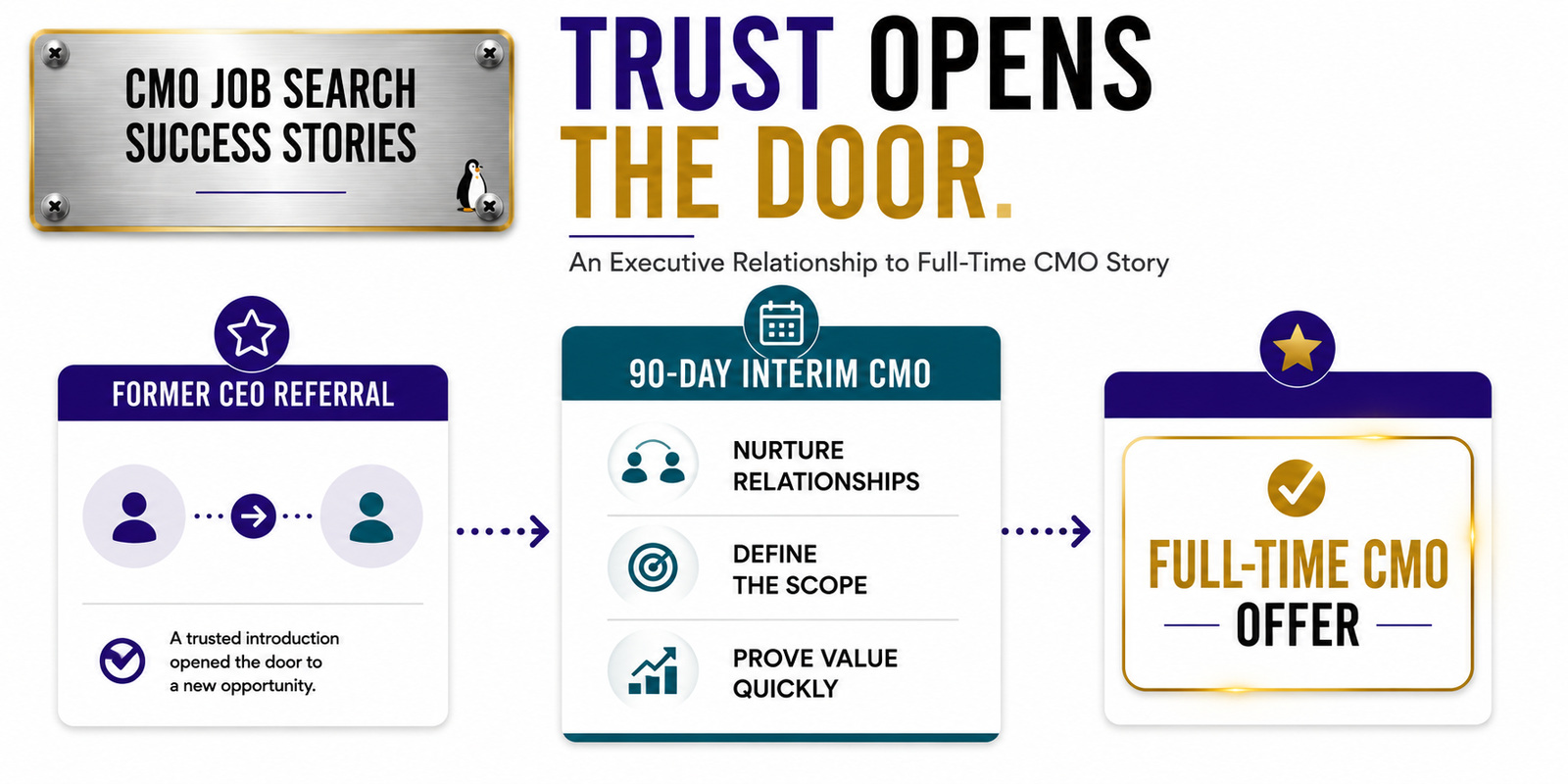
One Huddler’s yearlong search changed when a former CEO connected her with private-equity talent. Months later, that relationship produced two interim marketing opportunities. One became a full-time CMO role after only two weeks. The story shows how trusted relationships can create delayed opportunities and how interim work can quickly turn mutual interest into a permanent executive role.
A Former CEO Made the Introduction. The Opportunity Came Months Later.
One Huddler spent approximately a year searching for her next CMO role. The opportunity she eventually accepted did not begin with an application or recruiter message. It started with a recommendation from a former CEO.
That CEO introduced her to a talent professional at a private-equity firm. They spoke in September, but nothing immediate came from the conversation.
Then, in June, the talent professional reached back out with two companies looking for interim marketing help.
One opportunity ended quickly because the Huddler’s compensation requirements exceeded the company’s budget. The other moved forward with a short interview process: one 30-minute conversation with the CEO and two 30-minute conversations with general managers.
She accepted a planned 90-day interim engagement.
Two weeks later, the company asked her to stay full time.
Search Snapshot
The most important introduction in this search did not immediately produce a role. Roughly nine months passed between the Huddler’s first conversation with the PE talent professional and the outreach that eventually led to her new position.
That makes the relationship itself more important than its immediate outcome.
Senior-level opportunities often emerge when a company suddenly needs a particular kind of leader. Former CEOs, investors, recruiters, and talent partners who already understand an executive’s background can reconnect when that need appears.
The Huddler’s former CEO helped create that access. The talent contact kept the relationship alive long enough for the right situation to emerge.
When the PE contact returned, there was not one perfectly matched opportunity waiting. There were two companies looking for interim marketing leadership.
One did not progress because the budget and candidate expectations did not align. That outcome did not make the referral unsuccessful. The same relationship had created another option.
For CMOs in transition, this is one reason to think about networking as a portfolio rather than a single chain of introductions. A trusted contact may surface several possibilities over time, and not every one needs to work for the relationship to be valuable.
The opportunity that moved forward required only three short interviews before the Huddler began a 90-day interim assignment.
Two weeks into that engagement, the company asked her to stay permanently.
A conventional executive interview asks both sides to predict what working together will be like. An interim engagement can replace some of that prediction with direct experience.
The company had an opportunity to see the Huddler operate inside the business. She, in turn, had an opportunity to experience the role before making a long-term commitment.
In this case, two weeks of working together gave both sides enough confidence to move toward a full-time arrangement.
The interim engagement was not the Huddler’s only path. She also received another offer through her network.
She chose to remain with the company where she had been working because the equity opportunity was more compelling.
The source does not provide enough detail to compare the compensation packages more deeply, but the decision illustrates an important point for executive candidates: landing an offer does not end the evaluation process.
The Huddler had two network-generated options and firsthand experience with one of the companies. She used that information to decide which opportunity she preferred.
A one-year search ultimately turned on a relationship established months earlier. A former CEO opened the first door, a private-equity talent contact kept the connection alive, and an interim engagement created a fast path from introduction to permanent employment.
The sequence also shows why executive networking can be difficult to evaluate in real time. The September conversation appeared to produce nothing. By June, it had generated two opportunities. Within weeks, one of those had become a full-time CMO role.
For CMOs in transition, some of the most valuable relationships may be the ones that remain quiet until the right business need appears.
A former CEO who knows an executive’s work can make a credible introduction to recruiters, investors, or other leaders. In this case, that referral created a relationship with private-equity talent that eventually produced two opportunities.
Yes. In this story, a planned 90-day interim engagement converted into a full-time CMO opportunity after approximately two weeks.
Senior-level opportunities often depend on timing. A useful contact may not have a relevant opening when the relationship begins but can reconnect later when a matching need appears.
Compare the factors that matter most for the specific opportunities. In this case, the Huddler chose between two network-generated offers and favored the role with the more compelling equity opportunity.
Read the original CMO Job Search Success Story.
CMO Huddles supports experienced B2B marketing executives through its dedicated Transition Team, peer connections, practical search resources, and shared executive experience.